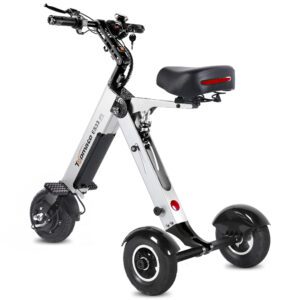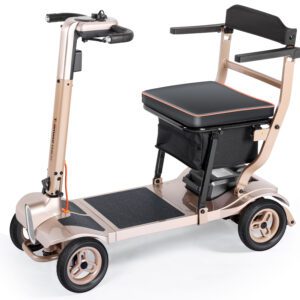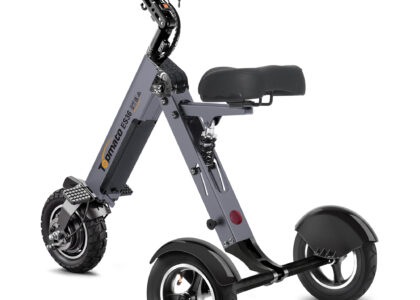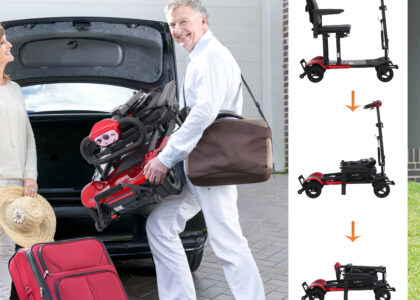

Direct answer: Before buying a mobility scooter, measure the scooter’s width, length, turning radius, folded dimensions, and storage footprint against the spaces you actually use. Check your front door, interior doorways, hallways, tight corners, elevator, bedroom, kitchen, charging area, storage space, thresholds, and any ramps. A scooter can fit through a doorway and still be difficult to maneuver once you are inside.
The easiest way to avoid that problem is to measure your entire route, not just one doorway.
Take a tape measure and follow the route you expect to use: outside the entrance → front door → hallway → rooms → storage or charging area. If the scooter will be transported in a car, measure the vehicle separately.
What Should You Measure Before Buying a Mobility Scooter?
Start with these measurements:
| What to measure | Why it matters |
|---|---|
| Scooter width | Determines whether it can pass through doors and narrow spaces |
| Scooter length | Affects parking, storage, and maneuvering |
| Turning radius | Helps determine whether the scooter can turn in tight areas |
| Folded dimensions | Important for closets, apartments, cars, and other storage |
| Doorway width | Shows whether the scooter can enter and exit rooms |
| Hallway width | Determines whether you have enough room for straight travel |
| Open turning space | Helps assess corners, kitchens, bedrooms, and hallways |
| Storage area | Shows whether the scooter can be parked without blocking access |
| Charging area | Confirms there is a practical place to charge it |
| Threshold height | Helps identify difficult transitions between floors |
| Ramp width and slope | Important if a ramp forms part of your normal route |
These measurements answer different questions. A scooter’s width tells you whether it can pass through a narrow opening, while its turning radius helps you understand what happens when the route changes direction.
Check the manufacturer’s measurements first
Before measuring your home, collect the scooter’s specifications. Look for the actual width, overall length, turning radius, folded size, weight, and ground clearance where available.
Check how the manufacturer measures width. Components such as armrests, controls, mirrors, or other accessories can affect the scooter’s practical width.
If you plan to use the scooter folded for storage or transportation, record both its folded and unfolded dimensions. Do not assume that the folded dimensions tell you whether it will fit through a doorway during normal riding.
1. Measure the Front Door’s Usable Opening
Measure the usable opening, not simply the width of the door itself.
Open the door as far as you normally can and measure the narrowest unobstructed space between the frame and any permanent obstruction.
For example, if the usable opening is 32 inches and the scooter is 25 inches wide, there are 7 inches of total clearance.
That sounds reasonable, but there is another question: Can you line the scooter up with the doorway?
Look at the area immediately outside and inside the door. A wall close to the entrance, a narrow porch, a step, or a sharp turn can make a doorway more difficult to use than its measurement suggests.
A useful test is:
Approach → Doorway → Exit → Turn
If any part of that sequence is tight, measure it rather than relying on the doorway width alone.
2. Measure Every Doorway on Your Normal Route
Do not assume every door in your home is the same size.
Measure the bedroom, bathroom, kitchen, garage, patio, and any other doorway you expect to use regularly.
Suppose your scooter is 25 inches wide and one interior doorway has a 29-inch usable opening. The scooter may physically pass through, but there is only 4 inches of total clearance.
That leaves little room for correcting your position.
Also consider how you approach the doorway. A straight approach is very different from entering while turning from a hallway.
If a doorway is close to a wall or another doorway, measure the surrounding area too.
3. Measure the Narrowest Part of Each Hallway
Measure wall-to-wall at the narrowest point, rather than measuring the widest section of the hallway.
Then account for anything that permanently or regularly reduces the available space:
- Shoe cabinets
- Furniture
- Radiators
- Plants
- Storage boxes
- Open doors
- Wall-mounted objects
A hallway that measures 36 inches across may have considerably less usable space once furniture is included.
Also ask what happens at the end of the hallway. Straight travel may be easy, but turning around could be difficult if there is no open area.
4. Check Tight Corners and 90-Degree Turns
This is one of the areas people often overlook.
A scooter may fit through a doorway and travel comfortably down a hallway, but struggle when the route makes a sharp turn. mobility scooter home measurements
Look for:
- L-shaped hallways
- 90-degree corners
- Doorways immediately after corners
- Narrow spaces beside furniture
- Hallway intersections
- Turns into bedrooms or bathrooms
This is where the scooter’s turning radius becomes useful.
Width tells you how much room the scooter occupies. Turning radius gives you a better idea of the space needed to change direction.
Do not try to calculate turning performance from width alone. If the manufacturer provides a turning-radius specification, compare it with the actual layout of your home.
5. Measure the Open Space Where You Need to Turn
Measure the areas where you expect to change direction or turn around.
Common examples include:
- Living rooms
- Bedroom entrances
- Kitchens
- Hallway intersections
- Garage entrances
- Areas outside elevators
A large room can still be difficult to navigate if furniture creates a narrow path.
For example, the open area in a living room may look generous until a sofa, coffee table, or dining chairs reduce the usable space.
If possible, measure the clear floor area after furniture is positioned normally, not an empty-room measurement.
6. Measure the Elevator if You Live in an Apartment
If an elevator is part of your daily route, measure both:
- The elevator door opening
- The interior cabin dimensions
Getting through the elevator door is only the first test.
You also need enough room to enter, position the scooter, and exit without repeatedly contacting the walls or other passengers.
Check the elevator threshold as well. A small raised edge at the entrance can affect how easily the scooter crosses it.
Building policies can also vary, so check with the property manager or building operator if scooter access is unclear.
7. Measure the Space Beside Your Bed
If you plan to use the scooter around the bedroom, measure the clear space beside the bed.
Imagine there is only 28 inches between the bed and a wall and your scooter is 25 inches wide. Although the scooter may technically fit, there is very little room left for positioning.
Think about what you actually need to do there:
- Approach the bed
- Turn or reposition
- Transfer from the scooter
- Move away from the bed
The measurement should account for your movement around the scooter, not just the scooter itself.
8. Check Kitchen and Dining-Area Clearance
Kitchens can present surprisingly tight routes.
Measure the spaces between:
- Counters
- Cabinets
- Appliances
- Islands
- Tables
- Chairs
If you have a dining table, measure with the chairs pulled out to their normal usable position. A passage that looks wide when the chairs are pushed in may become much narrower during everyday use.
You may also want to check whether the scooter can approach the kitchen without blocking a frequently used doorway or appliance.
9. Measure Your Storage Space
Next, decide where the scooter will live when you are not using it.
Possible locations include:
- Entryway
- Closet
- Bedroom
- Garage
- Utility room
- Apartment storage area
- Vehicle
For a folded scooter, record:
- Folded width
- Folded length
- Folded height
- Available floor space
- Space needed to fold and unfold it
For example, a scooter that folds to approximately 16 × 40 inches has a basic floor footprint of about 640 square inches. That does not mean you need exactly that much space, because you also need room to handle and remove the scooter.
A storage area that technically fits the scooter may still be inconvenient if you have to move several objects every time you want to use it.
10. Choose and Measure the Charging Area
The charging location deserves its own measurement.
Check:
- Distance to the electrical outlet
- Available floor space
- Clearance around the scooter
- Whether the scooter can remain safely positioned while charging
- Whether the battery can be removed for charging, if applicable
A removable battery can give you more flexibility because you may not need to position the entire scooter next to an outlet.
Always follow the scooter and battery manufacturer’s charging instructions. The charging location should also be dry, stable, and free from situations that could damage the equipment.
11. Measure Thresholds and Floor Transitions
Look closely at every transition your scooter needs to cross.
Common examples include:
- Front doors
- Garage entrances
- Balcony doors
- Bathroom entrances
- Room transitions
- Elevator thresholds
Measure the height and observe the shape of the threshold.
A low, rounded transition may behave differently from a sharp raised edge. Wheel size, ground clearance, approach angle, and the scooter’s design can also affect how the transition is handled.
Do not assume that a scooter can safely cross a threshold simply because the difference looks small. Check the manufacturer’s guidance when the transition is significant or uncertain.
12. Measure Ramps, Including the Space at Both Ends
If a ramp forms part of your normal route, measure more than its width.
Record:
- Usable ramp width
- Ramp length
- Slope
- Side edges or rails
- Turns
- Landing areas
- Space at the top
- Space at the bottom
For example, a 30-inch-wide ramp may accommodate a 25-inch scooter, but only 5 inches of total side clearance remain.
Ramp suitability also depends on slope, surface, scooter capability, and the transition onto and off the ramp. Width alone is not enough to determine whether a ramp is suitable.
What About Measuring a Car or SUV?
If you plan to transport the scooter, measure the vehicle separately from your home.
Check:
- Trunk or cargo-opening width
- Cargo-area length
- Cargo-area height
- Height of the loading lip
- Available space with seats folded
- Space required to lift or maneuver the scooter
This matters particularly for people who plan to drive to grocery stores, appointments, parks, airports, or vacations.
A scooter that fits perfectly through your home’s doors may still be awkward to load into a vehicle.
For a folding model, compare the folded dimensions and actual carry weight with what you can realistically handle. A compact folded scooter can be useful in an apartment or vehicle, but it still needs to be manageable when lifting, unfolding, or storing it. mobility scooter home measurements
Real-Life Example: A Small Apartment
Consider someone living in a small apartment.
They may have:
- A 30-inch entrance
- A narrow hallway
- A 29-inch bedroom doorway
- Limited storage beside the sofa
- A shared elevator
- A charging outlet near the entryway
The important question is not simply, “Does the scooter fit?”
They need to know whether the scooter can enter the apartment, turn into the hallway, reach the bedroom, park without blocking the entrance, and charge without creating an obstruction.
This is why home measurements are more useful when treated as a route rather than a collection of individual numbers.
A Simple Home Measurement Checklist
Before ordering a scooter, write down these numbers:
Entry
- Front-door usable width
- Space outside the door
- Space immediately inside
Indoor route
- Narrowest hallway width
- Narrowest doorway
- Tightest corner
- Smallest turning area
Living areas
- Bedroom clearance
- Kitchen clearance
- Dining-area clearance
- Elevator door and cabin dimensions
Storage
- Available floor space
- Maximum storage height
- Space needed to fold or unfold
Charging
- Outlet location
- Available charging space
- Battery-removal requirements, if applicable
Outdoor access
- Threshold heights
- Ramp width and slope
- Space at the top and bottom of ramps
Transportation
- Car or SUV cargo opening
- Cargo-area dimensions
- Scooter folded dimensions
- Scooter weight
Put these measurements next to the scooter’s specifications before making a purchase. mobility scooter home measurements
FAQ
Can a mobility scooter fit through a standard doorway?
It depends on the doorway’s actual usable width and the scooter’s width. Measure the narrowest part of the opening rather than relying on a standard-door assumption. Also check the space immediately before and after the doorway, because a tight turn can make an otherwise suitable doorway difficult to use.
How much hallway space does a mobility scooter need?
There is no universal hallway width because scooter width, turning radius, furniture placement, and the user’s maneuvering needs vary. Measure the narrowest section of the hallway and check whether there is enough space at corners or at the end of the route to change direction.
Should I measure my home before buying a folding mobility scooter?
Yes. Folding dimensions are useful for storage and transportation, but the scooter’s unfolded width, length, and turning characteristics still matter during normal use. Measure both the places where you will ride the scooter and the location where you plan to store it when folded.
What should I measure if I live in a small apartment?
Start with the entrance, narrowest hallway, smallest doorway, tightest turning area, elevator, storage location, and charging area. If you will transport the scooter, measure your vehicle too. In a small apartment, a scooter that is easy to store and maneuver can be more practical than one chosen solely for maximum range.