Spec comparison
The short answer: the ES35 and the ES36 are one scooter built in two storage shapes. Same 250 W motor, same 280.8 Wh battery, same 15 mph top speed, same 10-inch wheels, same front drum brake, same 100 kg rating. Only three numbers actually change your week:
- Folded size — ES35 folds to 44 × 57.5 cm, ES36 folds to 58 × 46 cm.
- Weight — 17.2 kg versus 17.8 kg.
- Front tire — road tread versus off-road tread.
If the scooter has to disappear into a car trunk, take the ES35. If it has to disappear into a narrow slot, or your riding includes gravel and wet brick, take the ES36.
The full spec sheet, side by side
Every figure below comes from the ES35 and ES36 user manuals, not from a reseller listing. Rows with a blue edge are the only lines where the two models diverge.
| Specification | ES35 | ES36 |
|---|---|---|
| Motor | 250 W brushless, 1,300 rpm | 250 W brushless, 1,300 rpm |
| Max output torque | 13 N·m | 13 N·m |
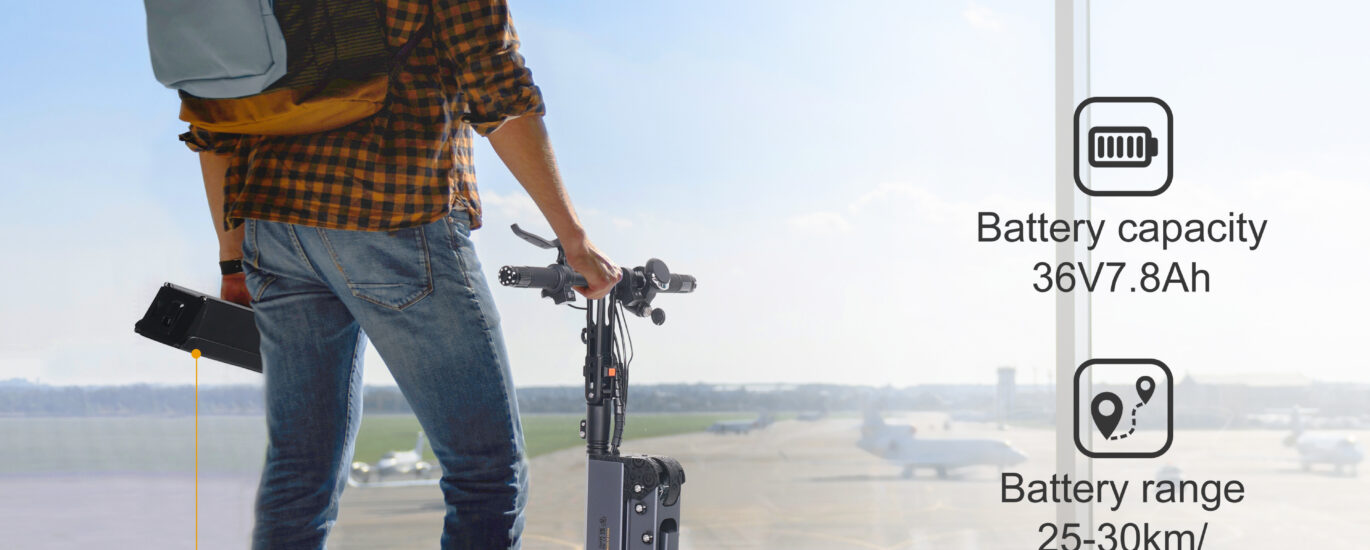
| Battery | 36 V 7.8 Ah / 280.8 Wh, removable | 36 V 7.8 Ah / 280.8 Wh, removable |
| Claimed range | 25–30 km / 15.5–18.6 mi | 25–30 km / 15.5–18.6 mi |
| Top speed | 15 mph / 24 km/h | 15 mph / 24 km/h |
| Speed settings | 3 / 7 / 15 mph (5 / 11 / 24 km/h) | 3 / 7 / 15 mph (5 / 11 / 24 km/h) |
| Charge time | 4 h | 4 h |
| Brake | Power drum brake, front wheel | Power drum brake, front wheel |
| Braking distance | 5 m / 196.9 in | 5 m / 196.9 in |
| Gradeability | 8° | 8° |
| Wheels | 10 in front, 10 in rear | 10 in front, 10 in rear |
| Max load | 100 kg / 220.4 lb | 100 kg / 220.4 lb |
| Net weight | 17.2 kg / 37.9 lb | 17.8 kg / 39.2 lb |
| Unfolded size | 99 × 57.5 × 92.5 cm | 102.7 × 58 × 95.2 cm |
| Folded size | 44 × 57.5 × 88 cm | 58 × 46 × 89.5 cm |
| Front tire tread | Road | Off-road |
| Frame finish | Silver | Graphite |
Read the identical column carefully. Buyers assume a higher model number means a bigger motor or a longer range. Here it does not. The ES36 is not an upgrade — it is a different cut of the same machine.
What this vehicle is, and what it is not
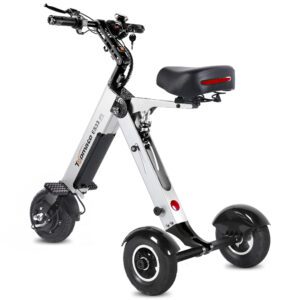
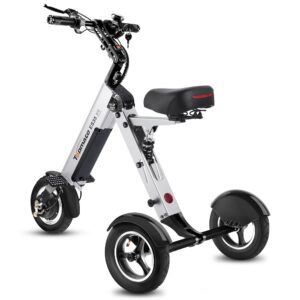
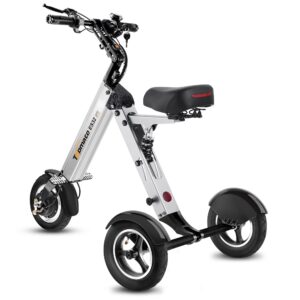
A three-wheel folding electric scooter with a seat is a seated, handlebar-steered, electric-only vehicle: one front wheel, two rear wheels, a hub motor in the front wheel, a removable lithium pack under the stem, and a frame that folds in three movements into roughly suitcase proportions. Both the ES35 and the ES36 belong to this category.
It is worth being blunt about the boundaries, because most of the disappointment around this class of product comes from wrong expectations:
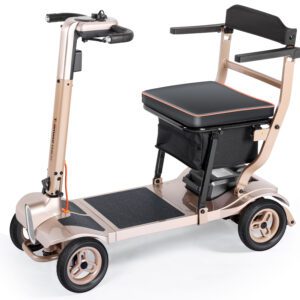
- It is not a mobility scooter. There is no joystick and no fourth wheel. You steer with handlebars and you keep your feet on the deck.
- It is not a standing e-scooter. You cannot stand on it — the deck is narrow and the seat is the riding position.
- It is not a bicycle. There are no pedals and no pedal assist. Throttle and brake, nothing else.
- It is not an off-road vehicle. Even the ES36, with its knobby front tire, is rated to 8° of gradeability on 10-inch wheels.
- It is not universally street legal. 15 mph sits inside the limit in many jurisdictions and outside it in others. Check your local rules before you commute on it.
Difference one: the folded footprint
This is the only difference that changes where the scooter can physically live. Folded, the two machines are almost mirror images of each other — one is short and wide, the other is long and narrow.
| Folded dimensions | ES35 | ES36 |
|---|---|---|
| Length | 44 cm / 17.3 in | 58 cm / 22.8 in |
| Width | 57.5 cm / 22.6 in | 46 cm / 18.1 in |
| Height | 88 cm / 34.6 in | 89.5 cm / 35.2 in |
| Box volume (calculated) | 222.6 L | 238.8 L |
The ES35 is 14 cm shorter when folded and about 6.8% smaller by volume. The ES36 is 11.5 cm narrower. Neither is simply “more compact” — compactness depends on the shape of the hole you are putting it into. A trunk cares about length. A closet slot cares about width.
Two practical consequences, stated as plainly as possible:
- If you lift it into a hatchback or a small SUV twice a week, the ES35’s 44 cm folded length is the number you will feel. It leaves 14 cm more cabin space behind the rear seats than the ES36 does.
- If your storage spot is a gap between a wall and a cabinet, or a hallway niche, the ES36’s 46 cm folded width is the number that decides whether the scooter goes in or stands in the way. The ES35 needs a 57.5 cm opening.
Difference two: 0.6 kg and 3.7 cm
ES35: 17.2 kg. ES36: 17.8 kg. That is a 1.3 lb gap — less than a full water bottle.
We are not going to pretend this is a headline. On flat ground, 0.6 kg is undetectable. It becomes real in exactly two situations: lifting the folded scooter into a trunk, and carrying it up stairs. In both, the ES35 also gives you 14 cm less length to wrestle with, which matters more than the weight itself.
The same honesty applies to the unfolded length: 99 cm for the ES35 against 102.7 cm for the ES36, a 3.7 cm difference. It is not a fit problem in any normal room. It is only worth knowing if you park it in a tight corridor and need to know whether a door can still open past it.
Difference three: the front tire tread
Both models use 10-inch wheels front and rear, and both share the same rear tires. The split is at the front: the ES36 runs a block-tread tire, the ES35 runs a road-oriented one.
What that buys you on a three-wheeler is real but narrow. The front wheel is your steering wheel, so extra tread bite shows up as more grip on gravel paths, cut grass, wet brick and packed dirt, and slightly less slide when you turn on a damp surface. What it costs you is road noise on smooth asphalt and faster tread wear if you ride pavement exclusively.
What it does not buy you: the 8° gradeability rating, the 10-inch wheel size, the 5 m braking distance and the 100 kg load limit are identical on both machines. A knobby front tire does not turn the ES36 into a trail scooter.
Which one fits your week
Ignore the model numbers and answer the question about your routine instead.
| Your situation | Pick | Why this one |
|---|---|---|
| It rides in a car trunk several times a week | ES35 | 44 cm folded length, 14 cm shorter |
| Home storage is a slot under 57 cm wide | ES36 | 46 cm folded width |
| Daily route includes gravel, grass or wet brick | ES36 | Off-road front tread |
| You sit on it for 40 minutes or more at a stretch | ES35 | The wider, deeper saddle in the studio photos |
| You carry it up stairs or into a lift every day | ES35 | 0.6 kg lighter and shorter to grab |
| You are close to the 100 kg load limit | Either | Identical 100 kg / 220.4 lb rating |
| You want the fastest or longest-range of the two | Neither | Identical 15 mph and 25–30 km |
The five numbers people ignore until they matter
| Limit | What it means in practice |
|---|---|
| 8° gradeability | About a 14% slope. Most residential driveways are 8–12%, so a steep one becomes a walk. This is the single most common surprise with this class of scooter. |
| 5 m braking distance, front drum only | The manual lists one brake, on the front wheel. On wet pavement, start braking earlier than instinct suggests. |
| 100 kg / 220.4 lb | Rider plus anything in a basket. Identical on both models. |
| Recommended rider height under 6’2″ (188 cm) | From the brand’s own sizing material. Taller riders sit further back than the seat geometry is designed for. |
| 280.8 Wh battery | Well above the 100 Wh cabin limit for lithium packs, so the standard battery cannot fly. A 94 Wh pack is offered as a custom option — confirm with your airline before you book. |
One more, which is not a number but a maintenance rule that voids warranties: the manual forbids washing with a pressure washer or dipping the scooter in water. Wipe it with a damp cloth. Cleaning a folding scooter like a bicycle is how the controller gets wet.
What “25–30 km” actually means
The range figure is the most quoted and least qualified number in every folding scooter listing, so here is the qualification the manual itself provides.
| Riding condition | Manual figure | Plan for |
|---|---|---|
| Gear II (~7 mph), 60 kg rider | up to 25 km / 15.5 mi | 20–25 km in real use |
| Gear III (15 mph) | Not published | Treat 25 km as a ceiling, not an average |
| Heavier rider, cold weather, hills | Not published | Expect a clear step down from the figures above |
The takeaway is not that the range is inflated — it is that the 25–30 km band assumes a 60 kg rider in the middle speed setting. If you plan to ride at 15 mph with an adult aboard, budget your trips around the bottom of the range and you will not be caught out. Charging is 4 hours from empty, and the manual recommends recharging once the pack drops below 20% rather than running it flat.
Frequently asked questions
Is the ES35 or the ES36 better for a heavier rider?
Neither. Both are rated to 100 kg / 220.4 lb, and both share the same frame material, motor and brake. A heavier rider does not get a mechanical advantage from either model — only a shorter real-world range, because more mass draws more current.
Can you take either scooter on a plane?
Not with the standard battery. At 280.8 Wh the pack is well above the 100 Wh cabin limit most airlines enforce. A 94 Wh pack is offered as a custom option, which would bring it under the limit — but airline rules vary, so confirm the specific carrier’s policy before you travel.
Can it climb hills?
Up to 8°, roughly a 14% slope. Gentle driveway ramps and park paths are fine. Long sustained inclines and steep driveways are not, and neither model changes that — the motor, torque and rating are identical.
Will it fit in a car trunk?
Both will fit in most hatchback and small-SUV trunks, but the ES35 needs 44 cm of folded length and the ES36 needs 58 cm. If trunk space is already tight, that 14 cm is the deciding number. Neither is light enough to lift one-handed at 17 kg, so plan on two hands either way.
How fast is it, and is it legal where I live?
Three settings: 3 mph, 7 mph and 15 mph (5, 11 and 24 km/h). There is no published unlock beyond 15 mph. Legality varies by city and country — some places cap seated electric scooters below 15 mph, and many restrict them from sidewalks. Check your local rules; the product spec will not answer that question for you.
Bottom line
The ES35 and ES36 are the same machine cut two ways. Choosing between them is not a performance decision, because there is no performance difference to weigh: the motor, battery, top speed, brakes, wheels and load rating are identical line for line.
It is a storage decision. Measure the space the scooter has to live in, and the answer falls out in about thirty seconds. Short and wide — 44 × 57.5 cm — is the ES35. Long and narrow — 58 × 46 cm — is the ES36, and it also brings the off-road front tread if your routes leave the pavement.
Where to buy
Before you click either link, measure two things: the depth of your car trunk, and the width of your storage slot. Then hold those numbers against the folded sizes below.
Still deciding? Browse the full folding scooter range at topmate.cc.
Figures in this comparison are taken from the published TopMate ES35 and ES36 user manuals, section 2.2 Specifications and Parameters, and section 5.2 Battery and Charging. Box volumes are calculated from the listed folded dimensions and rounded to one decimal place. Where the manual does not publish a figure, this article says so rather than estimating.