Quick Answer
Most seniors can learn the basics of using a mobility scooter within 15 to 60 minutes, while becoming fully comfortable and confident typically takes a few days to two weeks of regular use. The learning curve depends on factors such as previous experience with mobility devices, physical condition, scooter type, and the environment where the scooter will be used.
For many older adults, modern mobility scooters are designed to be intuitive. Simple controls, adjustable speed settings, comfortable seating, and stable designs help new users gain confidence quickly. Compact travel scooters are often easier to learn for indoor and smooth-surface use, while larger scooters may require additional practice due to their size and turning radius.
Introduction
Many seniors considering a mobility scooter share the same concern:
“Will it be difficult to learn?”
This question is understandable, especially for individuals who have never used a mobility device before. Some worry about steering, braking, navigating crowded areas, or operating the controls correctly.
Fortunately, modern mobility scooters are designed with ease of use in mind. Manufacturers understand that many users are older adults, so controls are intentionally simple, intuitive, and beginner-friendly.
In reality, most seniors adapt quickly. With a little practice and guidance, many riders feel comfortable operating a mobility scooter within their first day of ownership.
How Long Does It Usually Take to Learn a Mobility Scooter?
First 15–30 Minutes
During the first session, most seniors learn:
- How to turn the scooter on and off
- How to control speed
- How to steer
- How to stop safely
- How to reverse
At this stage, riders are becoming familiar with the controls.
First Day
After an hour or two of practice, many seniors can comfortably:
- Navigate sidewalks
- Make simple turns
- Enter and exit doorways
- Park the scooter
- Travel short distances
Confidence begins to develop quickly.
First Week
Within the first week, most users become comfortable with:
- Shopping trips
- Medical appointments
- Neighborhood travel
- Busy pedestrian areas
- Longer rides
By this point, scooter operation often feels natural.
Two Weeks and Beyond
Experienced users generally become proficient at:
- Tight turns
- Crowded environments
- Uneven surfaces
- Advanced maneuvering
- Efficient battery management
Most seniors achieve full confidence within two weeks of regular use.
What Makes Mobility Scooters Easy to Learn?
Simple Controls
Unlike cars or motorcycles, mobility scooters have straightforward controls.
Typical controls include:
- Forward throttle
- Reverse throttle
- Speed adjustment dial
- Battery indicator
- Lights and horn
Most functions can be learned within minutes.
Adjustable Speed Settings
Beginners can start at lower speeds while practicing.
Benefits include:
- Greater confidence
- Improved control
- Reduced risk of mistakes
As experience grows, speed can gradually be increased.
Stable Design
Mobility scooters are designed for stability.
Features often include:
- Four-wheel or three-wheel configurations
- Low center of gravity
- Wide seating area
- Balanced weight distribution
This stability helps reduce anxiety among first-time users.
Factors That Affect Learning Time
Previous Experience
Individuals who have previously used:
- Golf carts
- Power wheelchairs
- Mobility aids
May adapt more quickly.
Physical Condition
Factors that may influence learning include:
- Vision
- Hand strength
- Joint mobility
- Reaction time
However, many scooters are designed specifically to accommodate these challenges.
Scooter Type
Different scooters have different learning curves.
| Scooter Type | Learning Difficulty |
|---|---|
| Travel Scooter | Easy |
| Foldable Scooter | Easy |
| Mid-Size Scooter | Moderate |
| Heavy-Duty Scooter | Moderate |
| Outdoor Scooter | Moderate |
Smaller scooters are often easier for beginners.
Environment
Learning in a quiet parking lot or open area is easier than starting in a busy shopping center.
A gradual approach helps build confidence.
How to Learn Faster
Start Slowly
Begin with the lowest speed setting.
Practice:
- Starting
- Stopping
- Turning
- Reversing
Before increasing speed.
Practice in an Open Area
Ideal locations include:
- Empty parking lots
- Driveways
- Community centers
- Quiet parks
Avoid crowded areas initially.
Learn Basic Maneuvers
Practice:
- Straight-line driving
- Wide turns
- Tight turns
- Parking
- Backing up
These skills form the foundation of safe riding.
Increase Complexity Gradually
After mastering basics:
- Visit stores
- Use sidewalks
- Navigate ramps
- Travel longer distances
Progressive learning builds confidence.
Which Mobility Scooter Is Best for Beginners?
Best for Seniors Living Alone
Look for:
- Easy controls
- Compact design
- Comfortable seating
Best for Travel
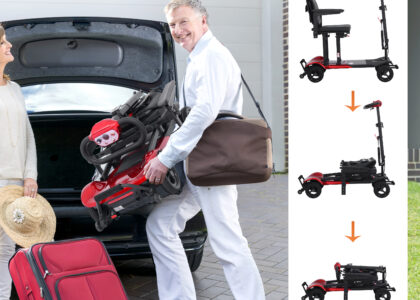
Travel scooters often feature:
- Lightweight construction
- Easy disassembly
- Simple operation
Best for Shopping
Important features include:
- Tight turning radius
- Stable platform
- Good battery range
Best for Outdoor Use
Outdoor scooters benefit from:
- Larger wheels
- Suspension systems
- Higher ground clearance
These features may require slightly more practice.
A Typical Learning Experience
Imagine a 72-year-old senior receiving a mobility scooter for the first time.
Day 1
The rider spends 20 minutes learning basic controls in the driveway.
Day 2
A short trip around the neighborhood improves steering confidence.
Day 4
The rider visits a local grocery store.
Week 2
The scooter becomes part of the daily routine for shopping, appointments, and recreation.
This gradual progression is typical for many new users.
Common Beginner Mistakes
1. Driving Too Fast Too Soon
New riders should begin at lower speeds.
2. Ignoring Turning Radius
Scooters require space to maneuver.
3. Forgetting Battery Monitoring
Always check battery levels before longer trips.
4. Practicing in Crowded Areas First
Start in open, low-traffic environments.
5. Not Reading the User Manual
Understanding scooter features improves safety.
6. Taking Sharp Turns Too Quickly
Slow down before turning.
7. Overestimating Initial Skill Level
Confidence grows with practice.
Conclusion
Most seniors learn how to use a mobility scooter much faster than they expect. Basic operation can often be mastered within an hour, while full confidence typically develops within a few days or weeks of regular use.
Modern mobility scooters are specifically designed for ease of use, featuring intuitive controls, adjustable speeds, comfortable seating, and stable platforms. By starting slowly, practicing in safe environments, and gradually expanding riding activities, seniors can quickly gain the skills needed for independent mobility.
FAQ
How long does it take seniors to learn how to use a mobility scooter?
Most seniors learn the basic controls of a mobility scooter within 15 to 60 minutes. With regular practice, many become fully comfortable and confident within one to two weeks.
Are mobility scooters easy for first-time users?
Yes. Mobility scooters are designed with simple controls, adjustable speed settings, and stable platforms, making them easy for most first-time users to operate.
What is the best way for seniors to practice using a mobility scooter?
Seniors should start in a safe, open area such as a driveway, parking lot, or quiet park. Practicing starting, stopping, turning, and reversing helps build confidence quickly.
Can seniors use a mobility scooter without prior experience?
Yes. Most mobility scooter users have no previous experience. The controls are intuitive, and many seniors learn to use them comfortably after a short practice session.

-scaled-2-420x300.jpg)