Getting onto and off a mobility scooter can be more important than top speed or maximum range for some riders. If a scooter is difficult to approach, requires awkward leg movements, or leaves little room for transferring from a chair, even a lightweight model may not feel easy to use.
The right choice depends on the rider’s body proportions, flexibility, transfer method, and where the scooter will be used. Instead of looking for a scooter with a specific “easy-access” label, evaluate seat height, armrests, foot placement, legroom, and the space around the seat.
Quick Answer
The easiest mobility scooter to get on and off is generally one that gives the rider clear access to the seat, a suitable seat height, usable armrests, adequate legroom, and enough surrounding space to complete the transfer comfortably.
A lower seat is not automatically easier. A wider seat is not automatically better. Likewise, a folding scooter is not necessarily harder to access than a larger model.
The best test is simple: Can the rider approach, sit down, position their legs, and get up again without unnecessary twisting, stepping over obstacles, or reaching awkwardly?
Start With the Rider, Not the Scooter
Before comparing scooters, think about how the rider normally gets into a chair.
For example, someone who can stand and sit independently may simply need an appropriate seat height and clear foot placement. Someone transferring from a wheelchair may need significantly more space beside the scooter.
This makes “easy seat access” a personal requirement rather than a single scooter specification.
Ask these questions first:
- Does the rider normally sit down from a standing position?
- Do they transfer from a wheelchair or another chair?
- Can they comfortably bend their knees?
- Do they need armrests for support?
- Do they have enough room to move their legs?
- Will a caregiver sometimes assist with the transfer?
- Where will the scooter usually be parked?
Once these questions are clear, it becomes much easier to identify the right design.
What Actually Makes a Mobility Scooter Easy to Get On and Off?
1. A Seat Height That Matches the Rider
Seat height is one of the first things to check, but there is no universal “correct” height.
Compare the scooter with a chair that the rider already uses comfortably. If the seat is too low, standing up may require more effort. If it is too high, the rider may have difficulty placing their feet securely or lowering themselves onto the seat.
The goal is a natural sitting and standing motion.
If possible, measure the height of a comfortable household chair and compare it with the scooter’s seat height and adjustment range.
2. Armrests That Help Rather Than Block
Armrests can give the rider a convenient place to position their hands while sitting down or standing up.
However, their position matters.
An armrest that sits too close to the body may reduce side-entry space. Fixed armrests can also make transfers more awkward for some riders.
Look for an arrangement that gives the rider useful hand support without creating an obstacle.
3. A Clear Footwell
Pay attention to the footwell before the rider even sits down.
The rider needs to be able to approach the seat, position their feet, sit down, and then bring their legs forward naturally.
A cluttered or restrictive foot area can make the transfer feel more complicated than expected.
This is particularly important for riders who have limited flexibility or prefer to approach the seat from the side.
4. Enough Knee and Tiller Clearance
The tiller should leave enough space for the rider’s knees and legs.
A compact scooter can save storage space, but compact dimensions should not come at the expense of usable seating space.
When evaluating a scooter, imagine the complete movement rather than simply looking at the folded dimensions:
approach → sit → move legs → place feet → ride → stop → move legs → stand.
The scooter should accommodate the entire sequence.
5. Enough Space Beside the Seat
This matters most for riders who transfer from another chair or wheelchair.
The scooter itself may have a comfortable seat, but that does not guarantee an easy transfer. The rider also needs enough space beside the scooter to position themselves.
Think about where the scooter will normally be used. A spacious garage may provide plenty of room, while a narrow hallway or crowded shop may not.
6. A Seat That Supports Natural Positioning
Seat width and depth both matter.
A very narrow seat can feel restrictive, while an excessively deep seat may make it harder for a shorter rider to position their legs correctly.
The right seat allows the rider to sit back comfortably while keeping their feet and knees in a natural position.
7. A Scooter That Can Be Positioned Easily
Sometimes the biggest problem isn’t the seat. It is getting the scooter into the right position.
A scooter that is difficult to maneuver into a transfer position may become frustrating in everyday use.
Consider the spaces where the rider will regularly get on and off:
- Bedroom or living room
- Garage
- Parking spaces
- Shopping aisles
- Doctor’s offices
- Dining areas
- Retirement communities
- Parks and other outdoor locations
The easier the scooter is to position, the easier the complete transfer process can be.
Three Real-World Situations to Consider
Scenario 1: The Rider Transfers From a Regular Chair
Suppose the rider can walk a few steps and normally sits down independently.
In this situation, seat height, foot placement, and armrest positioning may matter more than maximum scooter size.
A scooter that allows the rider to approach directly and sit without stepping over a large obstruction may be easier to manage.
Scenario 2: The Rider Transfers From a Wheelchair
This requires a different approach.
The scooter should be easy to position next to the wheelchair, with sufficient side clearance for the transfer.
In this case, don’t judge accessibility simply by looking at the seat itself. Look at the space around the seat.
A compact scooter can sometimes be easier to position in a restricted area, but its specific frame and seat layout still need to work with the rider’s transfer technique.
Scenario 3: A Caregiver Helps With Transfers
If a caregiver regularly assists the rider, consider the caregiver’s position as well.
There needs to be enough room for the caregiver to assist without being forced into an awkward posture.
A practical test is to simulate the entire process before buying:
- Position the scooter.
- Have the rider approach or transfer.
- Sit down normally.
- Move both legs into riding position.
- Reverse the process.
- Repeat it from the side the rider normally uses.
This can reveal problems that product specifications cannot.
Does a Folding Mobility Scooter Make Seat Access More Difficult?
Not necessarily.
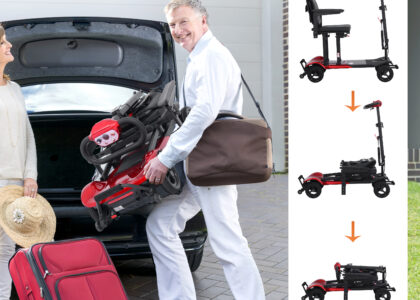
A folding scooter may actually be easier to position in smaller homes, garages, or around a vehicle because of its compact footprint.
However, portability and seat access are two different considerations.
A scooter can be easy to fold and transport but still be awkward for a particular rider to access. Conversely, a larger scooter may provide generous seating space but require more room to position.
Therefore, don’t assume:
folding = difficult access
or
larger = easier access.
Instead, evaluate how much usable space surrounds the seat during an actual transfer.
How to Test a Scooter Before Buying
If you can test a scooter in person, don’t simply sit on it for a few seconds.
Perform the complete movement.
Try this five-step test:
1. Approach the scooter
Can the rider walk or maneuver toward the seat naturally?
2. Sit down
Can they lower themselves without excessive twisting or reaching?
3. Position the legs
Can they bring their legs into the footwell without obstruction?
4. Get comfortable
Can they sit back naturally while maintaining a comfortable knee and foot position?
5. Get off
Can they reverse the movement without struggling?
If the scooter passes all five steps comfortably, it is a much stronger candidate than one that simply feels comfortable once the rider is seated.
What Caregivers Should Look For
Caregivers should evaluate the whole transfer, not just the seat.
Watch for signs that the rider is:
- Twisting excessively
- Reaching too far for support
- Struggling to position their feet
- Hitting their knees against the tiller
- Pulling heavily on the armrests
- Needing repeated repositioning
- Having difficulty standing back up
If any of these occur, consider whether a different seat height, layout, or scooter footprint would make the process easier.
The goal isn’t to find a scooter that looks accessible on paper. It is to find one that works with the rider’s normal movement pattern.
Where TopMate Models May Fit
TopMate’s folding mobility scooters can be worth considering when portability, compact positioning, and everyday maneuverability are important parts of the buying decision.
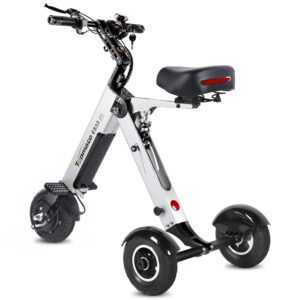
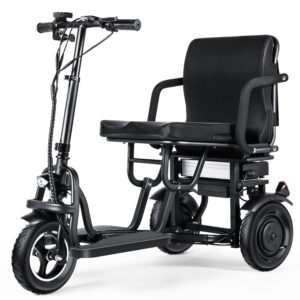
For example, the TopMate ES15 uses a three-wheel folding design with a padded seat and armrests. Its compact configuration may make it easier to position in some smaller spaces. However, seat access remains individual, so the rider should still evaluate the seat, armrests, legroom, and transfer space before choosing it.
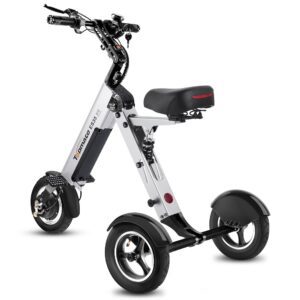
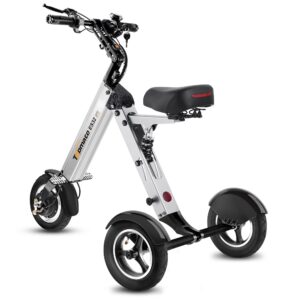
The TopMate ES33 also uses a three-wheel configuration and widened footrests. Its published specifications include a 20.8-inch unfolded width and a 220.4-lb maximum load capacity. Those dimensions can help shoppers evaluate overall space requirements, but they do not by themselves determine whether the scooter will be easy for a particular rider to access.
This distinction is important:
Specifications tell you how a scooter is built. A real transfer test tells you how accessible it is for the rider.
My Simple Decision Rule
If easy seat access is your main priority, I would evaluate scooters in this order:
1. Transfer method
How does the rider normally get onto a chair?
2. Seat height
Does it feel similar to a chair the rider already uses comfortably?
3. Side access
Is there enough room to approach or transfer?
4. Leg and knee clearance
Can the rider move their legs without obstruction?
5. Armrests
Do they provide useful support without blocking the transfer?
6. Footwell
Can the rider place their feet naturally?
7. Positioning
Can the scooter be placed correctly in the environments where it will actually be used?
This approach is more useful than choosing based solely on weight, range, speed, or folded size.
Final Takeaway
When seniors need a mobility scooter that is easy to get on and off, the most important question isn’t “Which scooter has the lowest seat?”
It is:
“Which scooter allows this rider to complete the entire transfer naturally and safely?”
Look at seat height, armrests, seat dimensions, footwell design, knee clearance, side-entry space, and maneuverability together.
Then consider where the scooter will actually be used.
A compact folding scooter may be ideal for one rider because it is easy to position and store. Another rider may need more seating or transfer space. There is no single design that works equally well for everyone.
FAQ
What makes a mobility scooter easy to get on and off?
A suitable seat height, clear space around the seat, accessible footwell, useful armrests, and adequate legroom can make a mobility scooter easier to enter and exit.
What seat height is easiest for seniors?
There is no universally ideal seat height. The right height depends on the rider’s height, leg length, flexibility, transfer technique, and the height of nearby seating.
Are armrests important for mobility scooter seat access?
Yes. Armrests can provide a useful hand position when sitting down or standing up. However, they should not unnecessarily restrict side access.
How can you test a mobility scooter for easy seat access?
Test the complete process: approach the scooter, sit down, position your legs, ride, stop, and get off. Repeat the process in realistic spaces where the scooter will be used.

-scaled-2-420x300.jpg)