What Does Mobility Scooter Braking Distance Mean?
Mobility scooter braking distance is the distance the scooter travels from the moment braking begins until the scooter comes to a complete stop.
It is different from total stopping distance, which also includes the distance traveled while the rider recognizes a hazard and reacts.
In simple terms:
Total stopping distance = reaction distance + braking distance
A manufacturer may publish a braking-distance figure measured under specific test conditions. That figure should not automatically be treated as the stopping distance the scooter will achieve on every road or surface.
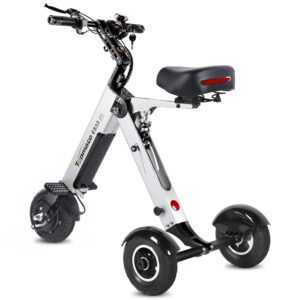
For example, TopMate’s published ES35 specification lists a 5 m (196.85-inch) braking distance, while its ES33 documentation also lists 5 m. These are manufacturer specifications, not universal stopping distances for all riders or conditions.
Reaction Time vs. Braking Distance
Stopping begins before the brakes physically slow the wheels.
Suppose a pedestrian steps into your path. Your eyes must detect the hazard, your brain must recognize it, and you must release or operate the control. During that short interval, the scooter continues moving.
That is reaction distance.
Only after braking begins does the scooter enter the actual braking phase.
This distinction explains why following too closely behind pedestrians can be risky even if the scooter’s brakes are functioning correctly. The rider needs enough space for both human reaction and mechanical braking.
How Does Speed Affect Stopping Distance?
Speed has a major effect on stopping performance.
At higher speed, the scooter has more kinetic energy that the braking system must dissipate. The rider also covers more ground during the reaction period.
For example, TopMate’s ES35 and ES33 are specified with a maximum speed of 15 mph (24 km/h).
That maximum speed does not mean a rider should use it in every environment. A slower speed gives the rider more time to identify pedestrians, obstacles, driveway entrances, uneven surfaces, and other hazards.
In the UK, mobility scooters used on pavements and pedestrian areas are subject to a 4 mph maximum speed, and the Highway Code advises reducing speed where pedestrian movement or narrow pavement conditions require it.
How Does Rider and Cargo Weight Affect Braking?
The braking system must slow the combined moving mass of:
rider + scooter + battery + accessories + cargo
A rider carrying groceries, bags, or other equipment therefore changes the load the brakes must bring to a stop.
This does not mean that every additional pound produces a predictable increase in stopping distance. Braking performance depends on the entire system, including tire grip and brake design.
However, operating close to the manufacturer’s maximum load can change handling and braking behavior compared with a lightly loaded scooter.
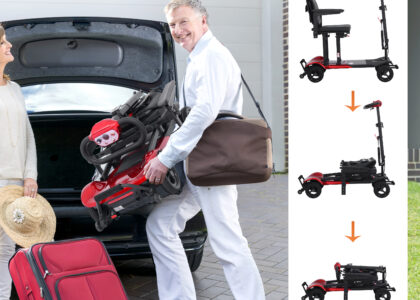
For example, the ES35 is specified with a 17 kg (37.5 lb) scooter weight and 100 kg (220.4 lb) maximum load. The ES33 is listed at 16.1 kg (35.4 lb) with a 100 kg (220.4 lb) maximum load.
Always remain within the manufacturer’s specified load limit.
How Do Tires Affect Stopping Performance?
Brakes can only slow the wheels effectively if the tires maintain suitable contact with the ground.
Tire characteristics affect:
- Traction
- Rolling resistance
- Surface contact
- Stability
- Performance on wet or loose ground
The ES35 uses 10-inch wheels, while the ES33 uses 8-inch front and rear wheels according to their published specifications. The ES15 is specified with three 10-inch pneumatic tires.
Wheel size alone does not determine stopping performance. Tire construction, condition, inflation where applicable, surface grip, and braking design all matter.
For pneumatic tires, maintaining the manufacturer’s recommended pressure is particularly important. A damaged, excessively worn, or incorrectly inflated tire should be addressed before relying on the scooter for longer journeys.
Why Is Wet Pavement More Difficult?
Wet pavement can reduce available tire grip.
The problem is not necessarily that the brake itself becomes weaker. Instead, the tire may have less ability to transfer braking force to the ground.
That can mean:
- Longer stopping distances
- Reduced steering control during braking
- Greater risk of wheel slip
- Less predictable handling
For this reason, riders should reduce speed before entering wet areas rather than waiting until an obstacle appears.
The same principle applies to wet leaves, mud, and other slippery surfaces. Massachusetts mobility-scooter guidance specifically advises reducing speed on uneven or soft surfaces and avoiding conditions such as snow, ice, cut grass, and wet leaves.
What About Gravel, Grass and Dirt?
Loose surfaces can make braking less predictable because the tire does not have the same firm contact available on dry pavement.
Gravel
Loose gravel can move underneath the tires, reducing traction. Deep or loosely packed gravel is particularly challenging.
Grass
Grass can conceal uneven ground and may become slippery when wet. Long grass can also interfere with some scooter components.
Dirt
Firm, compacted dirt may provide reasonable traction, while loose or muddy dirt can make braking more difficult.
Uneven surfaces
Potholes, broken pavement, bumps, and sudden changes in elevation can affect stability while braking.
When approaching these surfaces, reduce speed before entering them rather than braking aggressively once you are already on the difficult section.
How Do Downhill Slopes Affect Braking?
Gravity adds another challenge when traveling downhill.
On a descent, gravity is pulling the scooter forward while the braking system is trying to control its speed. A steeper slope therefore requires more careful speed management.
A useful rule is simple: do not wait until you are moving too quickly downhill before applying the brakes.
Massachusetts guidance recommends traveling as slowly as possible on declines and releasing the throttle if the scooter begins moving faster than expected.
The manufacturer’s maximum incline specification should also be treated as an operating limit, not as a recommendation for routine riding at that slope.
For example, the ES35 and ES33 are each specified with an 8° gradeability rating.
Electromagnetic Brakes vs. Other Braking Systems
Mobility scooters use different braking arrangements depending on their design.
An electromagnetic brake generally engages when power to the motor system is removed, helping bring the scooter to a stop and hold it stationary.
Other scooters may use mechanical or drum-style braking systems.
TopMate’s published ES35 and ES33 specifications identify power drum brakes on the front wheel, while the ES15 is described as having dual drum brakes and an incline parking brake.
Because braking systems differ, riders should follow the specific operating and maintenance instructions supplied with their scooter rather than assuming that every model brakes in exactly the same way.
Can the Battery or Electrical System Affect Braking?
Yes, depending on the scooter’s braking architecture.
Some scooter braking systems are integrated with the motor controller and electrical system. A problem involving the controller, wiring, power supply, throttle, or related components can therefore affect braking behavior.
However, the exact relationship depends on the scooter design.
If a scooter suddenly behaves differently when the throttle is released, takes noticeably longer to stop, moves unexpectedly, or develops an electrical warning, do not assume that the issue will correct itself after charging the battery.
Stop using the scooter if its braking behavior is abnormal and consult the manufacturer or a qualified mobility-equipment technician.
Practical Situations Where Extra Stopping Space Helps
Leave more space when:
- Approaching a crowded shopping center
- Passing pedestrians on a narrow path
- Traveling downhill
- Crossing a driveway
- Riding on wet pavement
- Moving from pavement onto gravel
- Traveling on grass
- Approaching a blind corner
- Carrying a heavier load
- Riding in poor visibility
- Operating on unfamiliar terrain
The principle is simple: the less predictable the environment, the more stopping margin you should create.
How Much Following Distance Should You Leave?
There is no universal number of feet that guarantees safe following distance for every mobility scooter.
Instead, maintain enough space to:
- Notice the person or obstacle.
- React to the change.
- Apply the brakes.
- Bring the scooter to a complete stop without entering the pedestrian’s path.
Pedestrians can change direction suddenly, particularly children, people using headphones, or people who may not notice the scooter approaching.
UK Highway Code guidance says mobility-scooter users should give pedestrians priority and show consideration for other pavement users.
What to Check Before Riding
Before each ride, make a quick inspection:
- Check that the brakes respond normally.
- Confirm the throttle returns correctly.
- Inspect tires for visible damage or excessive wear.
- Check pneumatic tire pressure according to the manufacturer’s specification.
- Make sure the battery is adequately charged.
- Confirm that the route does not contain surfaces beyond the scooter’s intended capability.
- Test braking at low speed in a clear area if you are unfamiliar with the scooter.
- Reduce speed before hills, wet areas, crowds, or uneven surfaces.
When Does a Braking Problem Require Professional Inspection?
Do not continue riding normally if you notice:
- A sudden increase in stopping distance
- The scooter continues moving when braking should engage
- Unusual brake noises
- Jerky or inconsistent braking
- The scooter rolls when it should remain stationary
- A brake warning or electrical fault
- Visible damage to brake components
- Significant changes in braking after servicing or battery/electrical work
A braking system is safety-critical. If its behavior changes unexpectedly, manufacturer or qualified technician inspection is more appropriate than attempting to compensate by simply riding more slowly.
TopMate Specifications: A Useful Example
TopMate’s published specifications show why braking distance must be considered alongside speed, weight, tires, and terrain.
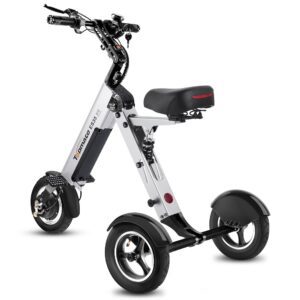
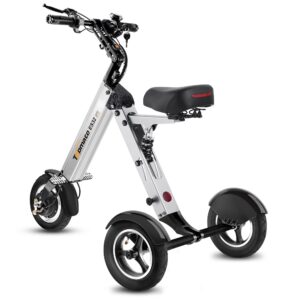
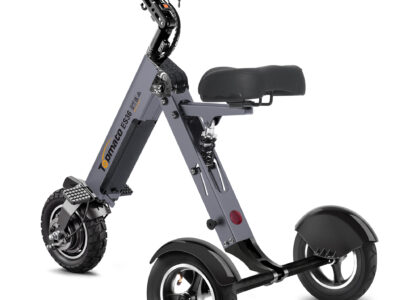
The ES35 has a stated maximum speed of 15 mph, weighs 17 kg, supports up to 100 kg, uses 10-inch wheels, has 8° gradeability, and specifies a 5 m braking distance. Its braking system is listed as a front-wheel power drum brake.
The ES33 has a stated maximum speed of 15 mph, weighs 16.1 kg, supports 100 kg, uses 8-inch wheels, has 8° gradeability, and also specifies a 5 m braking distance with a front-wheel power drum brake.
These published 5 m figures are useful because they demonstrate that an actual manufacturer can provide a braking-distance specification. They should not, however, be treated as a universal stopping distance. Actual stopping performance can change with speed, load, slope, tire condition, road surface, and other conditions.
Final Takeaway
Mobility scooter stopping distance is affected by far more than the brake itself. Speed, rider and cargo weight, tire grip, wet or loose surfaces, downhill travel, and mechanical or electrical condition can all change how much space is needed to stop.
There is no single braking-distance number that applies to every scooter and every situation. Where a manufacturer publishes a tested braking distance, use it as a specification under its stated conditions—not as a guarantee for every real-world ride.
The safest approach is to control speed, anticipate hazards, maintain adequate following space, inspect the scooter regularly, and slow down before difficult surfaces or slopes.
FAQ
How fast can a mobility scooter stop?
There is no universal stopping distance for every mobility scooter. Stopping performance depends on speed, rider and cargo weight, tires, road surface, slope, braking system, and scooter condition.
Does rider weight affect mobility scooter braking distance?
Yes. A heavier combined load means the braking system must slow more moving mass. Riders should stay within the manufacturer’s maximum weight capacity and account for additional cargo.
Do wet roads increase mobility scooter stopping distance?
Yes. Wet pavement can reduce tire traction and make braking less predictable. Riders should reduce speed before reaching wet or slippery surfaces and avoid sudden braking where traction is limited.
What should I do if my mobility scooter brakes feel different?
Stop using the scooter normally if you notice a sudden increase in stopping distance, unusual brake behavior, or an electrical or brake warning. Have the scooter inspected by the manufacturer or a qualified mobility-equipment technician.

-scaled-2-420x300.jpg)