Imagine riding along a neighborhood sidewalk when the pavement suddenly changes. The first section is smooth, then a cracked slab creates a small step. A few yards later, there is a driveway transition, followed by several uneven paving stones.
For a mobility scooter, these changes are more than a comfort issue. They can affect wheel contact, steering, traction, braking, vibration, and overall stability.
So, can mobility scooters go over uneven pavement? Many can handle minor cracks, expansion joints, driveway transitions, and moderately uneven sidewalks, but performance depends heavily on wheel size, tire construction, suspension, ground clearance, wheelbase, weight distribution, and speed. A compact travel scooter designed mainly for smooth indoor surfaces should not automatically be treated as an all-terrain vehicle.
The safest approach is to match the scooter’s specifications to the surfaces you actually encounter.
What Happens When a Scooter Encounters Uneven Ground?
When a scooter reaches a bump or depression, its wheels must climb over or drop into the irregularity while maintaining contact with the ground. mobility scooter uneven pavement
Several things happen simultaneously:
- The front wheel encounters the obstacle first.
- The tire deforms or the suspension moves to absorb some of the impact.
- The scooter’s frame transfers remaining forces toward the seat and steering column.
- The rear wheels encounter the same obstacle shortly afterward.
- The rider must maintain a steady direction while the scooter moves over the surface.
A small crack may barely affect a scooter with appropriately sized tires. A deep pothole can be much more significant because the wheel may drop into the hole before climbing out.
The geometry matters, too. A wheel with a larger diameter generally has an easier time rolling over a given obstacle because the obstacle represents a smaller proportion of the wheel’s circumference.
That does not mean a scooter with the largest wheels is automatically safest. Wheelbase, ground clearance, suspension, tire pressure, weight distribution, and manufacturer limitations all matter.
Why Some Surfaces Are Harder Than Others
Uneven pavement is not one type of terrain. A 10 mm pavement crack presents a very different challenge from a deep pothole or loose gravel.
The main variables are:
- Obstacle height: How high is the bump or pavement edge?
- Depression depth: How far does the wheel drop?
- Surface angle: Is the scooter approaching straight or diagonally?
- Traction: Can the tires maintain grip?
- Surface movement: Is the ground firm or loose?
- Wheel size: How easily can the wheel roll over the obstacle?
- Ground clearance: Could the frame contact the ground?
- Suspension travel: How much movement is available to absorb impacts?
This is why the same scooter can feel smooth on a cracked sidewalk but uncomfortable or difficult to control on cobblestones.
Surface-by-Surface: What Can a Mobility Scooter Handle?
Cracked Sidewalks
Small cracks and ordinary expansion joints are common outdoor obstacles.
A scooter with appropriately sized tires and adequate ground clearance can generally cross minor cracks when approached slowly and squarely.
However, a large vertical pavement lip is different from a simple crack. If the front wheel hits the edge at speed, the impact can be much greater. mobility scooter uneven pavement
Practical approach: slow down, keep the steering straight, and cross the transition deliberately.
Small Pavement Cracks
Small cracks are among the least demanding uneven surfaces.
The main issue is vibration rather than outright traction loss. Solid tires may transmit more vibration than pneumatic tires, while air-filled tires can provide some cushioning. Tire construction therefore affects ride quality as well as handling.
Potholes
Potholes deserve considerably more caution.
A pothole can:
- Suddenly reduce wheel support
- Produce a strong impact
- Affect steering
- Increase the chance of scraping the underside
- Reduce stability if entered at an angle
- Damage wheels or tires
If a pothole is deep, wide, or difficult to judge, going around it is safer than testing the scooter’s capability. mobility scooter uneven pavement
Gravel
Loose gravel changes the problem from impact absorption to traction and steering control.
The tires can move slightly over loose stones, making steering less predictable. Larger outdoor-oriented tires and appropriate suspension can help, but a mobility scooter should only be used on gravel when the manufacturer permits that type of surface.
Cobblestones
Cobblestones create repeated short impacts rather than one large obstacle.
A scooter may remain stable while transmitting considerable vibration through the frame and steering assembly. Pneumatic tires can provide additional cushioning, while suspension can reduce the amount of vibration reaching the rider.
Grass
Firm, short grass is different from soft or wet grass.
A scooter needs sufficient traction and ground clearance. Wet grass can reduce grip, while soft ground can increase rolling resistance and make steering more difficult.
Driveway Thresholds
Driveways often contain a transition between sidewalk and road that is angled or raised.
Approaching the transition slowly and as close to perpendicular as practical helps prevent one wheel from climbing a sharp edge while the others remain on a different surface.
Curb Cuts
A properly designed curb cut is generally easier to negotiate than a vertical curb. However, the transition angle still matters.
The safest technique is to reduce speed before entering the ramp and maintain a controlled, straight path.
Uneven Paving Stones
Paving stones can create repeated small changes in elevation. The result can be continuous vibration and steering movement.
A scooter with suitable outdoor tires, adequate clearance, and suspension may handle this type of surface better than an ultra-compact scooter designed primarily for smooth flooring.
How Wheel Size Affects Uneven-Surface Performance
Wheel diameter is one of the most useful specifications to examine.
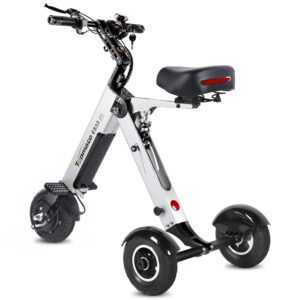
For example, TopMate’s ES40 uses 8-inch solid tires, along with two anti-tip wheels. Its manufacturer lists a maximum load of 275.6 lb and a scooter weight of approximately 38.36 lb. The four-wheel layout and anti-tip wheels are intended to provide stability on pavement and other everyday surfaces.
Larger wheels can generally roll over a given bump more progressively than smaller wheels. However, wheel diameter should be evaluated together with tire width, construction, suspension, wheelbase, and clearance.
A larger tire does not eliminate the need for careful riding.
Suspension and Ground Clearance
Suspension and ground clearance solve different problems.
Suspension allows part of the wheel assembly or frame to move relative to the scooter, helping absorb impacts.
Ground clearance determines how much space exists between the lowest part of the scooter and the ground.
A scooter can have good suspension but still scrape its underside if an obstacle is too high.
Likewise, substantial ground clearance does not necessarily produce a smooth ride if the scooter has limited shock absorption.
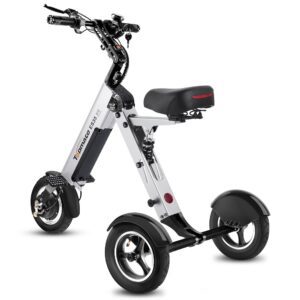
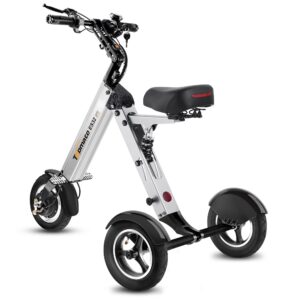
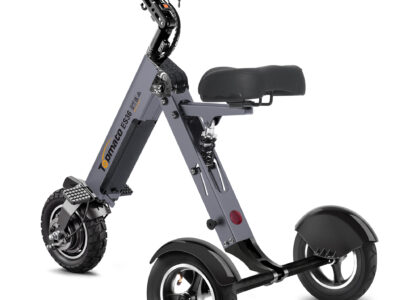
TopMate’s published material distinguishes compact travel scooters from models designed with greater emphasis on outdoor ride comfort and suspension. The company describes the ES36 as having enhanced suspension and larger comfort-focused tires compared with the ES15.
The important point is not simply to look for the word “suspension.” Check what type of suspension is used and what surfaces the manufacturer says the scooter is designed to handle.
Tire Type and Traction
Tire construction changes the way a scooter reacts to uneven pavement.
Pneumatic Tires
Air-filled tires can provide additional cushioning because the air inside compresses as the tire encounters an obstacle. They can be useful on outdoor surfaces such as uneven sidewalks, gravel, and grass.
The trade-off is maintenance. Air pressure needs to be checked, and punctures are possible.
Solid Tires
Solid tires eliminate the need for inflation and resist punctures.
However, because there is no air chamber to compress, more vibration can be transmitted through the scooter on rough surfaces.
Neither tire type is universally superior. The correct choice depends on the surfaces, mileage, and maintenance priorities of the rider.
Wheelbase, Width and Stability
A scooter’s wheelbase—the distance between its front and rear wheel contact areas—affects how it responds to changes in elevation.
A longer wheelbase can provide a more settled ride over some surfaces, while a shorter wheelbase can improve maneuverability in tight spaces.
Overall width also matters. A wider footprint may provide useful lateral stability, but it can make narrow sidewalks, doorways, and pathways harder to navigate.
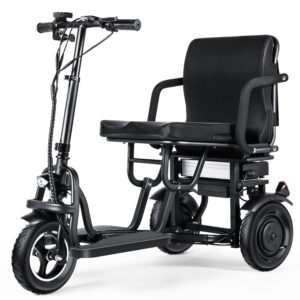
Three-wheel and four-wheel designs also have different handling characteristics. Three-wheel scooters generally emphasize maneuverability, while four-wheel designs provide a broader support footprint.
Speed and Braking Matter More Than Many Riders Expect
The same obstacle can produce a very different result at 2 mph and 5 mph.
Higher speed increases the energy involved in an impact and reduces the time available to react.
Before uneven pavement:
- Release the accelerator early.
- Reduce speed.
- Keep both hands on the controls.
- Avoid abrupt steering.
- Cross the transition under controlled power.
- Accelerate only after all wheels are back on stable ground.
TopMate’s ES41 manual specifically advises slowing the throttle, slowing during turns, and taking extra care on slippery surfaces.
The scooter’s maximum speed should therefore never be interpreted as an appropriate speed for every surface.
How Rider Weight and Load Affect Handling
Weight capacity is not merely a purchasing specification.
A scooter carrying a rider close to its maximum rated load may respond differently from the same scooter carrying substantially less weight. Additional weight can influence acceleration, braking, hill performance, tire loading, and suspension behavior.
Cargo also changes weight distribution.
Keep luggage within the manufacturer’s specified storage areas rather than attaching heavy objects to the steering column or placing unsecured loads where they can affect balance.
Never exceed the manufacturer’s maximum weight rating.
Practical Riding Techniques for Uneven Pavement
When approaching uneven ground, think about speed, angle, visibility, and escape space.
A practical sequence is:
Look → Slow → Straighten → Cross → Stabilize
First, inspect the surface. Then reduce speed before reaching it. Where practical, approach a raised transition as squarely as possible rather than striking it diagonally. Keep the steering controlled while crossing.
Do not suddenly turn while one wheel is climbing an obstacle.
Also check tire pressure regularly if the scooter uses pneumatic tires. Incorrect pressure can change handling, traction, and impact absorption.
When Is the Surface Unsuitable?
A route may be inappropriate when it contains:
- Deep potholes
- Loose rocks
- Deep mud
- Soft sand
- Steep cross-slopes
- Water covering unknown terrain
- Large vertical pavement edges
- Obstacles exceeding the manufacturer’s recommendations
- Slopes beyond the scooter’s rated capability
Do not assume that a scooter marketed for outdoor use is suitable for every outdoor surface.
“Outdoor” can mean paved sidewalks and paths rather than off-road terrain.
What Should You Look for Before Choosing a Scooter?
If uneven sidewalks are part of your normal route, examine the specifications rather than relying on general descriptions.
Pay particular attention to:
| Specification | Why it matters |
|---|---|
| Wheel diameter | Influences ability to roll over bumps |
| Tire construction | Affects cushioning, traction and puncture resistance |
| Ground clearance | Reduces risk of underside contact |
| Suspension | Helps absorb repeated impacts |
| Wheelbase | Influences stability and ride behavior |
| Overall width | Affects lateral footprint and route access |
| Turning radius | Matters when avoiding obstacles |
| Weight capacity | Determines allowable rider and cargo load |
| Scooter weight | Influences portability and loading |
| Maximum speed | Determines how quickly the scooter can approach obstacles |
There is no single specification that guarantees safe uneven-surface performance. The entire design needs to match the intended route.
FAQ
Can mobility scooters safely travel over cracked sidewalks?
Many mobility scooters can handle minor cracks and sidewalk joints, but large cracks, raised edges, and severely damaged pavement should be approached slowly or avoided.
Are larger mobility scooter wheels better for uneven pavement?
Generally, larger wheels can roll over bumps and surface irregularities more easily. However, suspension, tire construction, ground clearance, wheelbase, and weight distribution also affect performance.
Does suspension help a mobility scooter on uneven surfaces?
Yes. Suspension can absorb some impact from bumps and repeated surface irregularities, reducing vibration and improving ride comfort. It does not make a scooter suitable for surfaces beyond its manufacturer’s specifications.
What mobility scooter features are important for uneven sidewalks?
Important specifications include wheel diameter, tire type, suspension, ground clearance, wheelbase, weight capacity, overall width, and manufacturer surface recommendations.

-scaled-2-420x300.jpg)