
A mobility scooter can fit inside your garage or vehicle and still be incompatible with a lift or ramp. The problem is that transportation equipment has several limits at once: platform dimensions, weight capacity, ramp length, vehicle opening size, loading height, and scooter geometry.
Before buying a mobility scooter lift or ramp, measure the scooter in the configuration you will actually transport. Record the dimensions in inches or centimeters, weigh the scooter with the battery if possible, and compare every measurement with the transportation equipment manufacturer’s specifications.
This guide explains how to measure a mobility scooter for a car, lift, or loading ramp without relying on guesswork.
Why Overall Length and Width Are Not Enough
A scooter’s published dimensions usually describe its unfolded footprint. Transportation equipment may require additional information.
For example, two scooters can both measure 24 inches wide, but one might have a tall tiller that prevents it from fitting through a vehicle door. Another might weigh 65 lb without its battery but 80 lb when fully assembled.
Important measurements include:
| Measurement | Why it matters |
|---|---|
| Overall length | Determines platform and cargo-space requirements |
| Overall width | Determines platform and door-opening fit |
| Overall height | Determines vehicle clearance |
| Folded dimensions | Important for trunk or cargo-area loading |
| Seat height | Can affect internal vehicle clearance |
| Tiller/handlebar height | May be the highest point during loading |
| Ground clearance | Affects ramp transitions |
| Wheelbase | Helps assess ramp and threshold behavior |
| Scooter weight | Determines lift capacity requirements |
| Battery weight | May need to be included separately |
| Maximum loaded weight | Important for lift and ramp capacity |
Do not measure only the seat or frame. You need the largest external dimensions of the scooter in its transportation configuration.
Step 1: Measure the Scooter’s Length
Place the scooter on a flat surface in its normal riding configuration.
Measure from the furthest point at the front to the furthest point at the rear, including bumpers, baskets, rear wheels, or other permanently attached components.
For example:
Example scooter length: 44 inches
If a vehicle lift platform is only 40 inches long, the scooter cannot safely sit entirely on that platform even if its width is acceptable.
For a folding scooter, measure both:
- Unfolded length
- Folded length
The folded measurement is particularly important if the scooter will be placed inside a vehicle rather than on an external lift.
Step 2: Measure the Overall Width
Measure the widest point of the scooter.
Depending on the design, that could be:
- Rear wheels
- Armrests
- Foot platform
- Side panels
- Other protruding components
For example:
Scooter width: 24 inches
If the vehicle’s cargo opening measures 25 inches, the theoretical clearance is only 1 inch total, or approximately 0.5 inch on each side.
That may be technically possible but leaves very little room for maneuvering.
A lift platform also needs sufficient width to accommodate the scooter’s wheels and provide the required securing area.
Step 3: Measure the Overall Height
Measure from the ground to the highest point of the scooter.
On many models, this may be the top of the tiller or handlebars rather than the seat.
For example:
Unfolded height: 43 inches
If the scooter is being transported inside an SUV, compare that measurement with the actual cargo-door opening and available interior height.
Do not assume that the vehicle’s advertised cargo volume tells you whether the scooter will fit. A cargo compartment can have plenty of total volume while still having a low or narrow opening.
Seat Height vs. Tiller Height
These measurements are not interchangeable.
Seat height tells you how high the seating surface sits above the ground.
Tiller or handlebar height measures the steering assembly.
For transportation, the overall height is usually more important than seat height because the tiller may be the highest obstruction.
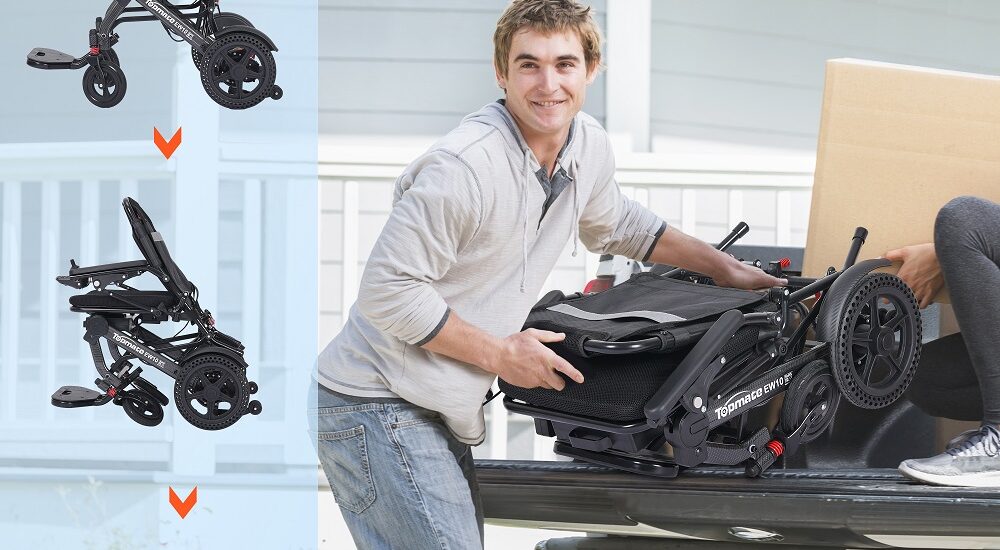
Step 4: Measure Folded Dimensions
If the scooter folds, measure it after folding it exactly as you will transport it.
Record:
- Folded length
- Folded width
- Folded height
- Folded weight
- Whether the battery remains installed
For example:
| Folded measurement | Example |
| Length | 30 inches |
| Width | 18 inches |
| Height | 16 inches |
| Weight | 62 lb |
A folded scooter with these dimensions may fit through a vehicle’s cargo opening even though its unfolded dimensions would not.
However, check the manufacturer’s folding procedure. Some scooters require the seat, basket, battery, or other components to be removed before folding.
Step 5: Measure Scooter Weight
Weight is one of the most important mobility scooter lift measurements.
Do not automatically assume the advertised scooter weight includes everything.
Manufacturers may publish:
- Scooter weight without battery
- Scooter weight with battery
- Battery weight separately
- Heaviest removable component
- Maximum user weight
For example:
Scooter chassis: 58 lb
Battery: 8 lb
Total assembled weight: 66 lb
If a lift has a 75-lb capacity, the 66-lb scooter leaves only 9 lb of theoretical capacity.
That is not necessarily enough if accessories or additional equipment will be carried on the platform.
The safest approach is to compare the actual transport weight with the lift’s rated capacity and follow the lift manufacturer’s instructions.
Step 6: Check the Lift or Ramp Weight Capacity
A lift’s maximum capacity must exceed the actual load it is designed to carry.
For a scooter weighing 66 lb, an example lift rated for 100 lb provides substantially more capacity than one rated for 75 lb.
Remember that the load may include:
Scooter + battery + permanently attached accessories + approved cargo
For example:
66 lb scooter
+ 5 lb basket and accessories
= 71 lb total load
A 75-lb platform would leave only 4 lb of capacity.
Never exceed the manufacturer’s stated capacity.
Also check whether the capacity changes depending on where the weight sits on the platform. Some lifts have loading-position restrictions.
Step 7: Check Ground Clearance and Ramp Angle
Ground clearance becomes particularly important when using a ramp.
A scooter does not simply travel upward along the ramp. Its wheels eventually transition between the ramp and the ground.
If the transition is too abrupt, the underside of the scooter can contact the ramp or ground.
How Ramp Length Affects Slope
A simple way to understand ramp steepness is:
Slope = vertical rise ÷ horizontal run
Suppose the vehicle cargo floor is 24 inches above the ground.
A 4-foot ramp provides:
24 ÷ 48 = 0.50, or a 50% rise-to-run ratio.
Now consider an 8-foot ramp:
24 ÷ 96 = 0.25, or a 25% rise-to-run ratio.
The longer ramp produces a shallower incline.
This is why a short ramp can be much steeper than a long ramp for the same vehicle height.
These are mathematical examples, not recommendations for a particular scooter. Always follow the ramp manufacturer’s maximum slope and the mobility scooter manufacturer’s loading instructions.
Do not assume that a scooter rated for a particular hill grade is automatically safe to load on a ramp at that same grade. Ramp use involves a different situation, and manufacturer instructions take priority.
Step 8: Measure the Vehicle Entry and Loading Space
When loading into a vehicle, measure the actual opening rather than relying on advertised cargo capacity.
Record:
- Door opening width
- Door opening height
- Cargo-floor length
- Cargo-floor width
- Available interior height
- Height from ground to cargo floor
- Obstructions such as seat backs or wheel wells
For example:
Vehicle cargo opening: 28 inches wide
Scooter folded width: 22 inches
That leaves 6 inches of nominal clearance.
But if the scooter must be rotated while entering the vehicle, the available maneuvering space may be much smaller than that figure suggests.
This is why a simple “will it fit?” measurement can be misleading.
Step 9: Compare the Measurements
Create a simple comparison before purchasing transportation equipment.
| Measurement | Example scooter | Transportation requirement |
| Length | 44 in | Platform ≥ 44 in |
| Width | 24 in | Platform ≥ 24 in |
| Height | 43 in | Vehicle clearance ≥ 43 in |
| Weight | 66 lb | Lift capacity > 66 lb |
| Ground clearance | 3.5 in | Compatible with ramp transition |
| Vehicle opening | 28 in | Scooter configuration must fit |
| Loading height | 24 in | Ramp length selected accordingly |
The numbers above are illustrative examples, not specifications for a particular scooter or vehicle.
Common Mobility Scooter Measurement Mistakes
Measuring the seat instead of the widest point
The seat may be narrower than the wheels or armrests.
Forgetting the battery
A published “scooter weight” may exclude a removable battery.
Measuring only the folded size
You still need the unfolded dimensions if the scooter will ever be loaded or unloaded unfolded.
Ignoring the tiller
The tiller can determine whether the scooter clears a vehicle opening.
Measuring the vehicle interior but not the door
A scooter might fit once inside but fail to pass through the opening.
Choosing a ramp based only on length
Ramp length must be evaluated against the loading height and the manufacturer’s permitted slope.
Ignoring accessories
Baskets, mirrors, armrests, and other components can increase dimensions or weight.
Choosing a Vehicle Lift
Suppose a scooter owner measures:
- Length: 44 inches
- Width: 24 inches
- Height: 43 inches
- Scooter plus battery: 66 lb
The owner finds a lift with:
- Platform: 48 × 28 inches
- Capacity: 100 lb
At first glance, the basic dimensions appear compatible:
48-inch platform > 44-inch scooter length
28-inch platform > 24-inch scooter width
100-lb capacity > 66-lb scooter weight
But the evaluation is not finished.
The owner must also verify:
- Hitch receiver compatibility
- Vehicle and lift manufacturer’s requirements
- Tie-down points
- Ground clearance
- Platform loading position
- Whether the scooter’s accessories interfere with the platform
- Whether the vehicle can safely carry the combined lift and scooter weight
A numerical match is only the first stage of compatibility.
Choosing a Loading Ramp
Suppose a vehicle’s cargo floor is 20 inches above the ground.
An owner is considering a 5-foot ramp, or 60 inches.
The simplified rise-to-run ratio is:
20 ÷ 60 = 0.33
A 10-foot ramp would produce:
20 ÷ 120 = 0.17
The longer ramp creates a gentler mathematical slope.
However, the correct ramp still depends on the manufacturer’s specified maximum slope, ramp design, scooter wheelbase, ground clearance, ramp width, surface, and loading method.
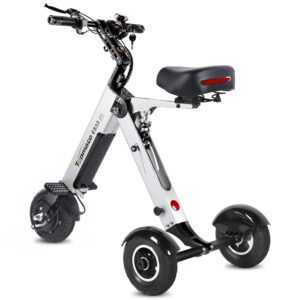
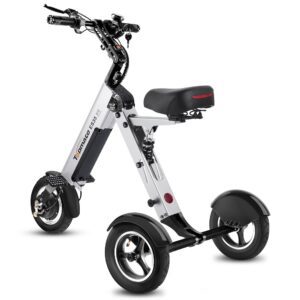
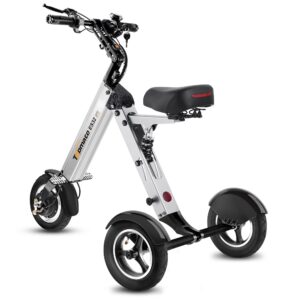
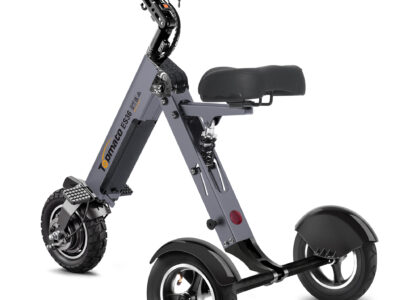
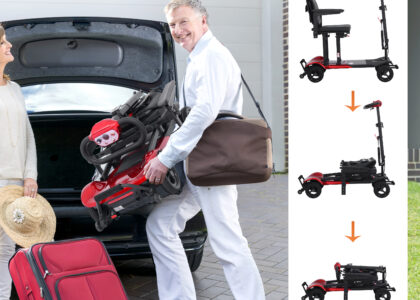
What About Foldable Mobility Scooters?
Foldable scooters can change the transportation equation because their folded dimensions may be considerably smaller than their normal riding footprint. measure mobility scooter for lift
TopMate’s ES15, for example, is designed as a folding mobility scooter and is marketed for transportation. Its manufacturer lists a maximum load capacity of 300 lb and a scooter weight of approximately 56.88 lb without the battery.
Those are manufacturer specifications. They should not be interpreted as confirmation that the ES15 fits a particular vehicle, ramp, or lift. The owner’s actual vehicle dimensions and transportation equipment specifications must still be checked.
FAQ
What measurements do I need before buying a mobility scooter lift?
Measure the scooter’s length, width, height, weight, ground clearance, wheelbase, and battery weight. If it folds, also record its folded length, width, and height.
How do I measure a mobility scooter for a car?
Measure the vehicle’s door opening, cargo-floor height, interior width, length, and available height. Compare these measurements with the scooter’s unfolded or folded dimensions, depending on how it will be transported.
How do I know if a mobility scooter ramp is long enough?
Measure the vertical distance from the ground to the loading surface and compare it with the ramp manufacturer’s recommended slope. A longer ramp generally creates a shallower incline for the same loading height.
Does mobility scooter weight include the battery?
Not always. Some manufacturers list the scooter’s weight without the battery and provide battery weight separately. Check the manufacturer’s specifications and calculate the total transport weight before choosing a lift.

-scaled-2-420x300.jpg)