
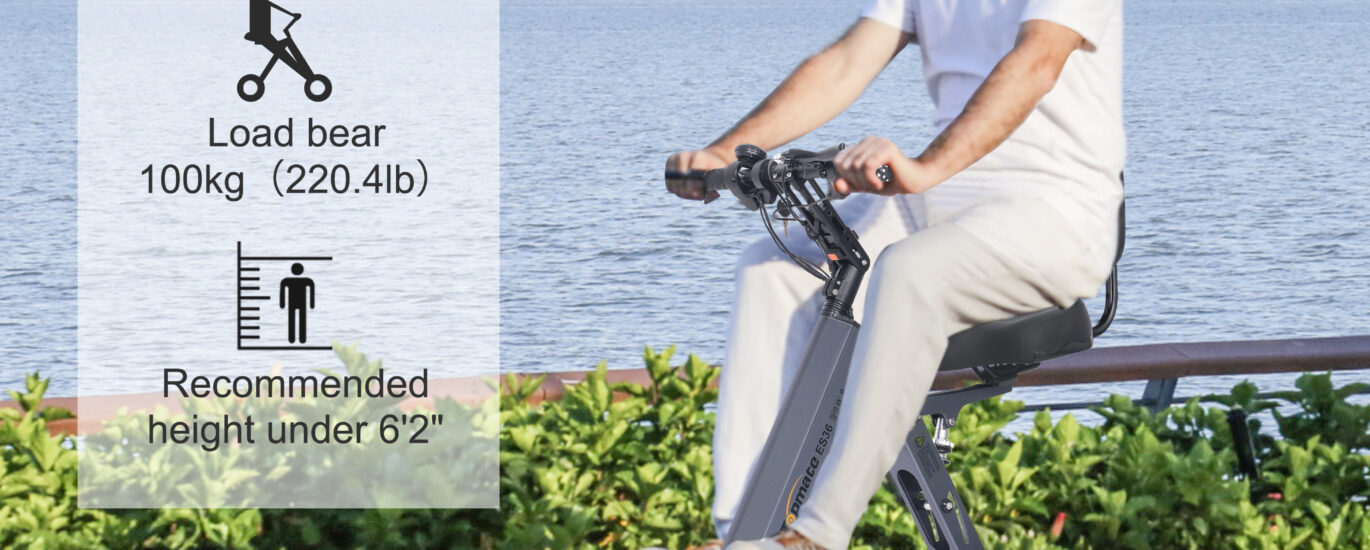
A mobility scooter can typically travel about 8 to 30+ miles on one charge, but there is no single range that applies to every scooter. Battery capacity, rider weight, terrain, speed, tire condition, temperature, and the scooter’s design all affect how far it can actually travel.
The more useful question is not simply “What is the maximum range?” It is “How much range do I need for the trips I actually make?”
A scooter advertised with a 20-mile range, for example, should not automatically be treated as a scooter that will reliably cover a 20-mile real-world journey. Manufacturer range figures are normally measured under particular conditions, while everyday trips include stops, hills, different surfaces, loads, and changing weather.
Quick Answer: How Many Miles Can a Mobility Scooter Travel?
Most mobility scooters are designed for a particular combination of portability, battery capacity, speed, and intended use. Compact travel scooters may have shorter ranges, while larger scooters with greater battery capacity can offer considerably more.
For planning purposes, choose a scooter whose published range comfortably exceeds your normal round-trip distance. That leaves room for detours, hills, weather, rider load, and battery aging instead of requiring you to use almost the entire rated range.
What Determines a Mobility Scooter’s Range?
Range is the result of several factors working together. Looking only at the battery’s amp-hour rating can give an incomplete picture.
Battery capacity
It is one of the first specifications to check.
Battery capacity may be expressed in amp-hours (Ah) or watt-hours (Wh). Watt-hours can be estimated by multiplying voltage by amp-hours:
Voltage × Ah = Wh
For example:
36V × 10Ah = 360Wh
A larger Wh figure generally means the battery stores more energy, but it does not guarantee a particular number of miles. Motor efficiency, scooter weight, rider load, terrain, speed, and other conditions still affect consumption.
Rider weight and cargo
The scooter is moving the combined load of the rider, scooter, and anything being carried.
A heavier total load can increase energy use, especially when starting, climbing slopes, or riding over surfaces that create more rolling resistance. Staying within the manufacturer’s stated weight capacity is important for both performance and safe operation.
Terrain and gradients
A flat paved route is very different from a route containing hills, grass, gravel, rough pavement, or repeated inclines.
If your usual trip includes several slopes, don’t plan your range using a perfectly flat test route. Local guidance also identifies rider weight, surface, gradients, and cold weather as factors that can reduce expected journey distance.
Speed and stop-start riding
Riding at the highest available speed can use more energy than maintaining a moderate, steady pace.
Frequent acceleration and braking can also affect consumption. This matters particularly in shopping areas, busy sidewalks, parking lots, and other places where you rarely travel continuously.
Tires and tire pressure
Tire condition matters because rolling resistance affects how much work the motor needs to do.
For scooters with pneumatic tires, maintain pressure according to the manufacturer’s instructions. UK government guidance for mobility scooters specifically recommends checking tire pressure regularly when considering vehicle roadworthiness and range.
Temperature and weather
Battery performance can change with temperature. Cold conditions can reduce available range, while wind can make the motor work harder.
Weather can also change the surface itself. Wet pavement, loose gravel, grass, or other difficult surfaces may require more careful and slower riding.
Battery age and condition
A scooter that once comfortably completed a particular trip may gradually provide less usable range as its battery ages.
If the range has dropped noticeably, don’t immediately assume that the battery is the only cause. Check tire condition, charging behavior, route conditions, load, and other maintenance factors first. If the reduction is substantial or sudden, the battery and scooter should be inspected according to the manufacturer’s guidance.
Is the Advertised Range the Range You Will Get?
Not necessarily.
An advertised range is best treated as a reference figure, not a promise that every rider will achieve the same distance.
Test conditions can differ from everyday riding. A controlled test may involve a particular rider weight, battery condition, speed, surface, and temperature. Your actual journey might include hills, multiple stops, extra cargo, wind, or colder temperatures.
That is why planning a trip right up to the scooter’s maximum claimed range is risky.
For example, if a person’s regular round trip is 10 miles, choosing a scooter advertised at exactly 10 miles leaves little room for an unexpected detour or more demanding conditions.
How Much Range Do You Really Need?
Start with your actual routine rather than an arbitrary mileage target.
| Typical use | What to consider |
|---|---|
| Short errands nearby | A compact scooter may provide sufficient range |
| Grocery shopping | Allow extra range for the journey around the store or shopping area |
| Several errands in one day | Add the distances together before choosing a scooter |
| Neighborhood trips | Include hills, crossings, and route changes |
| Full-day outings | Consider both battery range and access to charging |
| Travel and vacations | Balance range with folding, carrying, storage, and charging convenience |
Example: A normal errands day
Suppose someone rides:
- 2 miles from home to a shopping area
- 1 mile between two nearby locations
- 2 miles to another destination
- 3 miles back home
That’s an 8-mile day, not a 3-mile trip.
Planning only for the longest individual leg would underestimate the actual battery requirement.
It is also worth remembering that a person may make additional short movements during the day. A shopping center, medical facility, hotel, or large attraction can add distance even when the main destination is relatively close to home.
What About Travel in a Car, SUV, or Airplane?
For people who transport their scooter, maximum range is only one part of the decision.
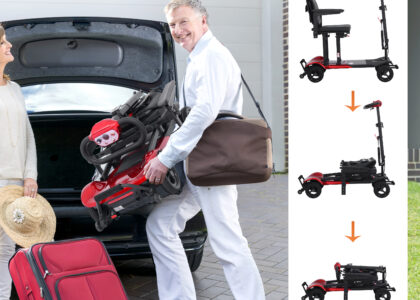
A scooter may offer plenty of range but still be inconvenient if it is difficult to lift, fold, or store.
Someone living in a small apartment may prioritize folded size and carrying weight because the scooter has to be stored without blocking a doorway. Someone who travels by SUV may have more storage room but still need to consider the actual lifting weight and where the scooter sits during loading.
This is where travel-oriented models can make sense.
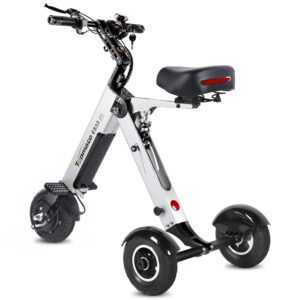
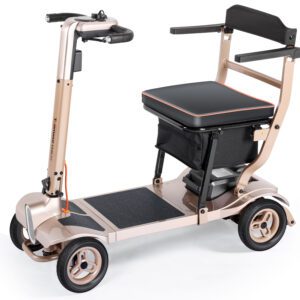
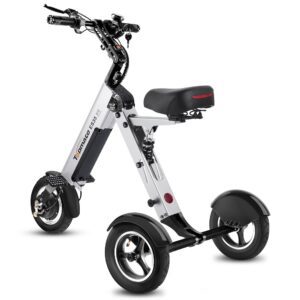
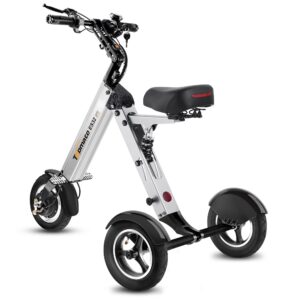
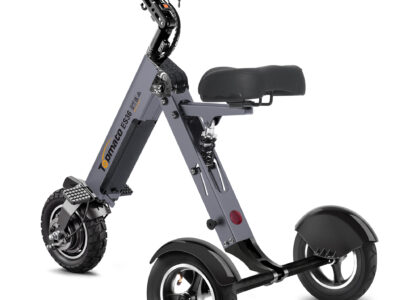
The TopMate ES15 is positioned around lightweight portability and frequent transportation. The ES35 is aimed more toward everyday use while retaining portability, while the ES36 combines everyday usability with an emphasis on comfort and stability. The ES40 is particularly travel-focused, with a folding four-wheel design and removable battery.
For example, TopMate currently lists the ES40 at 38.36 lb without the battery, with a published range of approximately 9–11 miles. Its removable 24V 10.4Ah lithium battery can also be charged separately.
The ES35 is listed with a 36V 7.8Ah removable lithium battery and a published maximum range of 15.53–18.64 miles. The ES36 uses the same stated 36V 7.8Ah battery and has a published range of approximately 15.5–18.6 miles. Actual range will vary with riding conditions.
These figures illustrate why comparing scooters by range alone can be misleading. A travel scooter with a shorter published range may be more practical for someone who needs to load it into a car frequently.
What If You Need More Range During the Day?
There are several ways to plan for a longer outing.
Leave a battery reserve
Don’t make your normal route dependent on reaching the advertised maximum.
A reserve gives you more flexibility if you encounter a hill, take a wrong turn, stop frequently, or travel farther than expected.
Check whether the battery is removable
A removable battery can make charging away from home more convenient when the scooter and charging location are separated.
However, always follow the manufacturer’s charging instructions and check the rules of the location where you intend to charge.
Identify charging opportunities
For a hotel, shopping center, cruise, workplace, or other destination, confirm in advance whether charging is permitted and where an appropriate electrical outlet is available.
Never assume that a public location will allow scooter charging.
Carry the correct charger
For longer trips, the charger can be just as important as the battery itself. Before leaving home, check the charger, cable, connector, and charging indicator.
Government battery-safety guidance recommends using the supplied or manufacturer-authorized charger and following the manufacturer’s charging and storage instructions.
How Can You Get More Usable Range?
You cannot turn a short-range scooter into a long-range scooter simply through riding technique, but good habits can help you use its available capacity efficiently.
- Keep pneumatic tires at the recommended pressure.
- Avoid carrying unnecessary weight.
- Use a steady speed when practical.
- Avoid unnecessary hard acceleration.
- Choose smoother routes when suitable.
- Keep the battery properly maintained.
- Charge according to the manufacturer’s instructions.
- Check the scooter before a longer journey.
Before a long trip, a short test ride can also reveal problems that might otherwise appear several miles from home. A pre-travel inspection should include the battery, charger, tires, brakes, controls, and folding mechanism.
Common Range-Planning Mistakes
Choosing the scooter with the biggest number
The highest published range is not automatically the most practical option. A larger scooter may be heavier and harder to transport or store.
Planning right up to the maximum range
If your trip requires nearly every advertised mile, there is little room for real-world variation.
Forgetting the return journey
A destination may be only 5 miles away, but a round trip is approximately 10 miles before adding any additional riding. mobility scooter range
Ignoring the route
Two journeys of the same distance can use different amounts of battery. A flat paved route and a hilly route should not be treated as equivalent.
Confusing battery life with travel range
“Battery life” can refer to how long a battery lasts before replacement, while range refers to how far the scooter can travel on a charge. These are different questions.
If your concern is that your scooter is suddenly getting fewer miles than it used to, that is a battery-performance or range-troubleshooting question rather than simply a buying question.
A Simple Way to Choose the Right Range
Before buying, write down three numbers:
1. Your longest normal one-way trip
2. Your typical round-trip distance
3. The extra distance you might realistically travel during the day
Then compare that total with the manufacturer’s published range.
For example, if your normal day requires 8 miles, don’t automatically select an 8-mile scooter simply because the specification matches the calculation. Give yourself a sensible reserve.
At the same time, don’t automatically pay for or carry the extra weight of a much larger scooter if your everyday trips are short and portability is a major priority.
The right balance depends on how you actually use the scooter.
Final Takeaway
A mobility scooter can travel roughly 8 to 30+ miles on one charge, depending on its battery, design, load, speed, terrain, weather, and condition. The published range is useful for comparing models, but it should not be treated as a guaranteed everyday distance.
For most buyers, the practical approach is to calculate the distance of a normal round trip, add room for unexpected riding, and then compare scooters based on range, portability, weight, storage, charging, and the terrain you actually use.
A person who makes short local trips may benefit more from a compact, easy-to-transport scooter than from carrying a much larger battery every day. Someone spending hours outdoors may place greater value on additional range and charging flexibility. mobility scooter range
The goal is not to find the biggest range number. It is to choose enough usable range for your routine without giving up the portability and practicality you need.
FAQ
How far can a mobility scooter go on one charge?
A mobility scooter can travel roughly 8 to 30+ miles on one charge, depending on the model and riding conditions. Battery capacity, rider weight, terrain, speed, tire pressure, temperature, and battery condition can all affect the actual distance. Always treat the manufacturer’s published range as a reference rather than a guaranteed everyday distance.
Can a mobility scooter travel 20 miles on one charge?
Yes, some mobility scooters have a published range of 20 miles or more, but whether they can actually complete a 20-mile trip depends on conditions. Hills, rider weight, cargo, temperature, speed, and battery age can reduce usable range. For a 20-mile outing, it is safer to choose a scooter with additional range rather than planning to use its maximum capacity.
Does rider weight affect mobility scooter range?
Yes. The total load carried by the scooter can affect energy consumption. A heavier rider or additional cargo can require more power, particularly when accelerating or climbing hills. Staying within the manufacturer’s weight limit is important. Range should therefore be considered together with the scooter’s rated load capacity and the terrain where it will be used.
How do I know how much mobility scooter range I need?
Start with your longest normal round trip and add the extra distance you may travel during the day. For example, an 8-mile daily routine should not necessarily be matched with a scooter advertised for exactly 8 miles. A reserve allows for detours, hills, additional errands, and changes in riding conditions.

-scaled-2-420x300.jpg)