You are on your way to a local shop when the pavement suddenly slopes into a driveway. The transition looks manageable from a distance, but the edge is sharper than expected, and a parked car limits the space available to manoeuvre. Should you continue, change your approach, or find another way?
For anyone using a mobility scooter, mobility scooter curb ramps require more than a quick glance. A transition that a pedestrian can step over easily may affect a scooter’s wheels, underside clearance, traction, and stability. Knowing how to assess the surface—and when to avoid it—can help you make safer decisions throughout an everyday journey.
Identify the Transition Before Approaching
Not every pavement transition is designed for the same purpose. Recognising the difference helps you decide what to check next.
Properly designed curb ramps and dropped kerbs
These provide a sloping connection between the pavement and the road or crossing area. A well-maintained, accessible ramp generally offers a more gradual transition than a standard curb. However, its slope, width, surface, and landing space must still suit your scooter.
Sloping driveway entrances
A driveway may cross the pavement at an angle, creating a dip, a raised lip, or a sudden change in slope. Some entrances are smooth, while others have a sharp break where the driveway meets the footpath.
Raised pavement edges and abrupt height changes
A raised slab, broken curb, or missing section of paving can create a near-vertical edge. Do not assume a scooter can climb it because the height looks small. Unless the manufacturer explicitly confirms that the obstacle falls within the scooter’s capabilities, do not attempt to mount it.
Damaged ramps and contaminated surfaces
Cracked concrete, loose paving stones, potholes, gravel, wet leaves, and standing water can make an otherwise usable transition hazardous. Water may also hide a hole or damaged edge.
A ramp’s appearance does not prove that it is safe for your scooter. Check the actual surface and geometry, not just whether a sloping section exists.
Pause and Assess: A Six-Point Check
Before moving onto a transition, stop in a safe position and assess six things.
Slope: Does the ramp rise or fall gradually, or does it change angle abruptly? Consider both the incline and any sideways slope across the pavement. Follow the scooter manufacturer’s limits for gradients and operating conditions.
Width: Is there enough room for the entire scooter, including its wheels, without clipping an edge or nearby obstacle? Allow for the space needed to steer and exit the transition.
Surface: Is the concrete firm and intact? Look for loose stones, slippery leaves, broken edges, standing water, and anything that could affect wheel grip.
Alignment: Can you approach without making a sudden turn? Check whether the path allows a controlled line through the transition without entering traffic or striking an obstacle.
Landing space: What happens immediately after the ramp? A narrow landing beside a wall, parked vehicle, bollard, or steep drop may leave insufficient room to straighten the scooter or stop safely.
Traffic and visibility: Can drivers and pedestrians see you? At a driveway, vehicle movements may create an additional hazard even when the ramp itself appears suitable.
If any part of the assessment raises serious doubts, stop and choose another route. Do not use forward momentum to test an unfamiliar edge. If you need assistance, seek it only when someone can help safely without placing either person in danger.
What Your Scooter’s Design Can Tell You
A scooter’s specifications help establish its limitations, but no single measurement guarantees that a transition is safe.
- Ground clearance: This is the space beneath the scooter’s lowest relevant component. Limited clearance can allow the frame or underside to strike the pavement when the scooter passes over a sharp change in angle.
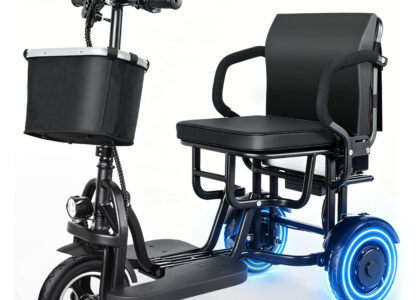
- Wheel size and configuration: Wheel diameter influences how a wheel responds to an edge. Three-wheel and four-wheel designs also behave differently when the ground slopes or one wheel encounters a raised section.
- Wheelbase: The distance between the front and rear axles affects how the scooter moves across changes in elevation. A short wheelbase does not automatically make a scooter better at crossing sharp transitions.
- Stability and turning space: The scooter needs sufficient room to approach and leave the ramp without a sharp turn. A narrow passage may prevent a safe manoeuvre even when the ramp itself is wide enough.
- Braking performance: The scooter must remain controllable on the relevant surface and slope. Wet pavement, loose material, and downhill travel can change how confidently it stops.
- Rated slope capability: Check the manufacturer’s maximum gradient and operating instructions. A published slope rating does not automatically establish that the scooter can negotiate a sharp driveway break or raised pavement edge.
Read the manual for the exact model you use. If the manufacturer does not document the relevant obstacle or operating condition, ask for clarification rather than guessing. Never exceed the stated limits or assume that a compact folding scooter can manage a curb simply because it is portable.
Four Everyday Situations, Four Different Decisions
Scenario A: A smooth dropped kerb at a pedestrian crossing
The kerb slopes gradually, the surface is dry, and there is enough space on both sides.
Check for cracks, drainage channels, road traffic, and the condition of the landing area. If the transition falls within your scooter’s documented capabilities, follow the manufacturer’s instructions and use a controlled, deliberate approach. Do not enter the crossing until traffic conditions and local crossing rules permit it.
If the ramp is damaged or the slope exceeds the scooter’s limits, use another accessible crossing.
Scenario B: A steep driveway with a sharp change in angle
The driveway slopes down to the road, but its entrance has a pronounced lip.
The issue is not just steepness. The sudden angle change may bring the scooter’s underside close to the ground, affect wheel contact, or make the scooter difficult to control. A scooter that can manage a gradual incline may still be unsuitable for this transition.
Do not try to overcome the lip by accelerating or rocking the scooter. Find a gentler, accessible route if the manufacturer has not confirmed that the transition is suitable.
Scenario C: A narrow ramp beside parked cars
The ramp looks smooth, but a parked vehicle leaves little room to line up with it.
Check whether you can approach and leave the ramp without making a sharp turn, scraping the scooter, or moving into live traffic. Also consider whether another vehicle could arrive while you are crossing.
If you cannot manoeuvre within the available space, do not squeeze through simply because the ramp is technically wide enough. Choose a less obstructed crossing or another route.
Scenario D: A wet or damaged transition after rain
Rain has left water and leaves around the bottom of a dropped kerb, and one corner of the concrete appears broken.
Water can conceal surface damage, while wet leaves and loose debris may reduce traction. The broken corner may also catch a wheel or create an uneven path.
Avoid the affected section when you cannot judge its condition or maintain control. Wait for a safer opportunity or use another route rather than testing whether the scooter can cross it.
Common Mistakes That Make Transitions More Hazardous
Rushing to clear the ramp: Hurrying can leave too little time to recognise a change in slope or a pedestrian entering the path. Assess the transition before moving.
Turning sharply on an incline: A sharp turn can change the scooter’s stability and steering response. If the route requires a turn on a slope, consider whether there is a safer alternative rather than assuming the manoeuvre is manageable.
Trusting an unfamiliar edge: A transition that looks shallow from the seat may have a sharper break than expected. Check it from a safe position before approaching.
Carrying bags that interfere with control: Shopping bags hanging from the handlebars can obstruct steering or shift unexpectedly. Secure items as the manufacturer recommends and stay within the scooter’s load limit.
Copying another rider: Different scooters have different clearances, wheels, braking systems, and documented limits. Another rider’s successful crossing does not prove your scooter can make the same manoeuvre safely.
Treating every dropped kerb as accessible: A ramp may be too steep, narrow, damaged, or poorly positioned for your needs. Accessibility depends on the complete route, including the landing area and surrounding traffic.
Before Your Next Journey: A Practical Checklist
Before leaving home, remember to:
- Plan a route with maintained, accessible crossings where possible.
- Check the scooter manual for gradient limits, ground clearance, braking guidance, and restrictions on obstacles.
- Inspect unfamiliar ramps and driveway entrances before approaching.
- Keep shopping bags and other items secured and controls unobstructed.
- Allow enough room to approach, cross, and exit without a sudden turn.
- Avoid wet, broken, slippery, or obstructed transitions when safety is uncertain.
- Identify an alternative crossing or route before committing to a difficult section.
- Follow local accessibility and road-use rules.
If a pavement transition is repeatedly unsafe, consider reporting the defect to the relevant council or local authority. An accessible route should not depend on riders taking risks to get past a broken pavement.
Make Route Choice Part of Safe Riding
Curb ramps and pavement transitions vary considerably, even along the same street. A smooth dropped kerb may be suitable for one scooter, while a sharp driveway lip or narrow, wet ramp may be unsuitable for another.
The safest decision begins with observation, a clear understanding of the scooter’s documented limits, and enough space to manoeuvre. When the transition is uncertain, choosing another route is not a failure to ride confidently. It is a practical way to protect your independence without taking an unnecessary risk.
FAQ
Should I inspect a curb ramp before every journey?
Inspect unfamiliar ramps and check familiar ones when conditions change, such as after heavy rain or roadworks. Look for new cracks, debris, standing water, and obstructions. Reassess any transition that appears different from your previous visit.
Can a caregiver help me cross a difficult pavement transition?
A caregiver can help assess the route or locate an accessible alternative. They should not push, pull, lift, or tilt an occupied scooter unless the manufacturer explicitly provides a safe procedure for that specific situation. Follow the scooter’s instructions and seek appropriate assistance when needed.
What should I do if my regular route has no usable dropped kerb?
Look for another accessible crossing or route that avoids the hazardous edge. If no safe option is available, postpone the journey or arrange suitable assistance. Report the missing or defective provision to the relevant local authority.
Are curb ramp requirements the same in every country?
No. Accessibility standards and road-use rules differ between the USA, UK, Canada, Australia, and individual local jurisdictions. A ramp that meets one local standard is not automatically suitable for every scooter or rider. Follow local guidance and your scooter manufacturer’s instructions.