Direct Answer
Mobility scooter seat height affects how easily you can sit down, stand up, position your feet, reach the controls, and maintain a stable riding posture. The correct height depends on your lower-leg length, footwear, cushion thickness, transfer needs, and the scooter’s footwell and tiller geometry—not simply your overall height.
What Mobility Scooter Seat Height Actually Means
Mobility scooter seat height generally describes the vertical distance between the floor and the seating surface. However, manufacturers may measure that distance from different reference points.
For example, one specification might measure to the seat base, while another could measure to the top of the cushion. Cushion compression can also change the effective height once you sit down. Research on wheeled mobility equipment has shown that the measurement point can produce substantially different seat-height results, making the manufacturer’s measurement method important when comparing scooters.
For practical fitting, think about seat-to-floor height while you are actually sitting on the scooter, rather than relying only on an unloaded specification.
Your overall height provides useful context, but it does not determine the correct position by itself. Two riders who are the same height may have different lower-leg lengths, hip proportions, flexibility, and transfer requirements.
That is why a proper mobility scooter seat height guide considers several body measurements together.
How Seat Height Is Measured
Place the scooter on a firm, level floor before taking measurements.
Measure vertically from the floor to the point where your body actually rests on the seat. If the cushion compresses significantly under your weight, the occupied height may differ from the unloaded measurement.
A useful body measurement is the distance from the sole of the foot to the back of the knee while seated naturally. This measurement helps establish how the rider’s lower legs relate to the scooter’s foot area and seating surface. Mobility seating guides also use lower-leg and heel-to-knee measurements when assessing seat height.
Seat Height Measurement Formula
A practical starting point is:
Target seat height ≈ floor-to-back-of-knee measurement + footwear allowance − cushion compression adjustment
This is only a starting point. The scooter’s footwell, deck height, seat construction, and steering layout can change the final fit.
For that reason, treat the formula as a measurement aid rather than a universal prescription.
Typical Seat-Height Ranges
There is no single correct mobility scooter seat height for every rider or scooter category.
Research involving wheeled mobility devices found occupied seat heights extending across a broad range, with one study recommending an adjustable range of approximately 17 to 25 inches (43.2 to 63.5 cm) for wheeled mobility seating and transfer surfaces. That research covered several types of wheeled mobility equipment, so the figures should not be interpreted as a universal specification for every mobility scooter.
As useful conversion points:
- 17 inches = 43.2 cm
- 18 inches = 45.7 cm
- 20 inches = 50.8 cm
- 22 inches = 55.9 cm
- 24 inches = 61.0 cm
- 25 inches = 63.5 cm
Some mobility-scooter fitting guides describe around 20 inches (50.8 cm) as a common seat-height reference, but individual scooter designs and rider measurements vary considerably.
The important point is not to select a number simply because it falls within a typical range. Compare the actual specification with your body measurements and transfer requirements.
Seat Height vs Rider Leg Length
What is the correct mobility scooter seat height?
The correct position allows your feet to rest securely while your knees remain in a comfortable position. Your hips should stay supported, and you should be able to reach the tiller without leaning excessively forward.
Check these points when sitting on a scooter:
- Both feet should have stable support.
- Your knees should not press against the tiller or steering column.
- Your thighs should receive adequate support.
- Your hips should remain comfortably positioned against the seatback.
- You should not need to slide forward to place your feet correctly.
- The tiller should remain reachable without excessive shoulder or back movement.
Seating assessments commonly consider lower-leg length, knee-to-seat depth, foot position, and other body measurements rather than relying on overall height alone.
Can a mobility scooter seat be too low?
Yes. A very low seat can increase the effort required to stand, especially when transferring from the scooter to a higher surface. It may also raise the knees relative to the hips and change the rider’s relationship with the tiller.
For someone who frequently transfers from a dining chair, bed, or vehicle seat, the difference between the two seating surfaces can be particularly important.
Can a mobility scooter seat be too high?
Yes. Excessive seat height can make it harder to place both feet securely and may increase the effort or instability involved in stepping down during a transfer.
A higher seat can also change the rider’s reach to the tiller. Therefore, increasing seat height is not automatically an improvement for a rider who finds a low position difficult.
Seat Width, Depth and Legroom: Related Measurements
Seat height works together with mobility scooter seat width, depth, and legroom. A scooter can have an appropriate seat height yet still provide a poor fit if the other dimensions are wrong.
Seat width
Measure the widest part of your hips while seated. Compare that measurement with the scooter’s usable seat width.
A small amount of additional space allows normal clothing and movement. Several mobility seating guides recommend adding approximately 1 to 2 inches (2.5 to 5 cm) to the measured body width when determining an appropriate seat width.
Avoid choosing an excessively wide seat, however. Too much space can allow the rider to shift sideways instead of maintaining a stable central position.
Seat depth
Seat depth extends from the rear of the seating surface toward the front edge.
Measure from the back of your sitting area to the back of your knee. A common seating reference is to leave roughly 1.5 to 2 inches (3.8 to 5.1 cm) between the front edge of the seat and the back of the knee.
Too much depth can press against the backs of the knees. Too little depth reduces thigh support.
Legroom
Legroom describes the available space between the seating area, steering assembly, and foot support.
Check whether you can position both feet naturally without:
- Pressing your knees against the tiller
- Turning your legs outward excessively
- Sliding forward on the seat
- Losing stable foot support
- Restricting steering movement
This is particularly important for taller riders because overall scooter dimensions do not necessarily indicate how much usable legroom the rider will have.
How Seat Height Affects Transfers
Seat height has a direct relationship with transfer effort.
If your scooter seat and your usual transfer surface sit at similar heights, you may need less vertical movement to transfer between them. Research into wheeled mobility seating has found that matching the heights of transfer surfaces can reduce the effort required for transfers.
Try this practical assessment before buying:
Sit down: Can you lower yourself onto the scooter without dropping heavily into the seat?
Stand up: Can you rise without pulling strongly on the tiller?
Pivot: Can you turn your body safely when getting on or off?
Foot placement: Do your feet reach their normal position immediately?
If the scooter requires awkward movements during these steps, the seat height or overall seating configuration may not suit you.
How Seat Height Affects Visibility and Control
Changing seat height also changes your relationship with the scooter’s controls.
A higher position can raise your eye level, which may change how you view pedestrians, counters, vehicle surroundings, and nearby obstacles. However, visibility should never be evaluated independently from control reach.
Your arms should reach the tiller without excessive forward leaning. Your knees should have enough clearance for steering movements. Meanwhile, your feet should remain stable while you operate the controls.
A suitable mobility scooter seat position therefore balances three things: body support, visibility, and control access.
Fixed vs Adjustable Seat Positions
Some scooters use a fixed seating position, while others provide adjustment through the seat post or another mechanism.
An adjustable seat can help accommodate differences in lower-leg length and transfer height. Some models also provide forward/backward seat movement, swivel functions, or adjustable backrests.
However, adjustment does not guarantee a good fit.
For example, raising the seat may improve transfer height but reduce knee clearance. Moving the seat forward may improve tiller reach but reduce available legroom. Each adjustment changes the relationship between the rider and the scooter.
Always make adjustments according to the manufacturer’s instructions and confirm that the seat locks securely before riding.
What Specifications to Compare Before Buying
Do not compare seat height in isolation. Create a simple fit profile using these specifications:
| Specification | What to evaluate |
|---|---|
| Seat height | Floor to seating surface |
| Seat width | Usable side-to-side seating space |
| Seat depth | Rear of seat to front edge |
| Tiller height | Relationship between controls and rider |
| Overall height | Total scooter height |
| Legroom | Knee and foot clearance |
| Seat adjustment | Available height or position changes |
| Weight capacity | Maximum permitted rider and cargo weight |
| Foot support | Position and usable space for both feet |
Also ask how the manufacturer measured each dimension. A published seat height is difficult to compare accurately if one company measures to the cushion top and another measures to the seat base.
TopMate Model Considerations
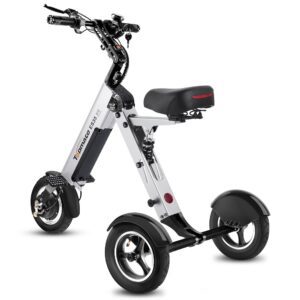
TopMate model specifications should be checked individually rather than inferred from photographs or overall dimensions.
For example, TopMate’s published documentation lists the ES35 unfolded dimensions as 99 × 57.5 × 92.5 cm (38.98 × 22.6 × 36.42 inches). The published ES33 documentation lists unfolded dimensions of 94.5 × 53 × 91 cm (37.2 × 20.8 × 35.8 inches).
These figures describe overall scooter dimensions. They do not represent seat height, so they should not be used as a substitute for a seat-to-floor measurement.
If seat fit is a deciding factor, check the current model documentation or contact TopMate for the exact seat-height measurement and ask whether the measurement refers to the seat base, cushion surface, or occupied seating position.
The same principle applies to seat width, depth, and legroom. Never estimate these dimensions from overall scooter size.
FAQ
What is the correct mobility scooter seat height?
The correct mobility scooter seat height allows your feet to rest securely, keeps your knees in a comfortable position, supports an upright posture, and makes transfers manageable. Lower-leg length and scooter footwell design are more important than overall rider height alone.
How high should a mobility scooter seat be?
There is no universal seat height for every rider. Measure your lower-leg length, compare it with the scooter’s seat-to-floor measurement, and consider your footwear, cushion thickness, legroom, and usual transfer surface.
Can a mobility scooter seat be too high or too low?
Yes. A seat that is too low can make standing transfers more difficult, while a seat that is too high can make stepping down harder and affect foot placement. The ideal position depends on the rider’s measurements and scooter design.
How do you measure mobility scooter seat height?
Place the scooter on a level floor and measure vertically from the floor to the seating surface. Check how the manufacturer defines the measurement because seat-base height and cushion-top height can produce different results.

-scaled-2-420x300.jpg)