Quick Answer
The TopMate ES15 is a strong choice for indoor use when you need maneuverability, a higher weight capacity, and a folding design that can also handle trips outside the home. The ES35 is better suited to riders who frequently need to lift and transport their scooter, while the ES36 makes more sense when a comfortable, stable ride and occasional outdoor surfaces matter. The right choice depends less on maximum range and more on how the scooter fits your home and daily routine.
Which TopMate Scooter Is Best for Indoor Use?
Indoor mobility is different from riding around a neighborhood or park. At home, you may need to turn between furniture, pass through doorways, use an elevator, park near a dining table, or maneuver around a kitchen counter. In a shopping center or medical building, the same scooter may need to handle narrow aisles, automatic doors, elevators, and crowded walkways.
That changes what you should prioritize.
For mostly indoor use, look closely at:
- Overall scooter width and length
- How easily it steers at low speed
- Turning space available in your home
- Folded size for storage
- Weight if someone needs to lift it
- Rider weight capacity
- Seat and riding position
- Battery charging arrangements
- Whether you will also use it outdoors
There is no single specification that determines whether a mobility scooter will work well indoors. A scooter that is easy to carry may not offer the same weight capacity or outdoor capability as a heavier model.
For TopMate buyers, the ES15, ES35, and ES36 illustrate these different priorities particularly well.
What Matters Most for Indoor Riding?
1. Maneuverability
A scooter does not need to be extremely fast indoors. In fact, a lower speed is usually more practical around furniture, people, pets, and doorways.
Three-wheel designs can be useful in situations where the rider needs to make frequent turns. However, maneuverability depends on the complete design, not simply the number of wheels.
2. Storage Space
Storage can become a bigger issue than riding space.
Someone living in a small apartment may have enough room to ride a scooter through the main rooms but nowhere convenient to leave it when it is not being used.
However, do not measure only the available storage area. Check the folded scooter’s dimensions and consider whether you can comfortably move the folded unit into that space.
3. Weight and Lifting
“Lightweight” means something different depending on who is moving the scooter.
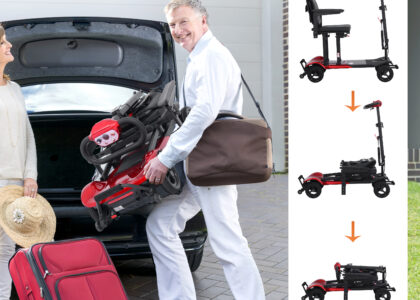
A rider who stores the scooter in an apartment may never need to lift it. Someone who keeps it in the trunk of a car may need to lift it every time they go shopping.
The current TopMate specifications illustrate the difference between models. The ES15 is listed at 56.88 lb without the battery, while the ES35 is listed around 35.5–37.5 lb, depending on the current documentation. The ES36 is listed at about 39.2 lb.
That does not automatically make the lightest scooter the best indoor option. It simply means that transport and lifting should be part of the decision.
If you cannot comfortably lift the scooter, consider whether another person will help or whether you can charge and store it without moving the entire unit.
TopMate Indoor Scooter Comparison
| Model | Best suited to | Published weight | Max load | Main advantage for indoor use |
|---|---|---|---|---|
| TopMate ES15 | Indoor use plus frequent transport/outdoor trips | 56.88 lb without battery | 300 lb | Maneuverable three-wheel design and higher capacity |
| TopMate ES35 | Everyday indoor use plus regular transportation | Approx. 35.5–37.5 lb | 220.5 lb | Lower transport weight and folding design |
| TopMate ES36 | Indoor use with greater emphasis on comfort/stability and outdoor capability | Approx. 39.2 lb | 220.5 lb | Comfortable everyday riding and larger pneumatic front tires |
| TopMate ES40 | Indoor use combined with travel | 38.36 lb without battery | 275.6 lb | Four-wheel folding design and compact folded profile |
The published specifications show why it is difficult to declare one model the winner for every indoor environment. The ES15 prioritizes capacity and a more substantial platform, the ES35 emphasizes portability, the ES36 adds comfort and outdoor-oriented tires, and the ES40 is particularly travel-focused.
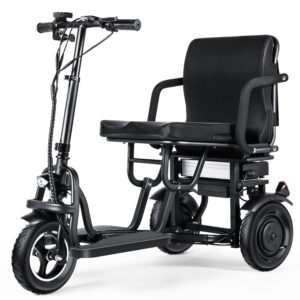
TopMate ES15: Best When Indoor Use Is Part of a Bigger Routine
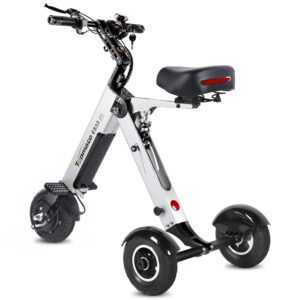
The TopMate ES15 is a good fit for someone who wants an indoor-friendly scooter but does not want to limit the scooter to indoor use.
It has a three-wheel configuration, three 10-inch pneumatic tires, dual 250W motors, a 300-lb maximum load, and a removable 36V 7.8Ah lithium-ion battery. TopMate lists a range of approximately 16–19 miles under its stated testing conditions.
For indoor use, the most relevant features are not the maximum speed or range. Instead, consider the combination of:
- Three-wheel layout
- Adjustable speed settings
- Removable battery
- Padded seat and backrest
- Folding construction
- 300-lb maximum load
The higher weight capacity can make the ES15 particularly relevant to riders who need more capacity than some lighter portable models provide.
There is a trade-off, though: at 56.88 lb without the battery, it is considerably heavier than the ES35 or ES36. If you live alone and regularly need to lift the scooter into a car, that difference matters.
Best indoor scenario: You use the scooter around the house, in stores, and at medical appointments, but you also want one scooter capable of handling regular outdoor trips.
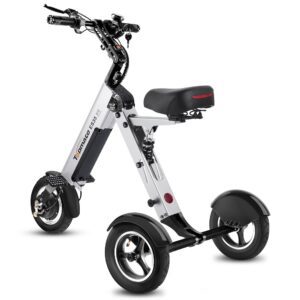
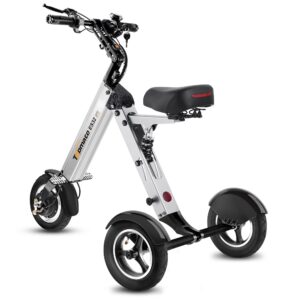
TopMate ES35: Best When Portability Matters Every Day
The TopMate ES35 takes a different approach.
It weighs approximately 35.5–37.5 lb depending on the published version, supports up to 220.5 lb, uses a removable 36V 7.8Ah lithium battery, and has a three-wheel folding design. Its published range is approximately 15.53–18.64 miles.
That lower transport weight can matter more than range for some indoor users.
Consider someone who lives in a condo and drives to a shopping center twice a week. They may use the scooter indoors at home only occasionally, but they need to fold and lift it every time they leave. In that situation, reducing the amount of weight to handle can make the scooter easier to incorporate into the routine.
The ES35 is also positioned for everyday use, commuting, shopping, and short trips rather than being limited to indoor riding.
Best indoor scenario: You want a folding scooter for daily mobility and expect to transport it regularly by car.
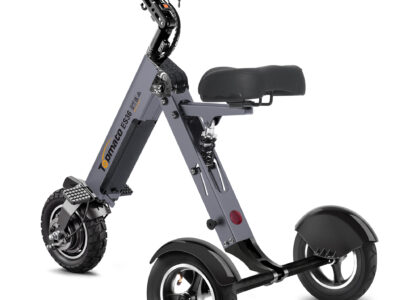
TopMate ES36: Best for Comfort and a More Stable Everyday Ride
The TopMate ES36 is worth considering when indoor mobility is only part of the picture and riding comfort matters more.
TopMate lists the ES36 at approximately 39.2 lb, with a 220.5-lb maximum load, a removable 36V 7.8Ah battery, and a published range of approximately 15.5–18.6 miles. It also uses 10-inch off-road pneumatic front tires and an extended rear anti-tip axle.
Those outdoor-oriented features are not necessarily required for a living room or hallway. They become more useful when the route from your home to the destination includes sidewalks, driveways, maintained uneven surfaces, or other outdoor areas.
For example, someone living in a retirement community may ride from an apartment to a dining hall, community center, or nearby store. In that situation, indoor maneuverability still matters, but the scooter may spend just as much time outside as inside.
Best indoor scenario: You want a scooter for everyday mobility where indoor riding is combined with outdoor paths and you place greater emphasis on comfort and stability.
What About the TopMate ES40?
The TopMate ES40 is not the first model I would choose solely for indoor use, but it becomes more interesting when indoor mobility is part of a broader travel routine.
It is a four-wheel folding scooter weighing 38.36 lb without the battery, with a 275.6-lb maximum load and a folded size of approximately 40.16 × 18.1 × 16.5 inches. TopMate’s manual lists a turning radius of no more than 1,200 mm and 75 mm of ground clearance.
The four-wheel layout and anti-tip wheels can be useful for riders who prefer that configuration, while its folding design makes it practical for transportation.
The important distinction is positioning: the ES40 is primarily a travel-focused folding scooter. It can work indoors, but its value becomes clearer when the same scooter needs to go into a vehicle, on vacation, or on a cruise.
Best indoor scenario: Your indoor scooter also needs to function as a compact travel scooter for vacations, cruises, and sightseeing.
Real-Life Indoor Use: Which Model Fits?
If you live in a small apartment
Do not start with range.
Measure the areas where you will actually ride and store the scooter. Pay particular attention to doorways, hallway turns, elevator entrances, and the space beside your bed or dining table.
If you also need to lift the scooter regularly, the ES35 or ES36 may be easier to manage than the heavier ES15.
If you live in a house
A house usually gives you more room, so the decision may depend more on capacity, comfort, and whether you will take the scooter outside.
The ES15 can make sense when a higher weight capacity is important. The ES36 may be more suitable when comfort and a stable everyday ride are higher priorities.
If you use the scooter for shopping
The scooter needs to work both inside the store and during transportation to and from the store.
Think about the entire trip:
home → vehicle → parking lot → store entrance → aisles → checkout → vehicle → home
A scooter that is comfortable inside a store but difficult to load into your vehicle may become frustrating to use regularly.
The ES35’s lower transport weight can be attractive for this type of routine, while the ES15 provides a higher published weight capacity.
If you use an elevator
Measure the elevator entrance and interior space if possible.
The important question is not simply whether the scooter can enter the elevator. You also need enough room to turn or position the scooter safely before the doors close.
Avoid assuming that every elevator or doorway is large enough for every mobility scooter.
If you use the scooter at a medical facility
Hospitals and clinics often have wider corridors than homes, but waiting areas, doors, elevators, and people can still create tight spaces.
Use a lower speed indoors and leave extra room when turning around people or furniture.
Can You Use a TopMate Scooter on Indoor Flooring?
Generally, indoor floors such as tile, vinyl, hardwood, laminate, and low-pile carpet are more straightforward than loose or heavily textured surfaces. TopMate Indoor Mobility Scooter
The bigger concern is often not the floor itself but what is lying on it.
Loose rugs, thick mats, cables, clutter, and wet flooring can interfere with safe movement. A narrow hallway that is technically wide enough can also become difficult if furniture or storage boxes reduce the usable space.
Before using a scooter at home, clear the route you use most frequently.
Charging a Mobility Scooter Indoors
A removable battery can make indoor charging easier because you may not need to move the entire scooter next to an electrical outlet.
For example, the ES15, ES35, and ES36 use removable lithium batteries.
Follow the manufacturer’s charging instructions and use the supplied or approved charger. Keep the charging area dry and away from heat sources.
If the scooter is stored in a garage, basement, or another area with extreme temperatures, pay attention to the battery manufacturer’s storage recommendations.
A Common Mistake: Choosing Based Only on Range
Indoor riders often do not need the longest possible range.
If most of your trips are around a house, apartment complex, shopping center, or medical building, you may use only a fraction of a scooter’s advertised range in a normal day.
Indoor Safety Tips
Indoor riding usually involves more obstacles and people than open outdoor paths.
If you are using a mobility scooter for the first time, practice turning, stopping, reversing, and positioning near a doorway in an open area before attempting tighter spaces. TopMate Indoor Mobility Scooter
How I Would Choose
If indoor use is your main requirement, I would make the decision in this order:
1. Measure your space.
Check doorways, hallway turns, elevator dimensions, and storage areas.
2. Decide whether you need to lift the scooter.
If the answer is yes, pay close attention to the actual transport weight.
3. Check the rider and cargo capacity.
Do not choose a scooter whose maximum load is too close to your normal combined load.
4. Think about comfort.
A scooter used for only a few minutes indoors has different requirements from one used for hours around a retirement community or shopping center.
5. Consider outdoor use.
If you regularly move between indoor and outdoor surfaces, tire design and overall stability become more important.
6. Look at the whole routine.
The best scooter is the one that fits the way you actually live, not simply the one with the most impressive specification.
So, Which TopMate Scooter Is Best for Indoor Use?
For many indoor users, the TopMate ES15 is a strong all-around option because its three-wheel design, 300-lb capacity, folding construction, removable battery, and ability to transition to outdoor use make it more versatile than a scooter intended only for indoor movement.
However, it is not automatically the best choice for everyone.
Choose the ES35 when lower transport weight and everyday portability are especially important. Consider the ES36 when comfort, stability, and outdoor capability are bigger priorities. The ES40 is worth considering when the scooter needs to serve as both an indoor mobility aid and a travel-focused folding scooter.
The final decision should come down to your doorway widths, storage space, lifting ability, weight requirements, comfort expectations, and how often you will take the scooter outside.
FAQ
Is a three-wheel mobility scooter better for indoor use?
A three-wheel scooter can be useful indoors because its configuration can make frequent turns easier, but wheel count alone does not determine maneuverability. Doorway width, scooter dimensions, steering design, and available turning space should all be considered before buying.
Is the TopMate ES15 too heavy for indoor use?
Not necessarily. The ES15 weighs 56.88 lb without its battery, so it is heavier than the ES35 and ES36. However, if you mainly ride it indoors and do not need to lift it frequently, its weight may be less important than its 300-lb capacity and versatile design.
Which TopMate scooter is easiest to transport?
The ES35 is one of the lighter options in this comparison, at approximately 35.5–37.5 lb depending on the published version. The ES36 is approximately 39.2 lb, while the ES15 is 56.88 lb without its battery. Always consider whether you will lift the scooter yourself or have assistance.
Can I use a folding mobility scooter both indoors and outdoors?
Yes, but the appropriate model depends on the outdoor surfaces you expect to encounter. A scooter used on sidewalks, driveways, or maintained outdoor paths may need different characteristics from one used almost entirely on smooth indoor flooring. Consider tire design, ground clearance, stability, and the manufacturer’s operating guidance.

-scaled-2-420x300.jpg)