What Do Mobility Scooter Dimensions Include?
Mobility scooter dimensions describe the physical space a scooter occupies during use, storage, and transportation. Depending on the model, manufacturers may provide measurements for both the unfolded and folded configuration.
For buyers, the most useful specifications include overall length, overall width, overall height, folded dimensions, seat height, seat width, ground clearance, and turning radius. Each measurement answers a different practical question. For example, width determines whether the scooter can pass through a doorway, while folded height can determine whether it fits inside a vehicle.
| Measurement | What It Means | Why It Matters |
|---|---|---|
| Overall length | Front-to-back size when ready to ride | Affects room, elevator, and vehicle space |
| Overall width | Widest side-to-side measurement | Determines doorway and hallway clearance |
| Overall height | Floor to the highest point | Helps with storage and overhead clearance |
| Folded length | Front-to-back size when folded | Useful for trunks, closets, and storage areas |
| Folded width | Side-to-side size when folded | Helps determine cargo-area fit |
| Folded height | Height after folding | Important for shelves, trunks, and compact storage |
| Seat height | Floor to the seat surface | Affects transfers and leg position |
| Seat width | Width of the seating area | Helps determine available seating space |
| Ground clearance | Distance between the ground and low components | Matters on thresholds and uneven surfaces |
| Turning radius/circle | Space required to make a turn | Important in bathrooms, hallways, elevators, and shops |
Not every manufacturer publishes every measurement. Therefore, if a specification is missing, contact the manufacturer instead of estimating it from photographs or assuming that a similar model has the same dimensions.
1. Overall Mobility Scooter Length
Mobility scooter length measures the front-to-back distance when the scooter is unfolded and ready to ride.
This figure becomes particularly important inside apartments, elevators, garages, and other confined areas. A scooter with a short overall length may require less space to position, park, or turn.
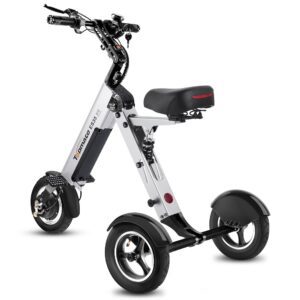
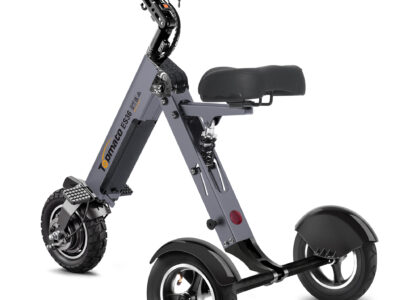
For example, the TopMate ES35 manufacturer manual lists an unfolded length of 99 cm (38.98 inches). Its folded length is 44 cm (17.33 inches). The difference shows why buyers should check both configurations rather than relying on one measurement.
Before buying, measure the available space from front to back. Then consider whether the scooter needs additional room to turn or whether another person must walk around it.
2. Mobility Scooter Width
For indoor users, mobility scooter width is often one of the first specifications to check.
The important number is the scooter’s widest point. Depending on the design, wheels, armrests, controls, or other components can determine that measurement.
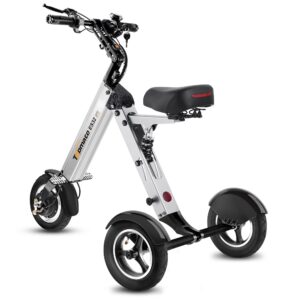
The TopMate ES35 is listed at 57.5 cm (22.6 inches) wide in both its unfolded and folded configurations. By comparison, the TopMate ES33 is listed at 53 cm (20.8 inches) wide.
Consequently, even a difference of several centimeters can affect how easily a scooter moves through a narrow apartment.
Consider a hallway that looks spacious but has a doorway opening along one side. The scooter may fit through the main entrance yet have difficulty making the next turn. For that reason, measure both the doorway and the surrounding maneuvering area.
3. Overall Height
Overall height measures the distance from the ground to the scooter’s highest point.
At first, this specification may seem less important than width. However, height becomes relevant when the scooter is stored beneath shelves, loaded into a vehicle, or moved through an area with limited overhead clearance.
The highest point can vary by design. It may be the handlebars, steering column, seat back, or control assembly.
For accurate comparisons, check how the manufacturer measured the scooter. If the handlebar or tiller can be adjusted, determine whether the published figure represents the minimum, maximum, or fixed height.
4. Folded Mobility Scooter Dimensions
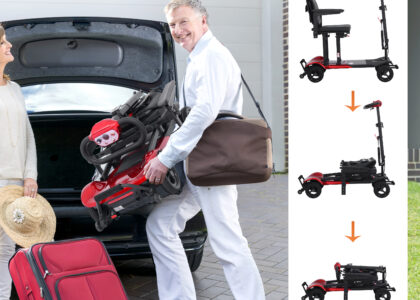
For people with limited storage space, folded mobility scooter dimensions can be more useful than the unfolded measurements.
Instead of checking only folded length, compare all three dimensions:
Folded length × folded width × folded height
This approach is especially useful when the scooter will be stored in a closet, garage, sedan trunk, or SUV cargo area.
For example, the TopMate ES33 manufacturer manual lists folded dimensions of approximately 40 × 53 × 85.5 cm (15.7 × 20.8 × 33.6 inches).
That means a storage compartment must accommodate not just the 15.7-inch folded length but also the 20.8-inch width and 33.6-inch height.
In practice, the available opening can be just as important as the internal storage dimensions. A compartment might have enough internal space but still have an opening that is too small for the folded scooter to pass through.
5. Mobility Scooter Seat Height and Width
Mobility scooter seat height affects how the rider transfers between the scooter and another seat.
A lower seat can reduce the distance a person has to move when sitting down or standing up. Conversely, a higher seat may provide a different leg position and relationship with the controls. The appropriate height depends on the individual rider and scooter design.
Seat width should also be considered separately from overall scooter width. A narrow scooter does not necessarily have a narrow seat, and a wide scooter does not automatically provide more usable seating space.
When comparing models, check the published seat height, seat width, and seat depth whenever those specifications are available.
6. Ground Clearance
Ground clearance refers to the distance between the ground and the scooter’s lowest relevant component.
This measurement matters when crossing small thresholds, driveway transitions, uneven pavement, or outdoor surfaces.
However, ground clearance should not be confused with climbing ability. Clearance describes the physical space beneath the scooter, whereas hill-climbing performance depends on factors such as motor power, traction, rider weight, and surface conditions.
Therefore, a scooter with greater ground clearance is not automatically capable of climbing a steeper hill.
7. Mobility Scooter Turning Radius
Mobility scooter turning radius tells you how much space the scooter needs to change direction.
This specification becomes particularly useful indoors. A scooter may be narrow enough to pass through a doorway but still require considerable room to turn around at the end of a hallway.
Think about the actual movements you make at home. You may need to enter a bathroom, turn beside the toilet, reverse toward the doorway, or position the scooter next to a bed.
If a manufacturer provides a turning radius, the approximate turning circle is twice that measurement. Always check the manufacturer’s terminology because some specifications list turning circle instead of radius.
How to Measure a Doorway
Start with the clear opening, rather than the nominal door size.
Open the door fully and measure the narrowest usable distance between the frame and any obstruction. Next, check the threshold because a raised edge can affect access even when the doorway is wide enough.
For example, a scooter that measures 22 inches wide should not be treated as an automatic fit for a 22-inch opening. There is effectively no maneuvering margin, and small measurement differences can create problems.
Ideally, allow additional clearance beyond the scooter’s published width. That extra space makes it easier to approach the doorway without scraping the frame.
How to Check Hallways and Elevators
Hallways require more than a simple width measurement.
First, identify the narrowest section. Then look for sharp corners, furniture, wall projections, interior doors, and other obstacles. These features can reduce the practical maneuvering space.
Elevators require a similar approach. Measure both the elevator door opening and the inside cabin.
A scooter might pass through the elevator entrance but leave insufficient room to turn or position itself. As a result, cabin length and width should be checked along with the entrance width.
How to Measure a Vehicle Trunk or Cargo Area
Vehicle compatibility depends on more than the published trunk volume.
Measure the cargo opening width and height first. After that, measure the interior floor length and width. Finally, check the available height from the cargo floor to the lowest obstruction.
For an SUV, take measurements with the rear seats in the position you normally use. With a sedan, pay particular attention to the trunk opening because the opening can be smaller than the space inside the trunk.
Folded height deserves special attention. A scooter can have enough floor space yet fail to fit through the trunk opening because the folded package is too tall.
For example, the TopMate ES35 has listed folded dimensions of 44 × 57.5 × 88 cm (17.33 × 22.6 × 34.64 inches). The vehicle should therefore be checked against all three dimensions rather than folded length alone.
Which Dimensions Matter Most?
The most important measurement depends on where the scooter will be used.
For indoor use, prioritize width and turning radius. These specifications determine how easily the scooter can pass through doors and maneuver around furniture.
In an apartment, check doorway width, hallway width, overall length, and turning space. Folded dimensions become important if the scooter will be stored inside a closet or another compact area.
For elevator access, measure the entrance and cabin separately. Length and turning space may become just as important as width.
When using an SUV or sedan, focus on the folded length, folded width, folded height, and cargo opening. Also remember to account for the scooter’s weight when planning loading and unloading.
For garage or closet storage, compare the complete folded dimensions with the available storage space. Leave enough room to remove the scooter without hitting nearby shelves, walls, or vehicles.
At shopping areas, width and turning ability become particularly relevant because aisles, displays, checkout lanes, and other customers can restrict maneuvering space.
FAQ
What mobility scooter dimensions should I check before buying?
The most important measurements are overall length, width, height, folded dimensions, seat height, seat width, and turning radius. Compare them with your doorways, hallways, elevator, vehicle cargo area, and storage space.
How wide is a typical mobility scooter?
Mobility scooter width varies by model. Compact scooters may be around 20–23 inches wide, while larger models can be wider. Always check the manufacturer’s exact width and compare it with the narrowest doorway or passage you need to use.
How do I measure my car for a folded mobility scooter?
Measure the vehicle’s cargo opening width and height first. Then measure the available cargo-floor length, width, and height. Compare all three measurements with the scooter’s folded length, width, and height rather than checking trunk volume alone.
Why is a mobility scooter's turning radius important?
Turning radius indicates how much space a scooter needs to change direction. It is particularly important in narrow hallways, bathrooms, elevators, apartments, and shopping areas where limited maneuvering space can make a scooter difficult to operate.

-scaled-2-420x300.jpg)