
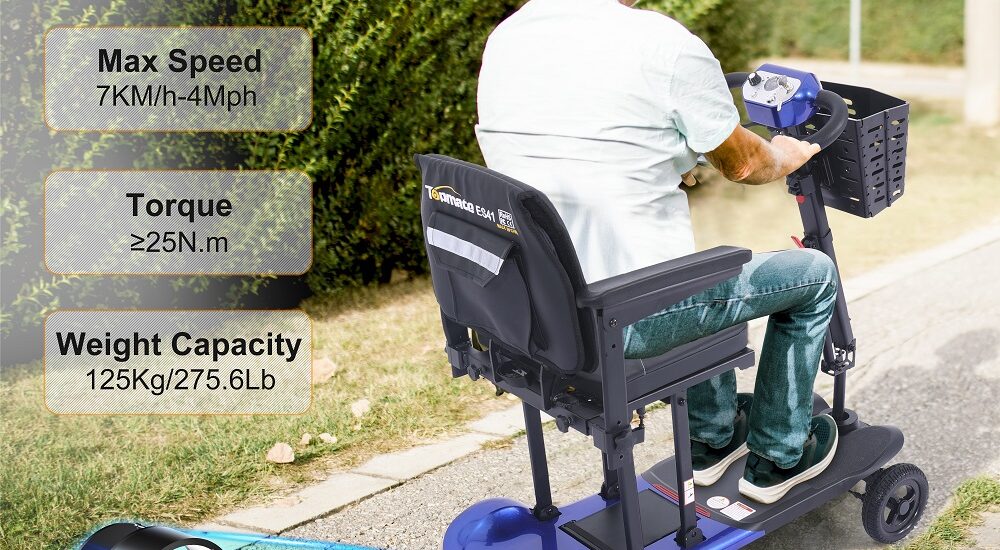
When comparing mobility scooters, buyers often focus on speed, range, weight capacity, and wheel size. One specification that can be overlooked is ground clearance. Yet this measurement can make a noticeable difference when moving from smooth indoor floors to cracked sidewalks, grass, gravel, or uneven pavement.
Ground clearance describes the space between the lowest part of a mobility scooter and the ground beneath it. It helps determine how much room the scooter has to pass over changes in surface height without the underside making contact.
Understanding this measurement can help seniors, caregivers, and first-time buyers choose a scooter that better matches their everyday environment.
What Is Ground Clearance?
Ground clearance is the vertical distance between the ground and the lowest part of the mobility scooter’s chassis or other components underneath it.
It is normally expressed in inches or millimetres, depending on the market and manufacturer.
For example, a specification might state:
- Ground clearance: 2.5 inches
- Ground clearance: 65 mm
- Ground clearance: 4 inches
The measurement should be taken with the scooter positioned normally on a level surface.
Importantly, ground clearance is not necessarily the distance from the ground to the bottom of the main frame. The lowest point could be a motor housing, chassis component, foot platform, suspension component, or another part underneath the scooter.
That is why buyers should use the manufacturer’s stated specification rather than estimating clearance from photographs.
How Is Ground Clearance Measured?
To measure ground clearance, place the scooter on a flat, level surface with its normal tires properly inflated or otherwise configured according to the manufacturer’s instructions.
Then identify the lowest fixed point underneath the scooter and measure vertically from that point to the ground.
For a manufacturer specification, the exact measurement method can vary. Therefore, when comparing two models, use specifications supplied under comparable conditions whenever possible.
Ground clearance can also change with:
- Rider and cargo weight
- Tire pressure on pneumatic tires
- Suspension movement
- Tire wear
- Load distribution
- Different wheel or tire configurations
The manufacturer’s specification should therefore be treated as the reference figure rather than assuming clearance remains identical in every situation.
Why Does Ground Clearance Matter?
Ground clearance matters because outdoor surfaces are rarely perfectly flat.
A low-clearance scooter may work very well on smooth indoor flooring and well-maintained pavement but have less room underneath when encountering a raised transition or uneven surface.
Adequate clearance can reduce the chance of the underside contacting the ground when moving over minor changes in surface height.
However, clearance does not make an obstacle automatically safe to cross. Riders should always follow the scooter manufacturer’s limits for slopes, obstacles, surfaces, and operating conditions.
What Happens When Ground Clearance Is Too Low?
If an obstacle or surface transition is higher than the available clearance, part of the scooter underneath can contact the ground.
Depending on the scooter and situation, this can:
- Stop or slow the scooter
- Cause the chassis to scrape
- Reduce stability
- Make the scooter feel harsh over uneven surfaces
- Potentially damage components underneath
The risk can be greater when the scooter approaches an obstacle at an angle or when the surface changes sharply.
Ground Clearance vs. Wheel Size
Ground clearance and wheel size are related, but they are not the same specification.
Larger wheels can contribute to a scooter’s ability to roll over certain surface irregularities more easily. However, simply installing larger wheels does not guarantee higher ground clearance.
The chassis design, axle position, frame geometry, tire dimensions, suspension, and location of the lowest components all influence the final clearance.
For example, two scooters can use similarly sized wheels but have different ground-clearance measurements because their frames and undercarriage designs differ.
Ground Clearance vs. Tire Size
Tire size describes the physical dimensions of the tire. Ground clearance describes the space below the scooter’s lowest point.
A larger tire may raise certain parts of the scooter, but the final clearance still depends on the complete design.
Ground Clearance vs. Suspension
Suspension helps a scooter respond to uneven terrain by allowing components to move relative to the frame. Ground clearance tells you how much space exists between the lowest point and the ground.
A scooter can have suspension and relatively modest clearance, or higher clearance without sophisticated suspension.
Neither specification should be used as a substitute for the other.
Ground Clearance vs. Maximum Climbing Ability
Maximum climbing ability describes the steepness of a slope the manufacturer says the scooter can negotiate under specified conditions.
Ground clearance describes underside space.
A scooter with high ground clearance does not automatically have a higher climbing capability. Motor power, gearing, traction, weight distribution, tires, braking, and other design factors affect climbing performance.
Real-World Obstacles
Ground clearance becomes easier to understand when applied to everyday situations.
| Situation | Why Ground Clearance Matters |
|---|---|
| Door threshold | A raised threshold creates a small change in surface height that the scooter must pass without the underside contacting it. |
| Uneven pavement | Depressions and raised sections can reduce the effective space underneath the scooter. |
| Gravel | Loose stones can create irregular contact points and make a low-clearance scooter more vulnerable to underside contact. |
| Grass | Uneven ground beneath grass can create hidden rises and dips that are not obvious from a distance. |
| Ramp transition | The transition between a ramp and level ground can create an angle that affects the scooter’s underside clearance. |
| Small curb/obstacle | Clearance may help with minor changes in height, but riders should never exceed the manufacturer’s stated obstacle or curb limits. |
Indoor vs. Outdoor Use
For predominantly indoor use, extremely high ground clearance may not be necessary.
Smooth floors, elevators, shopping centres, and accessible building entrances generally present fewer surface irregularities. In these environments, maneuverability, overall width, turning radius, and ease of control may be more important.
Outdoor users may place greater value on clearance because sidewalks, driveways, paths, and parking areas can contain cracks, uneven transitions, and changes in elevation.
However, higher clearance is not automatically better for every rider.
Increasing ground clearance can sometimes be accompanied by changes in seat height, centre of gravity, overall dimensions, or ease of entry and exit. The complete scooter design matters.
What Is Good Ground Clearance for a Mobility Scooter?
There is no single ground-clearance number that is “good” for every mobility scooter user.
For primarily indoor use, a lower clearance may be adequate if the scooter’s intended surfaces are smooth and accessible.
For regular outdoor use, buyers should look for a manufacturer’s specification that is appropriate for the surfaces they expect to encounter. Compare the stated clearance with the actual thresholds, pavement transitions, paths, and other obstacles on your regular routes.
Do not select a scooter solely because it has the highest number.
How Much Ground Clearance Does a Mobility Scooter Need for Outdoor Use?
The answer depends on the terrain.
Someone travelling mainly on smooth sidewalks may have different requirements from someone regularly using uneven park paths or gravel surfaces.
Rather than asking for one universal minimum, consider:
- What surfaces will you use?
- What is the largest routine surface transition?
- Does the manufacturer specify obstacle or curb limits?
- Does the scooter have suspension?
- What are the wheel and tire dimensions?
- Is the scooter intended for indoor, outdoor, or mixed use?
The goal is to match the scooter’s complete design to the environment.
Practical Examples
Consider a rider whose normal route includes an accessible building entrance, paved sidewalk, driveway transition, and compact gravel path.
A scooter designed primarily for smooth indoor surfaces may be less suitable if its low underside clearance leaves little room over irregular sections.
A model with more clearance may provide additional space underneath, but the rider still needs to consider traction, tires, suspension, climbing capability, weight distribution, and the manufacturer’s terrain limitations.
Similarly, a scooter with large wheels may roll over certain surface irregularities differently from a scooter with smaller wheels, but wheel size alone does not tell you its actual ground clearance.
This is why specifications should be evaluated together rather than in isolation.
FAQ
What is good ground clearance for a mobility scooter?
There is no single ideal ground-clearance measurement. The right amount depends on where the scooter will be used. Smooth indoor surfaces generally need less clearance, while uneven outdoor terrain may benefit from greater clearance.
Why is ground clearance important on a mobility scooter?
Ground clearance provides space between the scooter’s lowest components and the ground. Adequate clearance can help reduce underside contact when travelling over minor surface changes, thresholds, and uneven pavement.
Does wheel size affect mobility scooter ground clearance?
Wheel size can influence ground clearance, but the two measurements are not the same. Chassis design, tire dimensions, axle position, suspension, and the location of the lowest component also affect actual ground clearance.
Is higher ground clearance always better?
No. Higher ground clearance can be useful for some outdoor surfaces, but it does not automatically mean better performance. Wheel size, suspension, traction, climbing ability, stability, and the manufacturer’s terrain limits should also be considered.

-scaled-2-420x300.jpg)