When you compare mobility scooters, two numbers can look confusingly similar: product weight and weight capacity. They describe completely different things.
A scooter weighing 60 lb (27 kg) might support 220 lb (100 kg), for example. The first number tells you how much the scooter itself weighs. The second tells you how much rider and other supported load the manufacturer allows.
Understanding both specifications is important for choosing a scooter that you can safely use, transport, and store.
Two Numbers Explained
What Is Mobility Scooter Weight?
Mobility scooter weight is the weight of the scooter itself.
Manufacturers may list this as:
- Product weight
- Net weight
- Scooter weight
- Curb weight
- Weight without battery
The exact definition can vary between manufacturers. Therefore, always check whether the listed figure includes the battery, seat, basket, or other removable components.
For a battery-powered scooter, this distinction matters. A manufacturer may publish the scooter’s weight without the battery and separately list the battery weight.
For example, if a scooter weighs 50 lb (22.7 kg) without its battery and the battery weighs 8 lb (3.6 kg), the complete configuration weighs approximately 58 lb (26.3 kg).
What Is Mobility Scooter Weight Capacity?
Weight capacity is the maximum rider and/or supported load specified by the manufacturer.
Depending on the manufacturer, this may include the rider plus items carried on the scooter. Always check the product manual or specification sheet to determine exactly what the stated capacity covers.
A scooter with a 250-lb (113-kg) capacity does not weigh 250 lb. It means the manufacturer has specified that the scooter can support up to that amount of load under the stated conditions.
Why Are These Numbers Different?
The two numbers answer different questions.
Product weight asks:
“How much does the scooter itself weigh?”
Weight capacity asks:
“How much weight is the scooter designed to support?”
This means a relatively light scooter can have a substantially higher weight capacity.
Neither number should be used as a substitute for the other. Product weight is particularly important when transporting or handling the scooter. Weight capacity is primarily important when determining whether the rider and carried load fall within the manufacturer’s specified limit.
What Does Product Weight Include?
Before comparing scooters, determine exactly what the manufacturer’s weight measurement represents.
Check whether it includes:
- Main scooter frame
- Seat
- Battery
- Armrests
- Basket
- Accessories
- Other removable components
The battery weight deserves particular attention. Some specifications provide a complete scooter weight, while others provide separate figures for the scooter and battery.
If the manufacturer says “weight without battery,” do not treat that number as the actual lifting weight of the complete scooter.
What Is Folded Weight?
Some foldable scooters may also provide a folded or transport configuration.
However, folded dimensions and folded weight are different specifications.
A scooter may fold to a smaller physical size without becoming lighter. If the scooter must be lifted into a vehicle, the actual weight of the component you need to lift is more important than the folded dimensions alone.
If the scooter separates into multiple sections, check the weight of each section rather than assuming the total scooter weight represents the lifting weight.
What Does Weight Capacity Include?
Weight capacity generally refers to the maximum supported load specified by the manufacturer.
For practical planning, consider:
Total carried load = rider weight + carried items + supported accessories/load
Suppose:
- Rider: 180 lb (81.6 kg)
- Personal items: 15 lb (6.8 kg)
- Total load: 195 lb (88.5 kg)
- Scooter capacity: 220 lb (99.8 kg)
The rider is below the stated 220-lb capacity, with approximately 25 lb (11.3 kg) remaining based on those figures.
However, do not assume that every accessory automatically counts the same way. Follow the manufacturer’s definition of weight capacity and any restrictions in the owner’s manual.
It is also sensible to avoid treating the maximum rating as a target. A rider should select a scooter whose published capacity comfortably accommodates their normal total load.
How Much Weight Can a Mobility Scooter Carry?
There is no single capacity for all mobility scooters.
Different models are designed with different load ratings. The specification might be expressed in pounds in the USA and Canada or kilograms in many other markets.
When comparing models, look specifically for maximum weight capacity, and check whether it refers only to rider weight or the combined rider and load.
Do not estimate capacity from the scooter’s physical size, motor power, or product weight.
Real-World Example: Why the Calculation Matters
Imagine a first-time buyer weighs 180 lb (81.6 kg).
They normally carry:
- Backpack: 5 lb (2.3 kg)
- Shopping: 10 lb (4.5 kg)
Their normal supported load is therefore:
180 + 5 + 10 = 195 lb (88.5 kg)
If the manufacturer’s specified capacity is 220 lb (99.8 kg), the calculated load remains within the stated limit.
Now imagine the same rider regularly carries another 30 lb (13.6 kg) of equipment. The total becomes 225 lb (102.1 kg), which exceeds a 220-lb rating.
This demonstrates why buyers should consider their actual total load, rather than comparing only their body weight with the capacity figure.
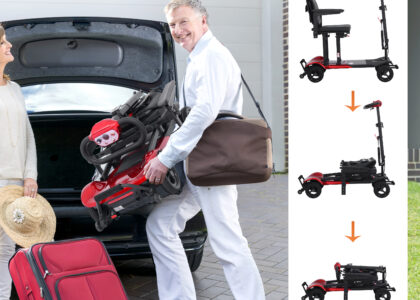
Why Scooter Weight Matters for Transport
Product weight becomes especially important when a scooter needs to be moved between locations.
A buyer may need to:
- Lift it into a car
- Move it through a garage
- Store it indoors
- Place it in a vehicle
- Load it with help from a caregiver
- Move separate components independently
A scooter’s total weight does not necessarily tell you how difficult it will be to handle. The shape, carrying points, weight distribution, removable battery, and ability to separate the scooter into sections can all affect handling.
For vehicle transport, check the actual weight of the configuration you intend to lift.
How Weight Can Affect Performance
Rider and cargo weight can influence how a mobility scooter performs.
When the scooter carries a greater load, factors such as the following can be affected:
Range
A greater total load can increase the energy required to move the scooter. As a result, real-world range may be lower than a published maximum range, particularly when combined with hills, rough surfaces, frequent stops, or other demanding conditions.
Hill Climbing
More total load can increase the effort required when travelling uphill. Motor output, gearing, battery condition, traction, slope, and surface conditions also influence climbing performance.
Never use weight capacity as an indication of maximum climbing ability.
Acceleration
A heavier combined load can affect how quickly the scooter accelerates. Actual performance depends on the scooter’s motor, controller, terrain, and operating conditions.
Stability and Handling
Load distribution matters as well as total weight. A scooter carrying weight within its rated capacity can still handle differently depending on where that weight is positioned.
Follow the manufacturer’s instructions about baskets, accessories, cargo placement, and rider positioning.
Does Rider Weight Affect Mobility Scooter Range?
Yes, rider weight can affect real-world range, but it is only one factor.
Battery capacity, terrain, speed, temperature, tire condition, riding surface, hills, stopping and starting, and battery condition can all influence range.
Therefore, a published range should not be interpreted as a guaranteed distance for every rider and environment.
Why Does Mobility Scooter Weight Matter When Buying?
Product weight matters when portability, storage, and transportation are priorities.
Weight capacity matters when determining whether the scooter can appropriately support the rider and their normal carried load.
For many buyers, the right choice requires balancing both:
A scooter should be light enough for your intended handling method and have sufficient rated capacity for your normal total load.
A lower product weight is not automatically better if the scooter does not meet your capacity or usage requirements. Likewise, a high weight capacity does not automatically make a scooter suitable if its weight is impractical for your transportation needs.
FAQ
What is the difference between scooter weight and weight capacity?
Scooter weight is the weight of the scooter itself, while weight capacity is the maximum rider and supported load specified by the manufacturer.
Does mobility scooter weight include the battery?
It depends on the manufacturer. Some specifications include the battery, while others list scooter weight without the battery. Always check the product specifications or owner’s manual.
How much weight can a mobility scooter carry?
Weight capacity varies by model. Check the manufacturer’s specified maximum capacity and determine whether it includes the rider only or the combined rider and carried load.
Does rider weight affect mobility scooter range?
Yes. A higher total load can affect energy consumption and real-world range. Terrain, speed, battery condition, tire condition, temperature, and riding style can also affect range.

-scaled-2-420x300.jpg)