Imagine entering your home on a mobility scooter and reaching the end of a hallway. The doorway is wide enough, but turning into the next room is difficult because there is not enough space to swing the scooter around.
This is a common reason that doorway width alone does not tell you whether a mobility scooter will work inside a home.
The specification that helps explain this is the mobility scooter turning radius. It describes how much space the scooter needs to make a turn. Understanding it can help buyers evaluate homes, elevators, shops, medical facilities, vehicles, and outdoor paths before choosing a scooter.
What Is a Mobility Scooter Turning Radius?
A mobility scooter’s turning radius is the distance from the centre of the scooter’s turning path to its outermost point while making a specified turn.
In simple terms, it helps describe how tightly the scooter can turn.
A smaller turning radius generally means the scooter can make a tighter turn, while a larger turning radius means the scooter requires more space.
For example, imagine two scooters approaching a narrow corner. If Scooter A has a smaller published turning radius than Scooter B, Scooter A may require less circular space to complete the same type of turn. However, the published specification should always be interpreted according to the manufacturer’s measurement method.
There is no single “good” turning radius for every user. The appropriate specification depends on where the scooter will be used.
Turning Radius vs. Turning Circle
These terms are related but should not automatically be treated as interchangeable.
Turning radius
The radius describes a distance from the centre of a turning path to its outer edge.
Turning circle or turning diameter
A turning circle or turning diameter describes the overall width of the circular path required for a turn.
In a simple geometric example, if a circle has a radius of 24 inches, its diameter is 48 inches.
However, mobility-scooter manufacturers do not necessarily use identical test methods or definitions when publishing turning specifications. Therefore, do not automatically double a manufacturer’s stated turning radius to obtain its turning circle unless the manufacturer’s definitions are compatible.
When comparing scooters, use the exact terminology and measurement method supplied by the manufacturer.
How Is Turning Radius Measured?
Turning measurements are generally determined by observing the scooter’s path while the steering is turned through its available range.
The measurement can depend on factors such as:
- Steering geometry
- Wheel arrangement
- Wheelbase
- Overall scooter dimensions
- The path followed by the wheels
- The outermost part of the scooter
- Manufacturer testing methodology
Because testing methods can differ, two specifications with similar wording may not always represent precisely the same measurement.
For this reason, a manufacturer’s published turning specification is more useful when considered alongside the scooter’s overall length and width.
Five Specifications That Help Explain Maneuverability
| Specification | What It Tells You | Why It Matters |
|---|---|---|
| Turning radius | Space needed for a specified turning path | Helps evaluate tight corners and maneuvering areas |
| Turning circle | Overall circular space associated with a turn | Helps visualize the scooter’s turning footprint |
| Overall width | How wide the scooter is | Determines whether it can pass through openings and narrow routes |
| Overall length | Front-to-back scooter dimensions | Affects turning space and maneuvering depth |
| Wheelbase | Distance between front and rear wheel positions | Influences how the scooter responds during turns |
None of these specifications should be viewed independently.
A narrow scooter may pass through a doorway but still need substantial space to turn. Similarly, a scooter with a relatively tight turning specification may still be difficult to maneuver if the available space is extremely narrow. Understanding mobility scooter dimensions can help you compare width, length, ground clearance, and turning space before choosing a model.
What Affects Mobility Scooter Turning Ability?
Turning performance comes from the scooter’s overall design rather than one component.
Scooter Length
A longer scooter can require more room to reposition, particularly in confined areas.
Scooter Width
Width determines how much lateral space the scooter occupies. It also affects whether you can make a turn without contacting walls, furniture, door frames, or other obstacles.
Wheelbase
Wheelbase is the distance between the front and rear wheel positions. It influences steering geometry and the path followed during a turn.
Wheel Arrangement
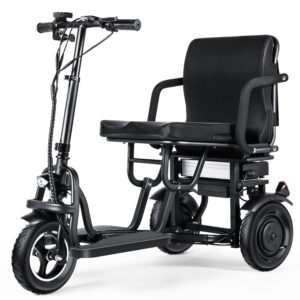
Three-wheel and four-wheel scooters can have different maneuvering characteristics because their wheel layouts and steering arrangements differ.
Three-wheel designs are often engineered with maneuverability as an important consideration, but the actual turning performance still depends on the complete design.
Wheel Size and Steering Geometry
Wheel size can influence the scooter’s physical layout, but larger or smaller wheels alone do not determine turning radius.
Steering angle, axle position, frame geometry, and wheel placement also matter.
User Steering Technique
The person operating the scooter also affects how efficiently available space is used.
Slow, controlled steering and allowing sufficient room around corners can make maneuvering more predictable. Riders should follow the manufacturer’s operating guidance and practice in a safe area before navigating confined spaces.
Where Does Turning Radius Matter in Real Life?
Inside the Home
Turning space becomes important in:
- Hallways
- Kitchens
- Bathrooms
- Bedrooms
- Doorways
- Tight furniture arrangements
A scooter may fit through a doorway but have insufficient room to turn immediately after entering.
For example, a 32-inch doorway does not mean there is automatically a 32-inch turning area beyond it. Walls, cabinets, furniture, and the hallway layout can reduce the available maneuvering space.
Elevators
Elevators create a particularly important combination of width, length, and turning-space requirements.
A scooter may physically enter the elevator but still leave insufficient room to reposition. Measure the elevator’s internal floor dimensions rather than relying only on its door width.
Shopping Areas
Store aisles can provide more space than a typical hallway, but displays, shelves, checkout areas, and other customers can temporarily reduce maneuvering room.
A scooter’s turning specification can therefore be useful when comparing it with the environments you visit regularly.
Medical Facilities
Clinics, hospitals, and care facilities may have accessible entrances and corridors, but individual rooms can have tighter layouts.
Consider the complete route rather than checking only the entrance.
Outdoors
Turning radius matters on:
- Narrow sidewalks
- Driveways
- Parking areas
- Ramps
- Garden paths
- Building entrances
Outdoor maneuvering generally provides more space than a bathroom or hallway, but obstacles such as parked vehicles, posts, curbs, and landscaping can create confined sections.
Can a Mobility Scooter Turn in a Hallway?
Yes, a mobility scooter can turn in some hallways, but the hallway width alone does not determine whether a turn is possible.
You also need to consider the scooter’s overall length and width, turning specification, the location of doorways, and whether the hallway provides additional space at the corner.
A long straight hallway may be easy to travel through but difficult to turn around in if there is no open area at the end.
How Much Space Does a Mobility Scooter Need Indoors?
There is no universal space requirement.
The required area depends on the scooter and the type of maneuver. A simple 90-degree turn into a doorway is different from making a complete reversal.
For indoor use, measure the actual locations where you expect to turn rather than relying on a general rule.
Pay particular attention to:
- Hallway intersections
- Bathroom entrances
- Kitchen corners
- Bedroom entrances
- Elevator interiors
- Areas beside furniture
Is a Smaller Turning Radius Better?
A smaller turning radius is generally useful when you frequently navigate confined spaces, but it is not automatically better for every rider.
A scooter designed for tight indoor maneuvering may have different priorities from a larger scooter designed around outdoor stability, ride comfort, suspension, or other requirements.
Therefore, compare turning radius with the complete specification set.
How to Check Whether a Scooter Will Turn in Your Space
Before purchasing, use this simple measurement process:
1. Measure doorway width.
Measure the actual clear opening rather than the door itself.
2. Measure hallway width.
Check the narrowest section, including areas affected by furniture or trim.
3. Identify the tightest corner.
Look for 90-degree corners, narrow intersections, bathroom entrances, and kitchen layouts.
4. Measure available turning space.
Determine the width and depth of the open area where you need to turn.
5. Compare scooter specifications.
Check turning radius or turning circle, overall width, overall length, and wheelbase where available.
6. Allow additional maneuvering space.
A theoretical fit does not necessarily provide comfortable operating room. Leave practical clearance from walls, furniture, people, and other obstacles.
What Is a Good Turning Radius for a Mobility Scooter?
There is no universal ideal number.
For users who primarily travel indoors, a smaller published turning radius may be particularly valuable. Someone who mainly uses wide sidewalks and open outdoor spaces may place less emphasis on this specification.
The right approach is to compare the scooter’s published turning measurement with the tightest spaces on your normal route.
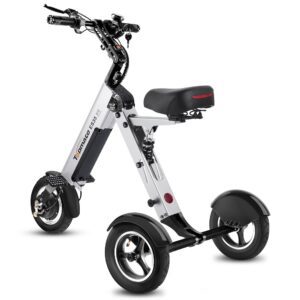
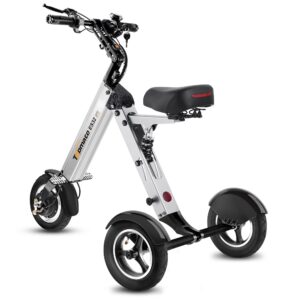
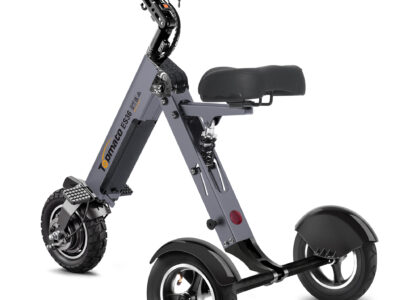
TopMate Example
TopMate publishes dimensions for its various scooter models, but a turning-radius figure is not consistently specified across the product information available for every model. Where a manufacturer does not publish a turning-radius or turning-circle measurement, it is better to state “not specified” rather than estimate it from photographs or overall dimensions.
For example, TopMate’s existing product information describes the ES15 as a compact scooter intended for environments such as shopping areas and indoor spaces, but that does not provide a numerical turning-radius measurement that should be substituted for an official specification.
This illustrates an important buying principle: do not calculate a scooter’s exact turning radius from its width, length, or wheelbase unless the manufacturer provides an appropriate measurement method and the necessary data.
Conclusion
Mobility scooter turning radius is more than a technical number. It helps buyers understand how much space a scooter may need to change direction.
However, turning radius should never be considered alone. Overall width, overall length, wheelbase, wheel arrangement, steering geometry, and the actual layout of your home or regular destinations all influence maneuverability.
The most reliable approach is to measure your tightest spaces first and then compare those measurements with verified manufacturer specifications.
FAQ
What is a good turning radius for a mobility scooter?
There is no universal ideal turning radius. A smaller turning radius is generally more useful for navigating narrow hallways, bathrooms, elevators, and other confined spaces, while outdoor users may have different priorities.
How much space does a mobility scooter need to turn?
The required turning space depends on the scooter’s turning radius, overall length, width, wheelbase, and the type of turn being made. Measure the actual space where you need to turn and compare it with the manufacturer’s specifications.
What is the difference between turning radius and turning circle?
Turning radius describes the distance from the centre of a turning path to its outer edge. Turning circle or turning diameter describes the overall circular space associated with a turn. Manufacturer measurement methods can vary.
Does scooter width affect turning ability?
Yes. Scooter width affects how much lateral space is available for maneuvering, but it does not determine turning performance by itself. Overall length, wheelbase, wheel arrangement, steering geometry, and the published turning specification also matter.

-scaled-2-420x300.jpg)