A mobility scooter can meet all your riding needs and still be the wrong choice for your vehicle.
Imagine finding a foldable scooter that is lightweight, comfortable, and powerful enough for your daily trips. You check your car’s cargo-space dimensions and discover that the numbers appear large enough. However, when you try to load it, the folded scooter cannot pass through the trunk opening. The problem is not the total cargo volume. It is the usable opening and loading path.
Before buying a mobility scooter, measure both the scooter and your vehicle. A few minutes with a tape measure can prevent an expensive storage problem.
Quick Answer
To determine whether a mobility scooter will fit, compare its folded length, width, and height with your vehicle’s actual cargo opening and usable cargo area.
Do not compare only the scooter’s folded dimensions with the manufacturer’s advertised trunk or cargo volume. Measure:
- Folded scooter length
- Folded scooter width
- Folded scooter height
- Trunk or hatch opening width
- Opening height
- Cargo-floor length
- Cargo-floor width
- Available cargo height
- Loading clearance
- Scooter weight and your lifting ability
Ideally, leave some practical clearance rather than selecting a scooter that matches the opening dimensions almost exactly.
Step 1: Measure the Mobility Scooter
Ask the manufacturer for the folded dimensions, not just the overall riding dimensions.
Measure or verify these three dimensions:
1. Folded Length
Measure the longest point from one end of the folded scooter to the other.
This determines whether the scooter can sit completely inside the cargo area with the rear hatch or trunk closed.
2. Folded Width
Measure the widest part of the folded scooter. Do not assume the frame width is the widest point. Wheels, armrests, handlebars, controls, or other components may extend farther.
3. Folded Height
Measure from the floor to the highest point when the scooter is in its normal folded position.
Height becomes particularly important when loading through a low sedan trunk or when the scooter must stand upright inside an SUV.
Example: TopMate ES35
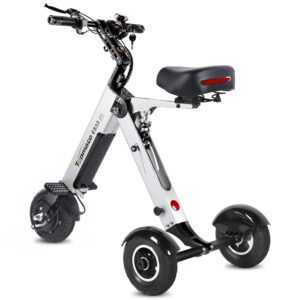
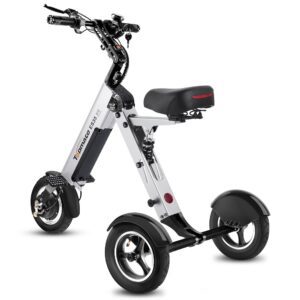
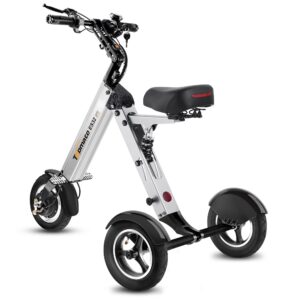
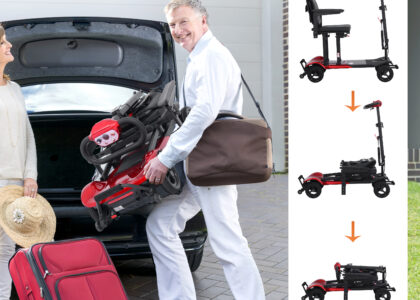
As a practical example, the official TopMate ES35 manual lists folded dimensions of approximately 44 × 57.5 × 88 cm (17.33 × 22.6 × 34.64 inches) and a net weight of 17 kg (37.5 lb).
These measurements are useful as a starting point, but they do not mean the ES35 will fit every vehicle. The vehicle’s actual opening, cargo floor, interior shape, and loading angle must still be checked.
Step 2: Measure the Vehicle Opening
This is where many buyers make a mistake.
Your vehicle may have a large cargo area once the scooter is inside, but the opening can be considerably smaller.
Trunk or Cargo Opening Width
Open the trunk or rear hatch completely. Measure the narrowest usable horizontal opening.
Do not measure the widest section of the trunk interior.
Opening Height
Measure the vertical distance from the bottom edge of the opening to the lowest obstruction at the top.
Check the measurement at the actual loading point. A hatchback may have a larger opening at the bottom than near the roof.
Loading Clearance
Think about how the scooter will enter the vehicle.
If you must tilt the scooter while loading, its effective height or diagonal clearance can become more important than its simple folded height.
A scooter that technically measures 22 inches wide may still be difficult to load through a 23-inch opening because there is almost no room for hand positioning or angle adjustment.
Step 3: Measure the Usable Cargo Area
Once the scooter passes through the opening, it still needs somewhere to go.
Measure:
Cargo-floor length: From the rear edge of the cargo floor to the seats or another obstruction.
Cargo-floor width: Measure between the wheel wells if they protrude into the cargo area.
Available cargo height: Measure from the cargo floor to the lowest part of the roof, hatch, parcel shelf, or other obstruction.
Remember that cargo space is rarely a perfect rectangle.
Seats may angle backward. Wheel wells can reduce width. The roof may curve downward. A spare tire compartment or raised floor can also reduce usable space.
Scooter vs. Vehicle Measurement Table
Use a table like this before purchasing:
| Measurement | Scooter | Vehicle | What to Check |
|---|---|---|---|
| Folded length | Manufacturer measurement | ___ | Is there enough floor length? |
| Folded width | Manufacturer measurement | ___ | Compare with narrowest opening |
| Folded height | Manufacturer measurement | ___ | Compare with opening and interior height |
| Trunk opening width | — | ___ | Measure the narrowest point |
| Opening height | — | ___ | Check the actual loading entrance |
| Cargo-floor length | — | ___ | Account for seat position |
| Cargo-floor height | — | ___ | Check lift height and clearance |
For example, an ES35 folded measurement of 17.33 × 22.6 × 34.64 inches should be compared against the vehicle’s actual opening and usable interior, rather than its advertised cargo volume.
Why Can a Scooter Be Smaller Than the Cargo Area but Still Not Fit?
This is one of the most important measurements to understand.
Suppose a vehicle has a cargo area that is 40 inches long and 35 inches wide. A scooter measuring less than those dimensions might appear to fit.
However, the trunk opening could be only 25 inches wide.
The scooter cannot pass through the opening unless it can be rotated or tilted into a suitable position.
This creates two separate fit tests:
Test 1: Entry fit — Can the folded scooter pass through the opening?
Test 2: Storage fit — Once inside, can it sit safely without interfering with the seats, hatch, or other equipment?
Both tests must pass.
Vehicle-Specific Measurement Considerations
Sedans
Sedan trunks often have a relatively narrow or low opening compared with the available trunk volume. Measure the opening first, then measure the depth of the trunk floor.
A scooter may fit diagonally, but do not assume this without physically checking the loading path.
Hatchbacks
Hatchbacks generally provide a larger rear opening. However, the roofline can slope toward the rear, reducing height near the hatch.
Measure both opening height and interior height.
SUVs
SUVs often provide more cargo volume, but wheel wells and raised cargo floors can reduce usable width or length.
Also measure the lift height from the ground to the cargo floor. A large SUV cargo area does not automatically mean easy loading.
Crossovers
Crossovers vary considerably. Some have generous rear openings, while others have sloping hatchbacks that limit vertical clearance.
Measure the actual vehicle rather than relying on the vehicle category.
Minivans
Minivans generally offer flexible cargo configurations. However, seats, rails, folded seatbacks, and interior trim can affect usable dimensions.
Measure the configuration you will actually use when transporting the scooter.
Weight Matters as Much as Dimensions
A scooter can fit perfectly and still be impractical to transport if it is too heavy to lift safely.
Check the complete lifting weight, not just the frame weight. If the manufacturer provides separate battery and accessory weights, calculate the configuration you will actually load.
For example, the official ES35 manual lists a net weight of 17 kg (37.5 lb).
Also consider whether the scooter can be partially disassembled or whether the battery can be removed before loading. A lighter component can make the loading process easier for a caregiver or another person assisting the rider.
How Much Trunk Space Does a Mobility Scooter Need?
There is no universal trunk-space requirement.
The required space depends on the scooter’s folded dimensions and loading orientation.
As a practical rule, calculate:
Required cargo space = folded scooter dimensions + clearance for loading + space needed around the scooter
Do not plan for a zero-clearance fit. A few extra inches can make a major difference when maneuvering a folded scooter into position.
Does Folded Scooter Size Matter More Than Overall Scooter Size?
For vehicle storage, folded dimensions are usually more important than the scooter’s unfolded dimensions.
Overall riding dimensions tell you whether the scooter is practical to use. Folded dimensions determine whether it can be transported and stored in your vehicle.
However, folded dimensions are only one part of the decision. Weight, lifting height, opening size, loading angle, wheel wells, and seat configuration also matter.
FAQ
How do I know if a mobility scooter will fit in my car?
Measure the scooter’s folded length, width, and height, then compare them with your vehicle’s actual trunk or cargo opening and usable interior space. Check the loading angle and leave enough clearance for easy loading.
What measurements should I take before buying a mobility scooter?
Measure the scooter’s folded length, width, height, and weight. For the vehicle, measure the cargo-opening width and height, cargo-floor length and width, available cargo height, and loading height from the ground.
Will a foldable mobility scooter fit in a sedan?
A foldable mobility scooter may fit in some sedans, but it depends on the scooter’s folded dimensions and the sedan’s trunk opening. The opening can be smaller than the trunk’s internal cargo space, so measure both.
Does folded scooter size matter more than overall scooter size?
For car storage, folded dimensions are generally more important because they determine whether the scooter can pass through the vehicle opening and fit inside the cargo area.

-scaled-2-420x300.jpg)