
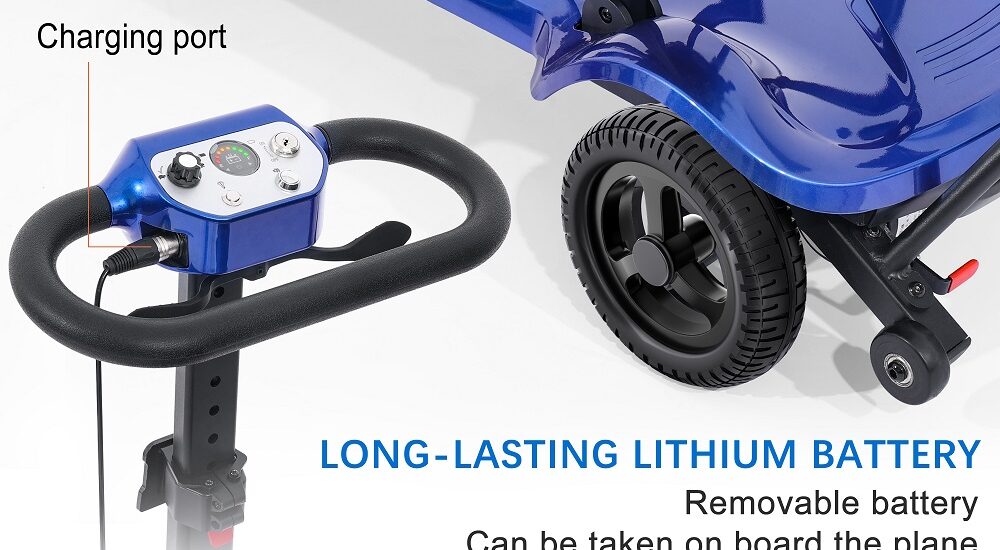
Front-wheel drive vs rear-wheel drive mobility scooters differ mainly in where the powered wheels sit and how those wheels interact with the rider’s weight, steering system, and terrain. Front-wheel drive pulls the scooter from the front, while rear-wheel drive pushes it from behind. That difference can influence traction, turning behavior, hill performance, stability, and space requirements.
The Fundamental Difference
A mobility scooter drivetrain determines which wheel or wheels receive power from the motor.
With a front-wheel drive mobility scooter, the powered wheel or wheels sit toward the front of the scooter. On some designs, the front drive wheel also participates directly in steering. The motor therefore pulls the scooter forward.
A rear-wheel drive mobility scooter places its powered wheels toward the rear. The motor pushes the scooter forward while the front wheel or wheels handle steering.
This sounds like a small mechanical distinction, but wheel position changes the way the scooter distributes weight and responds to acceleration, slopes, corners, and different surfaces.
Older mobility-scooter guidance generally describes front-wheel-drive models as more compact and maneuverable, while rear-wheel-drive designs tend to favor traction, power, and outdoor performance. However, modern scooter designs vary considerably, so drivetrain position should never be treated as the only performance factor.
How Each Drivetrain Delivers Power
The mobility scooter motor placement determines where electrical energy becomes mechanical driving force.
In a front-wheel-drive layout, the motor transfers power to the front drive wheel or wheels. When the rider accelerates, those powered wheels pull the rest of the scooter forward.
Rear-wheel drive reverses that arrangement. The motor drives the rear wheels, which push the scooter and rider forward.
Many rear-wheel-drive scooters use a transaxle or differential arrangement that allows the two rear drive wheels to rotate at different speeds while turning. This helps the scooter negotiate corners without forcing both powered wheels to travel exactly the same distance.
The drivetrain also interacts with the scooter’s weight distribution. Batteries, rider weight, motor placement, seat position, and frame design all determine how much load reaches the drive wheels.
Consequently, two scooters using the same drivetrain configuration can behave quite differently.
Turning and Maneuverability
Mobility scooter maneuverability depends on considerably more than front or rear drive.
Turning radius, wheelbase, overall length, steering angle, wheel diameter, tire design, and the position of the drive wheels all contribute to how much space the scooter needs.
A compact front-wheel-drive design can work well in tight environments because manufacturers often combine the drivetrain with a shorter frame. However, the powered front wheel may also influence the steering response, so some riders need time to become accustomed to its handling.
Rear-wheel-drive scooters generally provide predictable directional tracking and can feel more like a conventional vehicle because the rear wheels push the scooter while the front wheels steer.
Research examining wheeled mobility devices found that overall device length strongly influenced the space required for turning tasks. The study also found meaningful differences in maneuverability between drive configurations in power wheelchairs, although those findings should not be treated as a direct performance test of every mobility scooter.
Which is easier to maneuver?
There is no universal winner.
For narrow hallways, small rooms, elevators, and compact shopping areas, a short wheelbase and small turning radius may matter more than drivetrain position.
For outdoor routes, a longer scooter with rear-wheel drive may offer a more predictable steering feel but require more room to turn.
Traction and Surface Conditions
Mobility scooter traction depends on the force pressing the drive wheels against the ground, tire characteristics, surface conditions, motor torque, and weight distribution.
Rear-wheel drive often benefits when rider and battery weight load the rear axle. That can give the powered wheels substantial contact force during acceleration and climbing.
Front-wheel drive can behave differently because the drive wheels sit ahead of the rider’s center of mass. Weight transfer during acceleration or climbing can reduce the load available at the front drive wheel.
However, it would be inaccurate to claim that one drivetrain always provides better traction.
A scooter with larger pneumatic tires, appropriate tire pressure, strong torque delivery, and a well-designed suspension system may outperform another scooter with the same drivetrain but inferior tires or weight distribution.
Wet pavement, gravel, grass, loose soil, and uneven surfaces can all reduce available grip. Riders should therefore consider the complete wheel-and-drivetrain system rather than the drive-wheel label alone.
Hill Climbing
Which is better for hills?
In many conventional mobility scooters, rear-wheel drive has an advantage on inclines because rider and battery weight can load the powered rear wheels. This can help maintain traction while the motor pushes the scooter uphill. Traditional mobility-scooter guidance also associates rear-wheel-drive configurations with stronger outdoor and hill-climbing performance.
Still, drivetrain placement does not determine climbing ability by itself.
Consider these specifications:
- Motor power in watts
- Maximum output torque
- Maximum manufacturer-rated gradient
- Total scooter and rider weight
- Tire diameter
- Tire type and condition
- Battery voltage and output capability
- Controller characteristics
- Ground surface
- Available traction
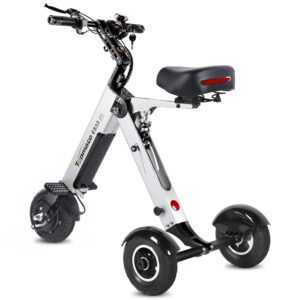
For example, TopMate’s ES15 uses two independent 250W motors, for a combined nominal motor rating of 500W, and TopMate lists a maximum slope of 10°. Its stated maximum load is 300 lb (136 kg).
Those figures illustrate why a buyer should examine the entire drivetrain specification rather than simply asking whether a scooter is front- or rear-wheel drive.
A manufacturer’s maximum gradient is also a limit, not a recommendation to climb every slope at that angle. Surface grip, rider weight, battery condition, and road conditions can change real-world performance.
Stability and Weight Distribution
Does drivetrain affect stability?
Yes, but drivetrain position is only one part of stability.
A scooter’s stability depends on wheelbase, track width, center of gravity, tire size, suspension, seat height, rider position, speed, and terrain.
Rear-wheel-drive designs often provide strong directional stability because the powered wheels sit behind the rider and push the scooter forward. Front-wheel-drive designs can have different steering characteristics because the powered wheel sits closer to the front of the scooter.
The Australian Agency for Clinical Innovation notes that front-wheel drive can produce rear-end swing during turns, while rear-wheel drive generally provides good directional stability. These observations come from power-wheelchair guidance, so individual scooter designs can differ.
Speed matters as well. A scooter that feels stable at walking speed can respond differently during a fast turn or sudden maneuver.
Maintenance and Mechanical Considerations
Drivetrain configuration changes the components that deserve attention during maintenance.
Front-wheel-drive scooters may integrate the motor closely with the front wheel and steering assembly. That can place the motor, wheel, and steering mechanism in a compact area.
Rear-wheel-drive scooters commonly place the motor and transmission near the rear axle. Some use transaxles, gears, belts, or related mechanical components.
Regardless of configuration, owners should monitor:
- Tire condition and pressure
- Unusual motor noises
- Steering play
- Wheel bearings
- Brake operation
- Electrical connections
- Drive-wheel wear
- Battery performance
- Loose fasteners
Do not dismantle a motor, transaxle, brake system, or steering assembly without appropriate technical knowledge and manufacturer service instructions.
Comparison Table
| Feature | Front-Wheel Drive | Rear-Wheel Drive |
|---|---|---|
| Drive-wheel position | Front | Rear |
| Power delivery | Pulls scooter forward | Pushes scooter forward |
| Traction | Depends heavily on weight distribution and tires | Often benefits from load over rear drive wheels |
| Turning behavior | Can provide responsive front-end handling | Generally predictable directional tracking |
| Indoor maneuverability | Often favorable on compact designs | Can require more space on larger models |
| Outdoor handling | Varies by model and wheel design | Often suited to longer outdoor routes |
| Hill performance | Depends strongly on motor, torque, load, and traction | Often advantageous on inclines |
| Weight distribution | Drive system concentrated toward front | Drive system concentrated toward rear |
| Typical use cases | Compact, maneuverability-focused designs | Outdoor-oriented and higher-performance designs |
| Potential limitation | Front drive can lose traction depending on load and incline | Larger models may have a greater turning requirement |
This table describes general drivetrain tendencies, not guaranteed performance for every scooter.
Which Configuration Fits Different Riders?
A front-wheel drive mobility scooter may suit someone who prioritizes a compact layout and frequently operates in tighter environments. Check the actual turning radius, overall width, wheelbase, and steering response before making a decision.
A rear-wheel drive mobility scooter may suit a rider who spends more time outdoors, encounters inclines, or wants strong directional tracking. Look beyond the drivetrain and compare the rated gradient, motor torque, tire dimensions, ground clearance, and weight capacity.
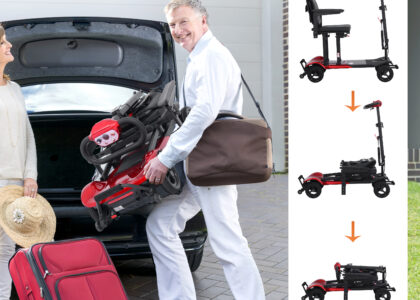
Caregivers should also consider where the scooter will be stored and transported. A drivetrain that performs well outdoors may belong to a larger, heavier chassis that creates more loading or storage work.
First-time riders should test the scooter if possible. A specification sheet cannot fully describe how a particular steering arrangement feels during a tight turn or on a slope.
Important Specifications to Check
Before comparing drivetrain layouts, record these figures for each scooter:
Turning radius: A smaller figure generally means less space is required to complete a turn.
Motor power: Check the rated wattage and, when available, maximum torque.
Wheel dimensions: Larger wheels can help with surface irregularities, but wheel size alone does not determine traction.
Ground clearance: This matters when crossing uneven surfaces, thresholds, and small obstacles.
Maximum gradient: Use the manufacturer’s rated value and check whether it is stated in degrees or percent grade.
Total weight: A heavier scooter may provide a different balance of stability and transport demands.
Weight capacity: Include the rider and any permitted cargo when comparing the specification.
Tire type: Pneumatic, solid, and foam-filled tires can produce different handling and comfort characteristics.
TopMate Product Context
TopMate’s current product range illustrates why drivetrain specifications should be examined alongside motor configuration and wheel design.
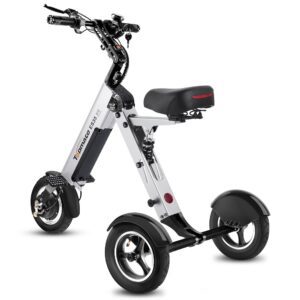
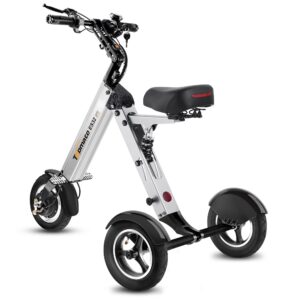
The TopMate ES33, for example, uses a 250W brushless hub motor, produces up to 13 N·m of maximum output torque, and has 8-inch front and rear wheels. Its manufacturer lists an 8° gradeability rating, a 100 kg (220.4 lb) maximum load, and a front-wheel power drum brake. TopMate also lists the ES33’s overall unfolded dimensions as 94.5 × 53 × 91 cm (37.2 × 20.8 × 35.8 in).
TopMate also sells an 8-inch front wheel motor specifically for the ES33, confirming the location of its powered wheel.
These specifications make the ES33 a useful example of why motor position, wheel size, torque, gradient rating, load capacity, and overall dimensions should be evaluated together.
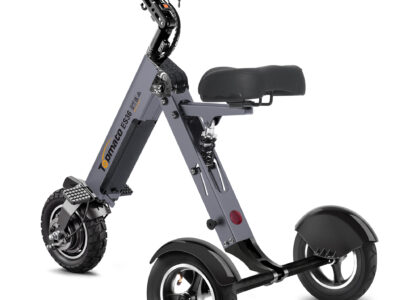
The ES15 uses a different motor arrangement, with two independent 250W brushless motors and three 10-inch pneumatic tires. TopMate lists a 10° maximum slope and 300 lb maximum load for this model.
Rather than labeling one configuration as universally superior, compare each scooter’s complete drivetrain and chassis specification with the terrain and space where you actually intend to ride.
Final Decision Guide
The key question is not simply front-wheel drive or rear-wheel drive? Instead, ask what the scooter must do every day.
Choose based on turning radius and overall dimensions when tight indoor spaces dominate your routine.
Give greater attention to traction, torque, rated gradient, and tire size when hills and uneven outdoor surfaces are common.
Prioritize weight, dimensions, and transport requirements if caregivers regularly load the scooter into a vehicle.
For mixed use, compare the complete specification rather than assuming the drivetrain alone determines performance.
Most importantly, do not treat front-wheel drive as automatically better for maneuverability or rear-wheel drive as automatically better for hills. Motor output, wheel design, weight distribution, chassis geometry, tires, and terrain can change the result substantially.
FAQ
What is a front-wheel drive mobility scooter?
A front-wheel drive mobility scooter uses a motor to power the front wheel or wheels, which pull the scooter forward. This configuration can work well in compact scooter designs, although actual maneuverability depends on wheelbase, turning radius, steering geometry, and tire design.
What is a rear-wheel drive mobility scooter?
A rear-wheel drive mobility scooter powers the rear wheels, which push the scooter forward. This configuration can provide strong traction and predictable directional tracking, particularly on outdoor routes and inclines.
Which drivetrain gives better traction?
Rear-wheel drive often benefits from greater weight over the powered wheels, especially during acceleration and hill climbing. However, traction also depends on motor output, tire condition, tire pressure, rider weight, surface type, and overall scooter design.
Which is better for hills and maneuverability?
Rear-wheel drive can offer an advantage on hills because the powered rear wheels can maintain useful traction during climbing. For maneuverability, neither drivetrain is automatically superior; turning radius, wheelbase, steering geometry, and scooter dimensions are more important factors.

-scaled-2-420x300.jpg)