The shopping list looks simple: groceries, a few household items, and perhaps a quick stop at another store. For someone who has difficulty walking long distances, however, the challenge is rarely the shopping itself. It is everything around it—the distance from the house to the car, the parking lot, the store aisles, standing or walking between sections, and getting everything back home.
A folding mobility scooter for shopping can make this kind of outing much more manageable. But using one for a real shopping trip reveals something important: the smallest folded size is not necessarily the feature that matters most.
A scooter can be easy to fold yet awkward to steer through a crowded aisle. It can be lightweight but have less storage than you need. It can have plenty of advertised range but still be inconvenient to load into your vehicle. Folding Mobility Scooter for Shopping.
Quick Answer
For shopping, look for a folding mobility scooter that balances easy transport, maneuverability, comfortable seating, sufficient battery range, useful storage, stability, and appropriate weight capacity. Portability matters, but so does what happens after you unfold the scooter and begin navigating parking lots, store aisles, checkout areas, and the trip home.
It Starts Before You Leave the House
Picture the scooter sitting in a garage or inside a storage area.
You need to get it ready without turning a simple shopping trip into a project.
That makes the folding mechanism and storage dimensions surprisingly important. If the scooter is awkward to unfold, difficult to move into position, or takes too much effort to prepare, you may be less inclined to use it for short errands.
This is why I would ask a practical question before looking at specifications:
Would I want to do this setup several times a week?
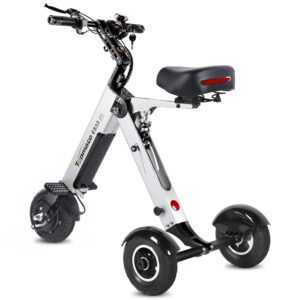
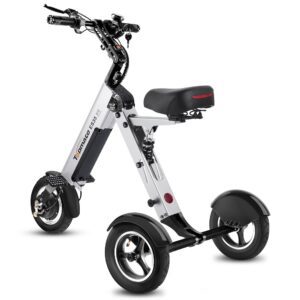
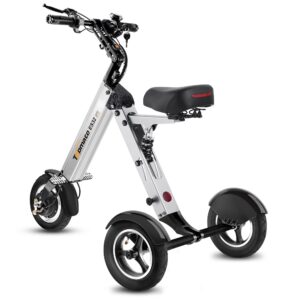
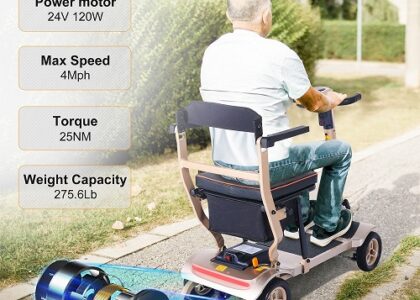
Folded dimensions also deserve more attention than the word “compact.” A scooter has to fit the space where you actually keep it. The TopMate ES33, for example, has published folded dimensions of 15.7 × 20.8 × 33.6 inches and a net weight of 35.4 lb.
Those numbers are more useful than simply knowing that the scooter is “foldable.”
Getting It Into the Car Is a Different Test
The next challenge is transportation.
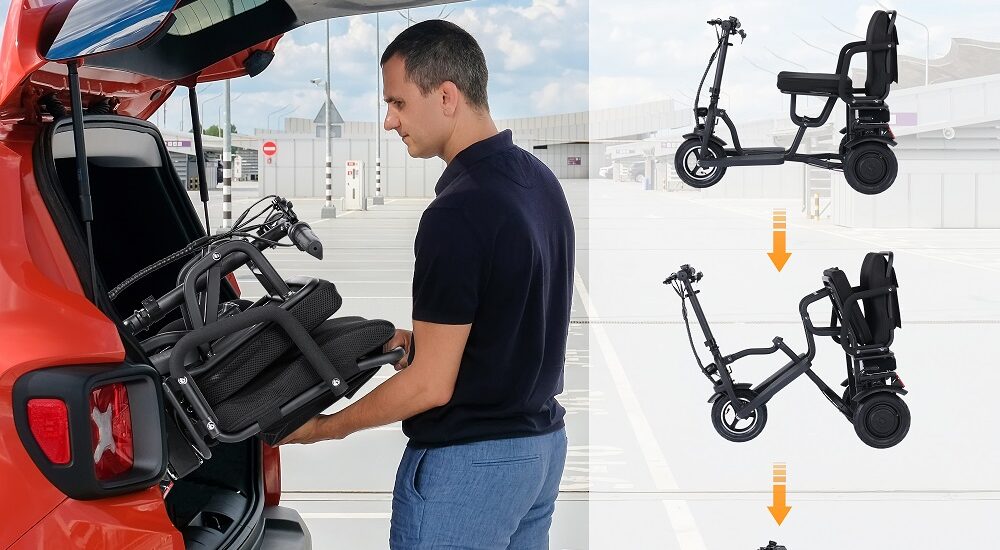
A scooter may fold neatly and still be difficult for one person to load. Think about the trunk opening, the height of the vehicle, how far you need to lift the scooter, and whether you normally have someone available to help.
This is particularly important for people who expect to use the scooter primarily for shopping trips by car.
Are folding mobility scooters easy to transport?
Often, yes—but ease of transportation depends on more than folding capability. Total weight, folded dimensions, battery configuration, and your vehicle’s available cargo space all contribute to how convenient the process actually is.
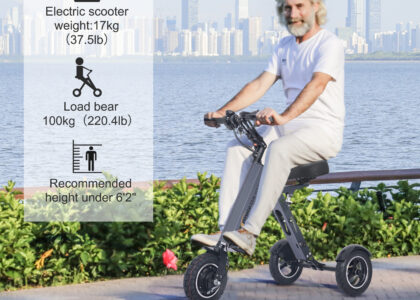
For example, TopMate’s ES33 weighs 35.4 lb, while the current ES15 listing gives a weight of 56.88 lb without the battery. The ES15, however, also has a removable battery, which allows the battery to be charged separately from the scooter.
That illustrates why choosing based on one specification can be misleading.
The Parking Lot Changes the Priorities
Once the scooter is unloaded, the shopping experience really begins.
The car might be parked farther from the entrance than expected. There may be a slightly uneven section of pavement. You may need to make several turns before reaching the automatic doors.
At this point, portability is no longer the only concern.
The scooter’s wheel configuration, tire design, steering, seating position, and battery capacity all start to matter.
Getting onto the scooter matters, too. A comfortable seating position and enough room to position your legs can make the beginning of the trip feel much easier. The exact fit is personal, so overall scooter dimensions should not be treated as a substitute for checking seat dimensions and seating position.
The goal is not to find the scooter with the most impressive specification sheet. It is to find one that feels manageable throughout the entire route.
Inside the Store, Small Turns Become Important
The first few aisles may seem easy.
Then you reach the end of an aisle and discover that another shopper has stopped with a cart exactly where you need to turn.
This is where maneuverability becomes more important than top speed.
Can a mobility scooter maneuver through store aisles?
Many compact scooters can, but the experience depends on their overall width, wheel arrangement, steering response, turning space, and the layout of the store.
A scooter that feels effortless on an open sidewalk may require more attention in a narrow aisle surrounded by shelves, displays, carts, and other shoppers.
For shopping, controllable speed is usually more useful than simply having a high maximum speed. You want to make small adjustments, slow down when necessary, and maintain enough visibility around the scooter.
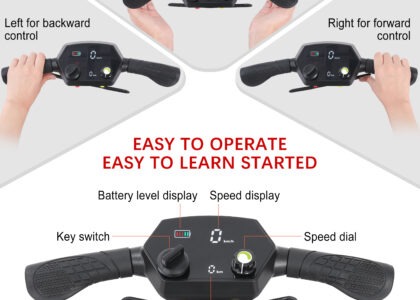
The TopMate ES33, for example, has three speed settings and a reverse function, while its published specifications list a width of 20.8 inches when unfolded.
Those details become much more relevant when you imagine the scooter in an actual store rather than looking at them in isolation.
Then There Is the Shopping Itself
A scooter can solve the walking problem and still leave you wondering where to put everything.
A few grocery items quickly become several bags. A pharmacy purchase gets added. Perhaps you pick up something unexpectedly large or heavy.
Can you carry groceries on a mobility scooter?
Small shopping purchases can generally be carried using the scooter’s designated storage, provided the load stays within the manufacturer’s recommendations and does not interfere with the controls, rider position, or normal operation.
Storage therefore deserves more attention than it often receives.
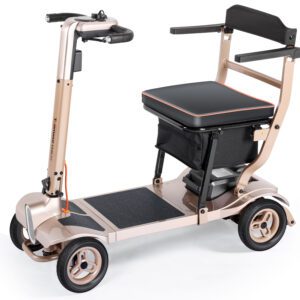
The TopMate ES15, for example, includes a detachable front basket and rear backrest pouch. Its current listing also specifies a maximum load of 300 lb.
That does not mean the full rated load should automatically be treated as available shopping capacity. The rider’s weight and any permitted cargo need to remain within the manufacturer’s stated limits.
A basket is useful because it keeps your hands free. It is not an invitation to turn the scooter into a heavily loaded shopping cart.
A Comfortable Seat Matters More Than You Expect
Shopping can take longer than planned.
You may spend several minutes comparing products, waiting at checkout, or browsing another section of the store. That means the seat is doing more work than you might expect from a short errand.
Back support, seat dimensions, legroom, armrests where applicable, and overall seating position can influence whether the scooter remains comfortable during the outing.
This is another reason not to judge a shopping scooter solely by its folded weight.
A lighter scooter that does not suit your seating needs may be less practical than a somewhat heavier model that better fits your everyday use.
Battery Range: Think About Your Whole Outing
How much battery range do I need for shopping?
Start with your normal journey, not the maximum number printed on the product page.
A grocery store close to home may require very little range. A trip involving a large shopping center, multiple stores, and a longer parking route is different.
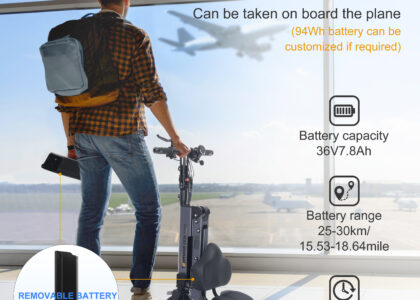
TopMate’s ES33 documentation lists 15.53–18.64 miles of recharge mileage and specifically notes that mileage can depend on use, load, and road conditions. The ES15 is currently listed with a 16–19-mile range.
Those figures provide a useful reference, but real-world range can vary.
Frequent stops and starts, rider weight, terrain, speed, surface conditions, and battery condition can all affect how far a scooter actually travels.
The important thing is to leave enough practical range for the entire trip rather than planning around the maximum advertised figure.
What Matters Most Depends on the Shopping Trip
| Shopping situation | Feature that matters most | Why |
|---|---|---|
| Grocery shopping | Storage | Carry small purchases |
| Large shopping center | Battery range | Longer trips |
| Crowded store | Maneuverability | Easier aisle navigation |
| Frequent car trips | Foldability and weight | Easier transportation |
| Short shopping trips | Portability | Faster setup |
There is no single priority list that works for everyone.
Someone who shops at a small neighborhood store may care most about portability and maneuverability. Someone who spends several hours in a large shopping center may put range and seating higher on the list.
What I Would Prioritize
If shopping were the main reason for choosing a folding scooter, I would start with these seven considerations:
- Easy transport — If loading it into the car is difficult, you may use it less often.
- Maneuverability — Store aisles require more precise movement than open roads.
- Comfortable seating — Shopping trips can involve substantial time on the scooter.
- Appropriate battery range — Choose enough range for your normal outing, not just the advertised maximum.
- Useful storage — A basket can make carrying small purchases much easier.
- Stability — Consider the scooter’s design and the surfaces you regularly encounter.
- Weight capacity — Account for the rider and permitted cargo.
The order can change depending on the person.
For a frequent car traveler, transport weight may move to the top. For someone shopping in large stores, maneuverability and range may matter more.
Which TopMate Models Fit Different Shopping Situations?
TopMate’s ES33 is worth considering when low transport weight is a major priority. It weighs 35.4 lb, supports up to 220.4 lb, folds to 15.7 × 20.8 × 33.6 inches, and has a published range of 15.53–18.64 miles.
The ES15 takes a different approach. It is heavier at 56.88 lb without the battery, but it has a 300-lb maximum load, a removable 36V 7.8Ah battery, three 10-inch pneumatic tires, and a published 16–19-mile range. It also includes front and rear storage.
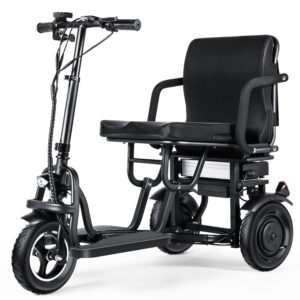
The ES36 may suit shoppers who want larger pneumatic front tires and a folding three-wheel design. TopMate lists a 39.2-lb weight, 220.5-lb load capacity, 15.5–18.6-mile range, removable 36V 7.8Ah battery, and 10-inch off-road pneumatic front tires.
These models demonstrate the main point: the right scooter depends on how the person shops, travels, loads the scooter, and uses it inside and outside the store.
Mistakes That Become Obvious on a Real Shopping Trip
Some choices look sensible until you imagine the entire outing.
Buying solely because a scooter is lightweight can overlook seating, storage, and range.
Choosing based on folded dimensions without considering unfolded width can create problems in tight spaces.
Looking only at maximum range can result in unrealistic expectations about battery performance.
Ignoring storage can leave you trying to manage shopping bags while steering.
Likewise, carrying too much weight can exceed the manufacturer’s recommendations or interfere with normal use.
Perhaps the biggest mistake is assuming every folding scooter behaves the same way indoors. Two scooters can both fold and still feel very different when turning around an aisle, approaching a checkout area, or navigating around other shoppers.
FAQ
What makes a folding mobility scooter good for shopping?
A good folding mobility scooter for shopping should be easy to transport, simple to maneuver through store aisles, comfortable to sit on, and have enough battery range for the full outing. Useful storage, an appropriate weight capacity, and easy loading into a vehicle also matter.
Are folding mobility scooters easy to transport?
Many folding mobility scooters are designed to make transportation easier because they can be folded for storage in a vehicle. However, the scooter’s folded size and weight still matter. Before buying, check whether you can comfortably lift, move, and store it in your specific vehicle.
How much battery range do I need for shopping?
The amount of range you need depends on the distance you travel, how long you spend shopping, and whether you use the scooter indoors and outdoors. It is sensible to choose a scooter with enough published range to cover your planned outing with some reserve rather than relying on the maximum advertised figure.
Can you carry groceries on a folding mobility scooter?
Yes, if the scooter has suitable storage such as a basket or bag. Keep purchases within the manufacturer’s recommended limits and distribute the load so it does not interfere with steering, controls, visibility, or your ability to operate the scooter safely.