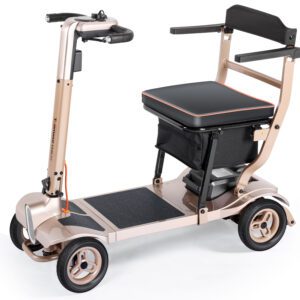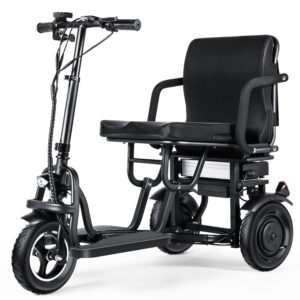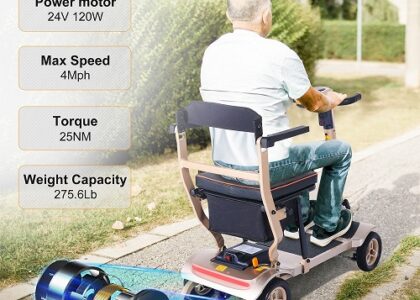
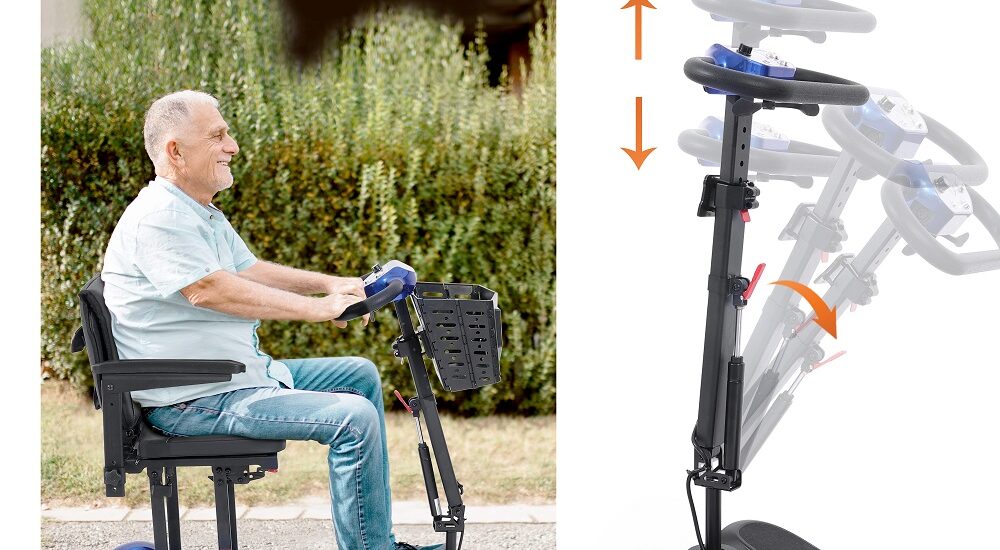
A mobility scooter that works perfectly around the house may not be the right choice for an RV trip or camping weekend. Once you leave home, you have to think about vehicle loading, storage space, campground surfaces, battery charging, outdoor range, and how easily the scooter can be moved when it is not being ridden.
For seniors, older adults, caregivers, and RV travelers, the right scooter is therefore less about finding the lightest model available and more about finding a practical balance between portability and outdoor capability. Mobility scooters for camping
Whether a mobility scooter is suitable for camping depends on the terrain, storage space, transport method, battery range, and the scooter’s weight and dimensions.
Quick Answer
The most practical lightweight mobility scooters for camping are usually foldable models that are easy to load, store, and charge while traveling. However, weight alone is not enough. For RV and campground use, also consider folded dimensions, ground clearance, wheel size, stability, battery range, weight capacity, and the surfaces you expect to ride on.
What Makes a Mobility Scooter Practical for Camping and RV Travel?
Camping creates a different set of requirements from everyday indoor mobility. A scooter may be excellent for navigating a home, shopping center, or doctor’s office but become inconvenient when you have to lift it into an RV storage compartment or ride across an uneven campground path. mobility scooters for camping
Here are the specifications that deserve the most attention.
1. Scooter weight
Weight matters whenever the scooter has to be loaded into an SUV, pickup, RV compartment, or storage area.
A lighter scooter can reduce the physical effort required from a caregiver or travel companion. However, don’t automatically choose the model with the lowest advertised weight. A very lightweight design may have smaller wheels, a lower weight capacity, or less capability on outdoor surfaces.
2. Folded dimensions
For RV travel, folded size can be just as important as weight.
Before buying, measure the actual space where you intend to store the scooter. Check the compartment opening, not just the compartment’s internal volume.
A scooter that technically fits inside a storage area may still be difficult to load if the opening is too narrow.
3. Ease of loading
Think about the complete loading process.
Can one person lift it? Does it fold quickly? Can the battery be removed first? Does the folded scooter have a practical shape for carrying?
These questions become especially important when moving between several campgrounds during a long RV trip.
4. Battery range and charging
Range should match your actual daily activities rather than the largest number in a product description.
Campgrounds can be surprisingly spread out. You may ride from your RV to the restrooms, recreation areas, camp store, picnic areas, or nearby attractions.
Remember that published range is not a guarantee of real-world range. Rider weight, speed, hills, surface conditions, temperature, tire condition, and frequent stopping can all affect battery performance.
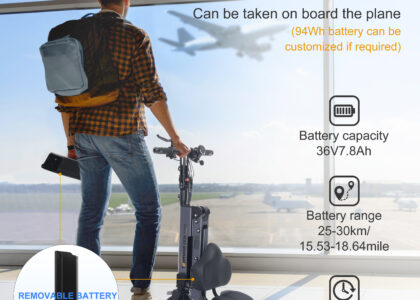
A removable battery can also be useful because it may allow charging without moving the entire scooter.
5. Wheels and outdoor surfaces
Not all campground paths are the same.
Some RV parks have smooth paved roads and sidewalks. Others have gravel, compacted dirt, grass, cracked pavement, or uneven transitions.
Larger pneumatic tires may provide advantages on certain uneven outdoor surfaces, but they do not automatically turn a travel scooter into a rough-terrain vehicle.
Always compare the manufacturer’s wheel size, tire type, ground clearance, gradeability, and stated usage before riding on challenging surfaces.
6. Stability and maneuverability
A three-wheel scooter can provide a tighter turning configuration, while a four-wheel design may appeal to riders who prioritize a different stability setup.
Neither configuration is automatically better for every campground.
Consider where you will ride: narrow RV pathways, open campground roads, uneven surfaces, or crowded recreational areas.
5 Real Camping and RV Scenarios
The best scooter for camping depends heavily on how you actually travel.
Scenario 1: Staying at a paved RV campground
If your campground has paved roads and relatively smooth paths, portability may be your biggest concern.
In this situation, prioritize:
- Low or manageable transport weight
- Compact folded dimensions
- Easy loading
- Adequate battery range
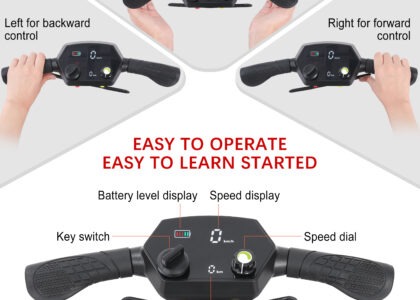
- Comfortable controls
- A weight capacity appropriate for the rider
You may not need a scooter specifically designed around uneven outdoor surfaces.
Scenario 2: Riding from the RV to campground facilities
A short ride can still involve several miles over the course of a day.
For example, a trip to the restroom in the morning, campground store later in the day, and recreation area in the evening can add up.
Here, battery range and charging convenience become more important. Consider your expected daily mileage and leave a reasonable reserve rather than planning to use the manufacturer’s maximum range as your everyday target.
Scenario 3: Loading the scooter into an RV or SUV
This is where portability becomes a practical issue rather than a marketing specification.
Measure:
- The storage compartment opening
- Interior storage dimensions
- The height from the ground to the loading point
- The scooter’s folded dimensions
- The scooter’s actual transport weight
If lifting is difficult, consider whether the battery can be removed before loading and whether another person or loading equipment will be available.
Scenario 4: Camping on uneven but maintained paths
Suppose your RV park has paved roads but some paths contain gravel, grass, or uneven sections.
In that case, look beyond scooter weight.
Pay attention to:
- Wheel diameter
- Tire construction
- Ground clearance
- Gradeability
- Weight distribution
- Manufacturer-rated surface capability
- Stability
For example, TopMate’s ES15 uses three 10-inch pneumatic tires and has a published maximum slope of 10 degrees. TopMate describes it for sidewalks, gravel paths, grass, and uneven outdoor surfaces. That information is more useful than simply calling it a “lightweight scooter.”
Scenario 5: Traveling between multiple campgrounds
Frequent relocation changes the priorities.
If you are driving to a new campground every few days, you’ll repeatedly load, unload, fold, store, and charge the scooter. mobility scooters for camping
In this situation, a scooter that is slightly heavier but substantially easier to handle may be more practical than a marginally lighter model that is awkward to fold or store.
Camping and RV Mobility Scooter Decision Table
| What matters | Why it matters for camping/RV travel | What to look for |
|---|---|---|
| Scooter weight | Determines loading and unloading effort | A manageable transport weight |
| Folded size | Determines whether it fits your RV or vehicle | Measure the actual storage opening |
| Battery range | Campgrounds can require longer daily trips | Enough range for your planned activities plus reserve |
| Removable battery | Makes charging more flexible | Battery that can be removed for charging |
| Wheel size | Affects how the scooter handles outdoor surfaces | Wheels appropriate for your expected terrain |
| Ground clearance | Helps when crossing surface transitions | Check the manufacturer’s specification |
| Weight capacity | Must safely accommodate the rider and belongings | Stay within the published limit |
| Stability | Important on outdoor paths and turns | Consider wheel configuration and chassis design |
| Gradeability | Relevant for campground slopes | Check the manufacturer’s rated incline |
| Folding mechanism | Matters when loading frequently | Quick, manageable folding design |
How to Choose Based on Your Trip
Mostly paved RV parks
Prioritize folded size, weight, range, and loading convenience.
You probably don’t need to choose a scooter solely because it has large off-road tires if your normal routes are paved.
Short campground trips
For occasional short rides, portability may matter more than maximum battery range.
A compact folding model can make sense if your main challenge is getting from the RV to nearby facilities.
Long-distance RV travel
For extended trips, look at the entire ownership experience.
Consider battery charging, range, storage, repeated folding, transport weight, tire maintenance, and the availability of replacement batteries or parts.
Users with limited lifting ability
Don’t evaluate scooter weight in isolation.
Ask who will actually load the scooter and how often. A removable battery can reduce the weight that needs to be handled at one time.
Also consider whether a caregiver will need to lift the folded scooter into a high vehicle compartment.
Travelers with limited storage space
Start with measurements.
A scooter with excellent specifications is not useful if it occupies the only practical storage area in your RV.
Measure before buying and compare both folded dimensions and the shape of the folded scooter.
TopMate Models to Consider for Camping and RV Travel
The appropriate TopMate model depends on the type of trip rather than a universal ranking.
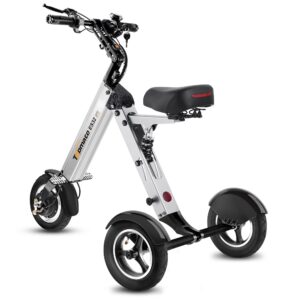
TopMate ES33
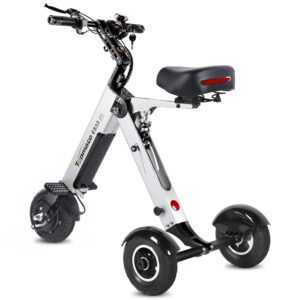
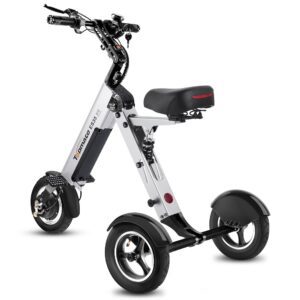
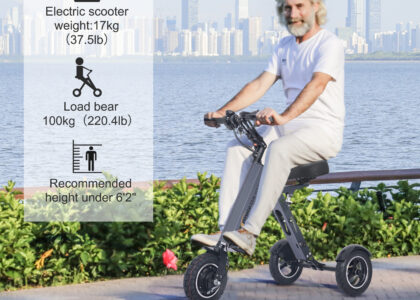
The ES33 is a strong example of a compact travel-oriented design. TopMate’s published specifications list a 35.4 lb net weight, 220.4 lb maximum load, 15.53–18.64 mile recharge mileage, 8-inch front and rear wheels, and an 8-degree gradeability rating. Its folded dimensions are approximately 15.7 × 20.8 × 33.6 inches.
That combination makes the ES33 worth considering for travelers who place significant emphasis on compact storage and transport.
It is better suited to travelers who understand its published specifications rather than assuming that its lightweight construction means it is appropriate for every type of campground terrain.
TopMate ES36
The ES36 puts more emphasis on outdoor-oriented tires while retaining a folding design.
TopMate lists a 39.2 lb weight, 220.5 lb load capacity, 10-inch off-road pneumatic front tires, 250W motor, and approximately 15.5–18.6 miles of range. Its folded dimensions are listed as approximately 18.1 × 22.8 × 35.2 inches.
This configuration may be worth considering for RV travelers who expect a mixture of paved routes and maintained uneven surfaces.
However, “off-road tires” should not be interpreted as permission to ride anywhere. Terrain should remain within the manufacturer’s stated capabilities and the rider’s comfort and safety limits.
TopMate ES15
The ES15 takes a different approach, combining portability with larger pneumatic tires and dual motors.
TopMate lists a 56.88 lb weight without the battery, 300 lb maximum load, 10-inch pneumatic tires, 500W combined nominal motor power, and approximately 16–19 miles of range. It also has a removable lithium battery and a folding mechanism.
For some campers, the higher transport weight may be worthwhile if outdoor traction, load capacity, and larger tires are more important than minimizing lifting weight.
The key is to compare the complete specification against the trip rather than assuming that lighter always means better.
Common Mistakes to Avoid
Choosing only by weight
A scooter that weighs less isn’t automatically the most practical camping scooter.
You also need to consider range, wheel size, load capacity, dimensions, and terrain.
Ignoring folded dimensions
Don’t measure only the available RV storage volume. Check whether the folded scooter can physically pass through the compartment opening.
Assuming lightweight means all-terrain
This is one of the most important distinctions.
A portable scooter can be excellent for travel while still being unsuitable for deep gravel, mud, steep terrain, or rough trails.
Forgetting charging requirements
Check where and how the battery will be charged during your trip. If the battery is removable, determine whether your travel setup makes indoor charging easier.
Not checking weight capacity
Always compare the rider’s weight plus anything carried on the scooter with the manufacturer’s published capacity.
Forgetting how the scooter will be loaded
A scooter may look manageable in a specification sheet but feel very different when lifted from ground level into an RV.
Consider the actual loading height, frequency, and who will perform the task.
Final Decision: Match the Scooter to the Trip
There is no single mobility scooter that is ideal for every camping or RV trip.
If your travel involves mostly paved RV parks and frequent vehicle loading, prioritize portability, folded dimensions, battery convenience, and manageable transport weight.
If you expect uneven campground paths, pay more attention to wheel size, tire construction, ground clearance, stability, gradeability, and the manufacturer’s stated terrain capability.
For long RV journeys, consider the complete travel routine: loading, storage, riding, charging, and unloading.
FAQ
What is the best type of mobility scooter for camping?
A foldable, lightweight mobility scooter is usually the most practical choice for camping because it is easier to transport, store, and charge. However, you should also consider wheel size, ground clearance, stability, battery range, and the type of campground terrain.
Can I take a mobility scooter in an RV?
Yes. A portable or folding mobility scooter can be convenient for RV travel, provided you have enough storage space and a safe way to load and secure it. Check the scooter’s folded dimensions and weight before your trip.
Can a lightweight mobility scooter handle campground paths?
Some lightweight mobility scooters can handle paved campground roads, sidewalks, compact gravel, and moderately uneven surfaces. However, lightweight models are generally not intended for deep mud, loose sand, steep terrain, or very rough trails. Always check the manufacturer’s terrain and slope specifications.
How far can a mobility scooter travel on one charge while camping?
The usable range depends on the scooter, rider weight, terrain, speed, temperature, and battery condition. For camping and RV travel, choose a scooter with enough stated range for your typical daily trips and plan where you will recharge the battery.