For seniors who prioritize easy steering, the most suitable mobility scooter is not necessarily the smallest or lightest model. Easy steering depends on turning radius, scooter width, wheel configuration, steering controls, wheelbase, tire design, and low-speed response. The right model is the one whose steering characteristics match where and how the rider travels.
Who This Guide Is For
This guide is for riders who want predictable steering rather than simply looking for the highest speed or longest range.
It can help:
- Seniors buying their first mobility scooter
- Adults who regularly navigate shops or narrow pathways
- Caregivers comparing compact scooter designs
- Riders who frequently make low-speed turns
- People who need to park or reverse in limited spaces
- Users choosing between three-wheel and four-wheel configurations
- Travelers who need a scooter that remains manageable in unfamiliar environments
The same scooter can feel very different depending on the rider. Hand position, steering technique, confidence, body position, and familiarity with the controls all influence the experience.
What “Easy Steering” Actually Means
What makes a mobility scooter easy to steer?
An easy steering mobility scooter generally combines a manageable turning radius, appropriate width, predictable steering response, accessible controls, and a riding position that lets the user make small directional corrections without excessive movement.
Several specifications deserve attention.
Turning radius indicates how much space the scooter needs to make a turn. A smaller radius can be useful inside stores, apartments, elevators, and narrow paths.
Overall width determines how easily the scooter fits through doorways and between obstacles.
Wheel configuration also matters. Three-wheel layouts generally leave more room for the front steering arc, while four-wheel designs add another contact point and may require more space to turn.
Wheelbase affects directional stability and turning behavior. A longer wheelbase can track steadily but may require more room for tight turns.
Steering control design determines how the rider translates hand movement into directional input. A tiller, handlebar, or other control arrangement can feel different even when two scooters have similar dimensions.
Tire type and pressure affect rolling resistance and steering feel. Pneumatic tires, for example, can behave differently from solid tires when pressure changes.
Finally, low-speed response is critical. A scooter that accelerates quickly may require more precise throttle control in a crowded store than one designed around slower operation.
User Type A: Indoor and Tight-Space Users
Consider a rider living in an apartment, retirement community, or smaller home. Their daily route might include a hallway, elevator, doorway, kitchen, or compact shopping aisle.
For this user, the first specifications to check are overall width and turning radius.
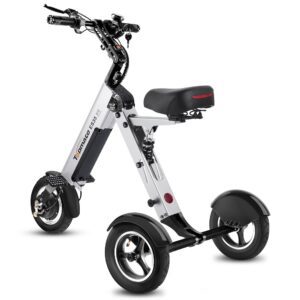
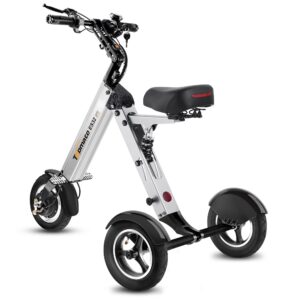
The TopMate ES33 measures 53 cm (20.8 inches) wide when unfolded. Its three-wheel configuration is designed for maneuverability, and TopMate describes it as suitable for short trips and daily commuting. The manufacturer lists 8-inch front and rear wheels and an unfolded length of 94.5 cm (37.2 inches).
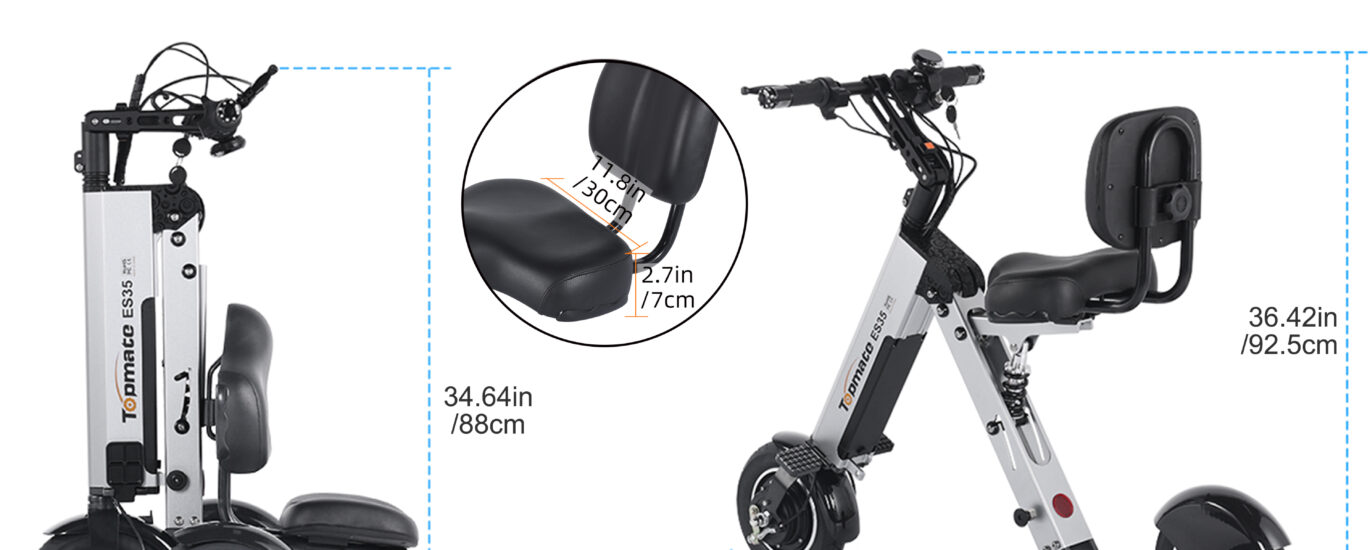
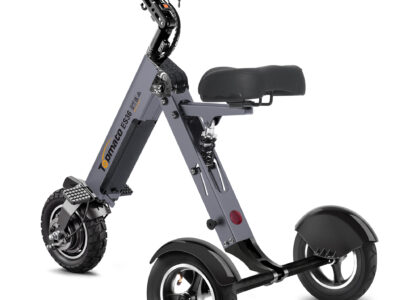
The ES35 is wider at 57.5 cm (22.6 inches) and measures 99 cm (38.98 inches) long when unfolded. It also uses a three-wheel configuration with 10-inch wheels.
That difference of about 4.5 cm (1.8 inches) in width may matter in a narrow doorway or hallway.
However, do not assume that a three-wheel scooter will automatically fit every tight space. Measure the actual doorway opening and the area available for turning.
User Type B: Shoppers and Errand Riders
A grocery trip creates a different steering challenge.
The rider may need to approach a checkout, turn around a shopping display, stop near a curb cut, reverse from a parking position, and make several small corrections.
Here, low-speed control becomes particularly important.
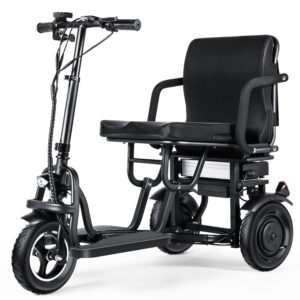
The TopMate ES40 uses four wheels, 8-inch solid tires, and control handles with separate forward and reverse operation. Its manufacturer lists a maximum forward speed of approximately 4 mph, a reverse speed of approximately 1 mph, and a minimum turning radius of 1,200 mm (47.2 inches) in the manual.
That makes the ES40 a useful example of why “easy steering” should not be judged only by wheel count. A four-wheel scooter can offer a different handling experience from a three-wheel model, while its turning requirements may be greater.
For shoppers, compare the turning radius with the spaces you actually use.
User Type C: Frequent Outdoor Riders
Outdoor riders may have more room to maneuver, so turning radius may become slightly less important than other factors.
Consider a rider traveling through a suburban neighborhood in the USA, along paved paths in Canada, through compact UK pedestrian areas, or around parks and outdoor facilities in Australia.
This rider should also examine:
- Wheel diameter
- Tire construction
- Ground clearance
- Motor output
- Maximum gradient
- Weight capacity
- Suspension, if specified
- Overall wheelbase
- Braking system
The TopMate ES15, for example, uses three 10-inch pneumatic tires and two independent 250W brushless motors, providing a combined nominal motor rating of 500W. TopMate lists a maximum slope of 10°, a maximum load of 300 lb, and a maximum speed of 15 mph.
Those figures indicate a scooter designed around a different use profile from a low-speed four-wheel travel scooter.
Still, motor power does not automatically make steering easier. A rider should evaluate how the scooter responds at the speeds they actually intend to use.
User Type D: First-Time Riders
First-time users often benefit from predictable controls more than maximum performance.
The ideal learning environment is an open, flat area with enough room to practice without pedestrians or vehicles nearby.
Start at the lowest practical speed. Practice moving forward in a straight line before making wide turns. Then try gradual left and right turns.
Once those movements feel predictable, practice:
- Stopping smoothly
- Reversing
- Parking
- Making a U-turn
- Approaching a doorway
- Turning around an obstacle
- Starting again after stopping
The objective is not to make the tightest possible turn. Instead, the rider should learn how much steering input produces a particular directional change.
Specifications That Affect Steering
| Specification | Why It Matters |
|---|---|
| Turning radius | Determines the space required for a turn |
| Overall width | Affects doorway and aisle clearance |
| Wheel configuration | Changes steering geometry and handling |
| Wheelbase | Influences tracking and turning behavior |
| Wheel size | Affects surface interaction and rolling behavior |
| Tire type | Changes grip, cushioning, and steering feel |
| Tire pressure | Incorrect pressure can affect handling |
| Steering controls | Determines how hand input reaches the steering system |
| Tiller adjustment | Can change reach and rider posture |
| Scooter weight | Influences transport and manual handling |
| Motor power | Influences acceleration and climbing capability |
| Maximum speed | Affects how quickly the scooter responds to steering inputs |
One important distinction is turning radius versus turning diameter. A radius is measured from the center of the turning circle to its outer edge. The diameter is twice the radius.
When comparing manufacturer specifications, confirm that both scooters use the same measurement.
How Different TopMate Models Compare
The following comparison uses specifications currently published by TopMate. Where a steering-related specification is not published, it is identified rather than estimated.
| Model | Configuration | Weight | Max Load | Wheel Size | Motor | Max Speed | Published Range | Turning Radius |
|---|---|---|---|---|---|---|---|---|
| ES33 | 3-wheel | 16.1 kg / 35.4 lb | 100 kg / 220.4 lb | 8 in front/rear | 250W | 15 mph | 15.53–18.64 mi | Not specified |
| ES35 | 3-wheel | 17 kg / 37.5 lb | 100 kg / 220.4 lb | 10 in front/rear | 250W | 15 mph | 15.53–18.64 mi | Not specified |
| ES40 | 4-wheel | 17.4 kg / 38.36 lb without battery | 125 kg / 275.6 lb | 200 × 50 mm / ~7.9 in | 120W nominal / 240W max | 4.35 mph | 9 or 18 mi depending on battery | ≤1,200 mm / 47.2 in |
| ES15 | 3-wheel | 56.88 lb without battery | 300 lb | 10 in pneumatic | 2 × 250W | 15 mph | 16–19 mi | Not specified |
ES33 specifications come from TopMate’s manual; ES35 specifications come from its current manual; ES40 specifications come from its manual and product page; and ES15 specifications come from its current product listing.
The comparison also shows why there is no meaningful way to label one model universally as the “easiest to steer.” The ES33 is narrower than the ES35, the ES40 provides four-wheel stability and a published turning radius, while the ES15 combines a three-wheel layout with larger pneumatic tires and dual motors.
Recommended Model by User Type
| User Type | Steering Priority | Specifications to Prioritize | Suitable TopMate Model |
|---|---|---|---|
| Indoor and tight-space user | Compact maneuvering | Width, turning radius, wheel configuration | ES33 |
| Shopper and errand rider | Low-speed control and compact handling | Width, controls, reverse function, turning space | ES33 or ES35 |
| Frequent outdoor rider | Steering plus surface capability | Wheel size, tire type, motor output, gradient | ES15 |
| First-time rider | Predictable control | Speed settings, control layout, width, wheel configuration | ES40 or ES33 |
These are use-case recommendations, not universal rankings. Actual suitability depends on rider measurements, terrain, confidence, and the dimensions of the spaces involved.
When a Different Scooter Configuration May Be Better
A three-wheel scooter may provide useful maneuverability, but it is not automatically appropriate for every rider or environment.
Someone who prioritizes four-wheel contact and a slower operating speed may prefer a four-wheel configuration such as the ES40.
A rider who regularly travels over uneven outdoor surfaces may need to look beyond turning radius and examine tire size, ground clearance, motor output, and maximum gradient.
Similarly, a heavier rider should start with weight capacity, not steering characteristics. The ES33 and ES35 are rated for 220.4 lb, while the ES15 is rated for 300 lb and the ES40 for 275.6 lb.
What to Test Before Buying
Before choosing a scooter for easy steering, test the actual movements you expect to make.
Straight-line test: Drive slowly and determine whether you can maintain a straight path with small steering corrections.
Cornering test: Make gradual left and right turns. Notice how much hand movement is required.
Tight-space test: If possible, approach a doorway or marked area similar to the spaces you use at home.
Reverse test: Reverse slowly while checking the surrounding space. Do not rely solely on mirrors or assumptions about where the rear wheels will travel.
Parking test: Try positioning the scooter beside a fixed point. This reveals how predictable the steering feels at very low speed.
Control test: Confirm that the throttle, brake, horn, speed control, and other switches are reachable without changing your grip awkwardly.
Posture test: Your arms should remain comfortably positioned while the scooter is moving. Excessive reaching can make steering corrections less controlled.
Final Buying Guidance
The best mobility scooter for seniors who prioritize easy steering is the model whose steering characteristics match the rider’s environment and control preferences.
For shopping and errands, examine low-speed response, reverse control, and control placement.
For outdoor riding, add wheel size, tire type, motor output, ground clearance, and gradient rating to the comparison.
TopMate’s ES33, ES35, ES40, and ES15 demonstrate how different specifications produce different use profiles. The most useful decision comes from matching those specifications to real-world tasks rather than selecting a model based on a single feature.
FAQ
What makes a mobility scooter easy to steer?
A mobility scooter can feel easier to steer when it has a manageable turning radius, suitable width, predictable steering response, accessible controls, and a wheel configuration that matches the rider’s environment.
Is a three-wheel mobility scooter easier to maneuver?
A three-wheel scooter may provide a tighter turning geometry and can suit riders who frequently navigate narrow indoor spaces. However, wheelbase, steering design, width, tire condition, and rider technique also affect maneuverability.
What turning radius is good for a mobility scooter?
There is no universal ideal turning radius. A smaller turning radius can be useful for indoor spaces, while outdoor users may have enough room for a larger turning circle. Always compare the specification with your actual surroundings.
How can a first-time rider practice steering a mobility scooter?
Practice in a clear, level area at low speed. Start with straight-line driving, then practice wide turns, stopping, reversing, parking, and progressively tighter turns. Focus on smooth steering movements rather than sudden corrections.

-scaled-2-420x300.jpg)