
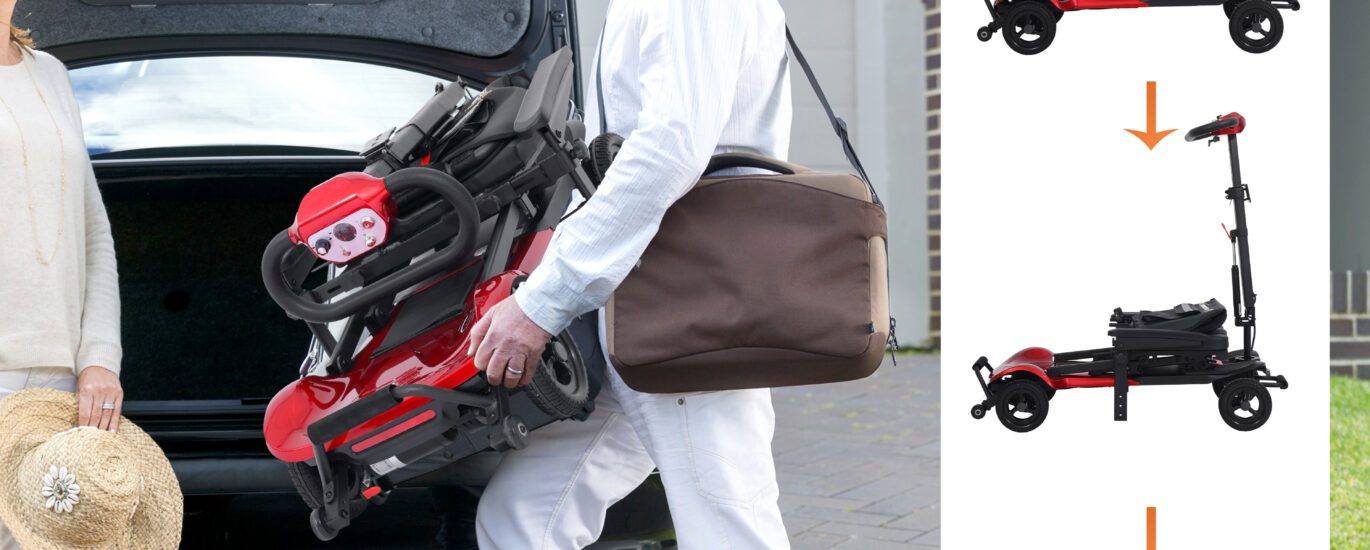
A mobility scooter may be able to use a wheelchair ramp, but the ramp’s slope, width, load capacity, surface, turning space, and the scooter’s own specifications must all be suitable. Before attempting the route, check the scooter manufacturer’s guidance and confirm that the ramp can safely support the scooter, rider, and required maneuvering.
Can a Mobility Scooter Use a Wheelchair Ramp?
Yes, a mobility scooter wheelchair ramp can be suitable in some situations. However, a ramp designed for wheelchair accessibility should not automatically be assumed to be safe for every mobility scooter.
Scooters have different wheel sizes, wheelbases, ground clearances, turning circles, weights, and dimensions. A ramp can meet accessibility requirements and still be unsuitable for a particular scooter.
For example, a narrow ramp may provide enough space for a wheelchair but leave very little clearance around a wider four-wheel scooter. Similarly, a short ramp may appear convenient but create a steeper incline than the scooter can safely manage.
The important question is therefore not simply, “Can a mobility scooter use a wheelchair ramp?” It is:
Does this particular ramp safely match this particular scooter and route?
What Makes a Ramp Suitable for a Mobility Scooter?
Several factors need to be considered together:
- Ramp slope or gradient
- Ramp length
- Ramp width
- Scooter overall dimensions
- Ground clearance
- Wheelbase
- Scooter and rider weight
- Ramp weight capacity
- Turning and maneuvering space
- Surface condition and traction
- Weather conditions
- Manufacturer instructions
A ramp should also be installed or positioned securely. Portable ramps need stable contact with the ground and the upper surface, while permanent ramps should be appropriately constructed for their intended use.
Accessibility guidance can provide useful design principles, but compliance with an accessibility standard does not automatically mean that every mobility scooter can safely use the ramp.
Why Ramp Slope Matters
The slope is one of the most important considerations when evaluating a mobility scooter wheelchair ramp.
A steeper ramp generally requires more effort from the scooter’s motor and can make steering and braking more difficult. It can also increase the risk of losing traction, particularly when the surface is wet.
Do not rely on a single universal maximum slope. Mobility scooters differ considerably, and manufacturers may specify their own limits or operating guidance. Applicable accessibility and safety requirements can also vary by location and type of installation.
Instead, check:
- The ramp’s actual gradient.
- The scooter manufacturer’s maximum recommended gradient, if provided.
- Whether the rider can maintain controlled steering.
- Whether there is enough level space at the top and bottom.
- Whether the ramp remains stable under the expected load.
A simple example
Imagine two ramps reaching the same doorway.
One is long and rises gradually. The other is much shorter and rises the same vertical distance. The shorter ramp has a steeper slope, even though both reach the same entrance.
This is why looking only at ramp length can be misleading.
How Ramp Width Affects Scooter Use
Width matters because a mobility scooter needs enough room for the entire scooter, not simply enough space for its wheels.
Measure the scooter’s overall width, including its widest components. Then consider the usable ramp width rather than simply the manufacturer’s stated ramp width.
A rider also needs enough clearance to maintain a straight path without repeatedly approaching the ramp’s edges.
Width becomes particularly important when:
- The scooter has a wide seat or armrests.
- The ramp has raised side edges.
- The rider needs additional steering room.
- The ramp connects to a doorway at an angle.
- The rider must turn immediately after leaving the ramp.
A ramp that is technically wider than the scooter may still be awkward if there is little maneuvering room around it.
Why Ground Clearance and Wheelbase Matter
Two scooters with similar overall dimensions can behave differently on a ramp.
Ground clearance is important when the scooter transitions between level ground and the ramp. A scooter with limited clearance may be more vulnerable to the underside contacting a steep transition.
Wheelbase also matters. A scooter with a longer distance between its wheels may behave differently when moving over changes in slope or transitions at the top and bottom.
Before using a ramp, look at both ends. The transition should not create a sharp change that causes the scooter’s underside to scrape or the wheels to lose stable contact.
Ramp Weight Capacity
Never evaluate ramp capacity using the scooter’s advertised weight alone.
The total load can include:
Scooter weight + rider weight + carried items
For example, if a scooter weighs 100 lb and the rider weighs 180 lb, the ramp must support at least the combined load of 280 lb, subject to the ramp manufacturer’s stated capacity and safety requirements.
For a portable ramp, also check whether the stated capacity applies to the intended configuration and whether the ramp requires specific support conditions.
Do not exceed the manufacturer’s load rating.
Surface, Traction, and Weather
A ramp’s surface can change how safely a scooter climbs or descends.
Wet, muddy, icy, oily, or otherwise slippery surfaces can reduce tire traction. Rain can also make some ramp materials more difficult to use.
Before riding onto the ramp, inspect it for:
- Water or ice
- Loose dirt or gravel
- Oil or other contaminants
- Damaged sections
- Loose edges
- Objects blocking the path
A ramp may be suitable in dry conditions but require extra caution or avoidance when its surface becomes slippery.
Approaching and Leaving the Ramp Safely
Approach the ramp as straight as practical rather than entering it at an angle.
Reduce speed before reaching the ramp and maintain a controlled speed throughout the climb or descent. Avoid sudden steering movements or abrupt acceleration.
At the top, make sure there is sufficient level space before turning. At the bottom, allow the scooter to return fully onto stable ground before making a sharp turn.
Do not stop partway up a ramp unless the scooter and ramp manufacturers specifically indicate that doing so is safe.
Portable Ramps vs Permanent Ramps
Portable ramps
Portable ramps can be useful for temporary access, vehicles, thresholds, or locations where a permanent structure is not practical.
However, check:
- Ramp length
- Usable width
- Weight capacity
- Folding or telescoping mechanism
- Surface traction
- Support points
- Storage requirements
- Whether the ramp is appropriate for the scooter
A folding ramp must be fully deployed and secured according to its instructions before use.
Permanent ramps
Permanent ramps may provide a more predictable route when properly designed and installed. They can also offer better maneuvering space and smoother transitions.
However, the fact that a ramp is permanent does not automatically make it suitable for a particular scooter. The scooter’s dimensions and operating requirements still need to be considered.
Common Ramp Situations
Home entrance
Check the distance from the driveway or path to the doorway. Pay particular attention to the ramp’s slope and the space available to turn after reaching the entrance.
Store entrance
A store may have a wheelchair-accessible entrance, but the approach can still be difficult if the ramp is narrow, crowded, wet, or followed immediately by a tight doorway.
Vehicle loading
Vehicle ramps are a separate situation from building-access ramps. The ramp must match the vehicle height, loading angle, scooter dimensions, and total weight. Follow both the vehicle-ramp and scooter manufacturer’s instructions.
Public building
For public buildings, accessibility provisions may make access easier, but conditions can vary. Check the route, entrance width, ramp surface, doors, and turning areas rather than assuming that an accessible entrance will accommodate every scooter.
When Should You Avoid a Ramp?
Avoid using the ramp when you cannot confirm that the scooter and ramp are compatible.
This includes situations where:
- The slope exceeds the scooter manufacturer’s guidance.
- The ramp’s weight rating is insufficient.
- The ramp is too narrow for controlled travel.
- The surface is dangerously slippery.
- The ramp is unstable or damaged.
- There is insufficient space to approach or leave safely.
- The scooter’s underside could contact the ramp.
- The rider cannot maintain adequate control.
If you are uncertain about a particular ramp, find a safer accessible route rather than testing its limits.
What Measurements Should You Check Before Buying or Using a Ramp?
Before purchasing or using a ramp, record the measurements that affect the entire route:
For the ramp:
- Length
- Width
- Height it needs to reach
- Slope or gradient
- Weight capacity
- Surface characteristics
For the scooter:
- Overall width
- Overall length
- Weight
- Ground clearance
- Wheelbase
- Manufacturer’s gradient guidance
Also measure the available turning area at both ends.
A useful approach is to measure the complete route, not just the ramp. A ramp may work perfectly on its own but become impractical if the doorway, landing, driveway, or sidewalk leaves insufficient maneuvering space.
Before You Go Checklist
Before using a mobility scooter on a ramp, ask:
Is the slope within the scooter manufacturer’s guidance?
Can the ramp support the scooter, rider, and cargo?
Is the usable width sufficient for controlled travel?
Can the scooter clear the ramp transitions without scraping?
Is the surface clean, dry, stable, and sufficiently grippy?
Is there enough room to approach, exit, and turn?
If all of these factors check out, the ramp may be appropriate. If one important factor is uncertain, verify it before attempting the route.
Conclusion
A mobility scooter wheelchair ramp can provide useful access, but suitability depends on the combination of ramp and scooter. Slope, length, width, weight capacity, ground clearance, wheelbase, traction, weather, and maneuvering space all matter.
The safest approach is to compare the ramp’s specifications with the scooter manufacturer’s guidance and evaluate the complete route. Accessibility design can provide an important foundation, but it should not be treated as an automatic guarantee that every mobility scooter will fit or operate safely.
FAQ
Can a mobility scooter go up a steep ramp?
A mobility scooter may climb a ramp only when the gradient is within the scooter manufacturer’s specified operating guidance and the ramp provides adequate traction, stability, and clearance. A steeper slope can affect motor performance, steering, braking, and traction, so do not assume that a scooter can safely climb a ramp simply because it is short.
How wide does a ramp need to be?
There is no single width that is suitable for every mobility scooter. The ramp should provide enough usable width for the scooter to travel in a controlled, straight path while accounting for the scooter’s widest dimensions and the ramp’s side edges. Check the scooter’s actual width and the ramp manufacturer’s specifications before use.
Can a folding mobility scooter use a portable ramp?
A folding mobility scooter can potentially use a portable ramp if the ramp’s width, slope, load capacity, surface, and support configuration are suitable. Folding the scooter does not necessarily make it suitable for every ramp. When the scooter is being driven, evaluate its operating dimensions and specifications rather than its folded size.
What should I check before using a ramp?
Check the ramp’s slope, length, usable width, weight capacity, surface condition, stability, and turning space. Compare these with the scooter’s width, weight, ground clearance, wheelbase, and manufacturer guidance. Also consider the rider’s weight and any cargo because the ramp must safely support the complete load.

-scaled-2-420x300.jpg)