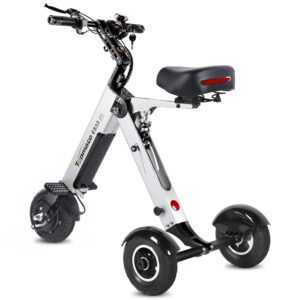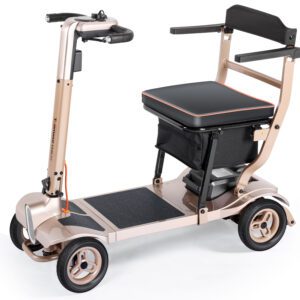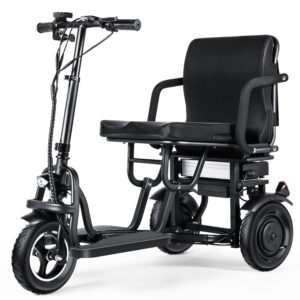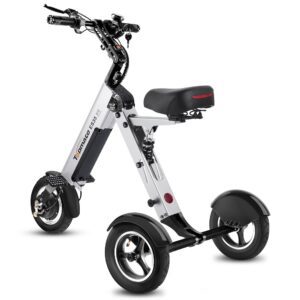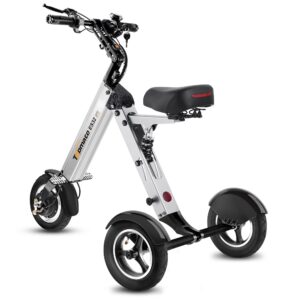

A mobility scooter works by using stored electrical energy from a rechargeable battery to power an electric motor. A controller regulates that power based on the rider’s controls, while the drivetrain turns the wheels. Steering changes direction, and electromagnetic or mechanical brakes slow or stop the scooter.
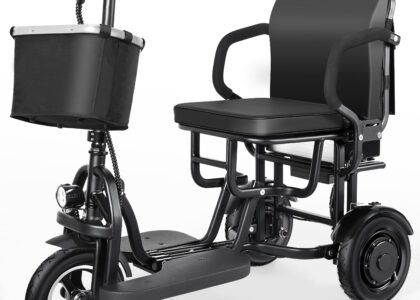
If you’ve never used one, it can look like a fairly simple machine: a seat, two or four wheels, handlebars, and a battery. Underneath, however, several electrical and mechanical systems work together every time the scooter moves.
Understanding those systems makes it easier to understand what affects range, speed, hill climbing, steering, comfort, and charging.
What Happens When You Turn a Mobility Scooter On?
The process starts when the rider inserts a key, presses a power button, or activates another type of ignition system.
Turning the scooter on connects the battery’s electrical power to the scooter’s control system. The display or control panel may light up and show information such as battery level, speed, or fault indicators.
At this point, the motor is not necessarily running. The controller is essentially waiting for an instruction from the rider.
Think of the controller as the scooter’s traffic manager. It receives information from the controls and determines how much electrical power should be sent to the motor.
The Battery: Where the Energy Comes From
The battery stores the electrical energy needed to operate the scooter.
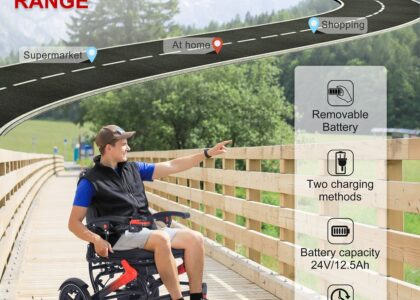
Many modern mobility scooters use rechargeable lithium-ion batteries, while some larger or older scooters use sealed lead-acid batteries. Battery specifications are commonly expressed in volts (V) and amp-hours (Ah).
For example, a battery might be rated at:
- 24 V and 20 Ah
- 36 V and 10 Ah
- 48 V and 20 Ah
A useful way to estimate stored energy is:
Watt-hours (Wh) = Volts (V) × Amp-hours (Ah)
So, a 24 V, 20 Ah battery has a nominal capacity of about 480 Wh.
That does not mean the scooter will necessarily use exactly 480 Wh during a journey. Terrain, rider weight, speed, temperature, tire condition, hills, and driving habits all affect energy consumption.
What does the battery actually power?
The battery supplies electricity to the scooter’s electrical systems, most importantly the motor controller and motor. It may also supply power to lights, displays, indicators, and other electronics.
The battery is therefore the scooter’s energy reservoir—not the part that physically turns the wheels.
The Controller Decides How Much Power to Use
Between the battery and motor is the controller.
When the rider operates the throttle or speed control, the controller interprets that input. It then regulates electrical current flowing to the motor. mobility scooter actually work
This allows the scooter to accelerate progressively rather than simply switching the motor between “off” and “full power.”
The controller can also coordinate functions such as:
- Speed regulation
- Reverse operation
- Braking
- Battery protection
- Fault detection
- Current limiting
This is one reason a scooter can respond differently depending on how gently or firmly the rider operates its controls.
The Motor Turns Electrical Energy Into Movement
The electric motor is what ultimately produces the force needed to move the scooter.
When electrical power reaches the motor, electromagnetic forces cause the motor’s internal components to rotate. That rotational movement is transferred through the drivetrain to the driven wheel or wheels.
Mobility scooter motors are often described by their power rating in watts (W). Depending on the scooter, motor ratings can range from relatively low-power units around 200–250 W to several hundred watts or more on larger models.
A higher motor wattage can provide greater potential for handling demanding conditions, but wattage alone does not determine performance. Motor design, gearing, controller settings, battery capability, total load, and terrain also matter. mobility scooter actually work
How the Wheels and Drivetrain Move the Scooter
The motor’s rotation has to reach the wheels.
Depending on the design, the motor may drive one or more wheels through a gearbox or transaxle assembly. The drivetrain converts the motor’s rotation into usable wheel torque.
This is particularly important when the scooter starts moving or travels uphill.
A scooter doesn’t simply need enough power to achieve a certain speed. It also needs sufficient torque to overcome resistance from the rider’s weight, tires, slopes, and the surface underneath.
A practical example
Imagine the same scooter being used on two different surfaces.
On a flat, smooth indoor floor, relatively little force is needed to maintain movement.
On a steep outdoor slope, gravity works against the scooter. The motor and drivetrain must produce more torque, and the battery may supply more current.
That’s why a scooter’s performance can change noticeably on hills even when the battery still shows a reasonable charge.
Steering: Turning the Scooter in the Desired Direction
Most mobility scooters use a tiller rather than a traditional steering wheel.
The rider moves the tiller left or right. This mechanically changes the direction of the front wheel or steering assembly.
Four-wheel and three-wheel scooters can have different steering characteristics.
A three-wheel configuration can provide a tighter turning circle on some designs. A four-wheel configuration may provide a broader footprint. However, the actual turning radius depends on the specific chassis and steering geometry.
This matters when maneuvering through:
- Doorways
- Hallways
- Shopping aisles
- Elevators
- Parking areas
- Tight corners
Accelerating: From a Small Control Movement to Moving Wheels
Now the complete process can be followed.
Step 1: The rider operates the throttle
The rider gently presses or operates the throttle control on the tiller.
Step 2: The controller receives the signal
The controller determines that the rider wants to move and calculates how much power should be supplied.
Step 3: Electrical power reaches the motor
The battery supplies electrical energy through the controller to the motor.
Step 4: The motor rotates
The motor converts electrical energy into mechanical rotational movement.
Step 5: The drivetrain turns the wheels
Gears or other drivetrain components transfer that rotation to the driven wheels.
Step 6: The scooter moves
The tires push against the ground, producing forward motion.
The process happens very quickly, so the rider experiences it simply as “press the control and move.”
What Happens When You Release the Throttle?
When the rider releases the throttle, the controller reduces or stops power to the motor.
Many mobility scooters use electromagnetic braking. In simple terms, the braking system can automatically engage when the drive control is released or when the scooter is switched off.
Some scooters may also have mechanical braking components or parking-brake arrangements.
The exact braking system varies by model, so the manufacturer’s documentation should always be followed.
The Display and Control Panel
The control panel gives the rider information and access to operating functions.
Depending on the scooter, it may show:
- Battery level
- Current speed
- Lighting status
- Direction
- Fault codes
- Warning indicators
- Speed adjustment
Some basic scooters have simple gauges and switches, while more advanced models may use digital displays.
The display doesn’t normally provide the energy itself. It communicates information from the scooter’s electrical system to the rider.
The Charger: Putting Energy Back Into the Battery
After a journey, the battery needs to be recharged.
The general process is:
Scooter/battery → charger connection → electrical current → battery → stored chemical energy
The charger converts household electrical power into a form suitable for the scooter’s battery.
Charging time varies substantially. A small battery may take several hours, while a larger battery can require 6–10 hours or longer depending on its capacity, charger, battery chemistry, and state of charge.
Always use the charger specified or approved for the particular battery system.
One important distinction
A battery’s voltage describes its electrical potential, while amp-hours describe its nominal charge capacity. Watt-hours combine the two to provide an approximate measure of stored energy.
These numbers should not be treated as guaranteed real-world range.
One Simple Look at the Main Components
| Component | What it does | What the rider notices |
|---|---|---|
| Battery | Stores electrical energy | Range and charging needs |
| Controller | Regulates electrical power | Smooth acceleration and control |
| Motor | Converts electrical energy into rotation | Movement and hill performance |
| Throttle | Tells the controller to accelerate | Speed response |
| Brakes | Reduce or stop movement | Stopping distance and control |
| Drivetrain | Transfers motor rotation to wheels | Traction and movement |
| Wheels/tires | Contact the ground | Ride quality and stability |
| Tiller | Controls steering direction | Maneuverability |
| Display | Shows operating information | Battery/speed/status information |
| Charger | Replenishes battery energy | Charging time |
What Happens When the Battery Is Low?
As battery charge decreases, the scooter may provide warnings through its battery gauge or display.
Performance can eventually be affected, particularly under demanding conditions such as hills.
The displayed battery level should therefore be treated as an indicator rather than a precise prediction of remaining distance.
What Happens When the Battery Is Completely Discharged?
If the battery becomes fully discharged, the scooter’s motor cannot continue operating normally because there is insufficient electrical energy available.
The scooter may stop before reaching the destination.
This is why practical range should be considered with a safety margin rather than planning a journey around the manufacturer’s maximum range figure.
What Happens When the Motor Is Overloaded?
If the scooter encounters excessive resistance—for example, a steep incline combined with a heavy load—the motor may demand more current.
The controller can limit current to protect the electrical system. Depending on the design, the scooter may slow down, stop, or display a fault condition.
Repeated operation beyond the scooter’s rated load or intended terrain can place additional stress on the motor, controller, battery, and drivetrain. mobility scooter actually work
What Happens When the Scooter Goes Uphill?
Going uphill requires more energy than traveling on level ground.
Gravity creates additional resistance, so the motor needs greater torque to maintain movement. This can increase battery consumption and reduce speed.
A scooter’s ability to climb a hill depends on factors including:
- Gradient
- Rider and cargo weight
- Motor and controller characteristics
- Battery condition
- Tire condition
- Surface type
- Manufacturer’s rated maximum slope
A scooter’s advertised top speed therefore tells you very little about how it will perform on a steep hill.
What Actually Matters to the Rider?
The technical components matter because they produce practical differences.
Battery capacity affects range. A larger energy reserve can support longer trips, although real-world range depends on conditions.
Motor and drivetrain characteristics affect hill climbing. Torque and available power become especially important on slopes.
Controller behavior affects acceleration and responsiveness.
Steering geometry affects maneuverability. This becomes noticeable in tight indoor spaces.
Wheels and suspension affect the ride. Tire size, tire type, suspension design, and surface conditions can influence comfort.
Charger and battery design affect convenience. A scooter that needs many hours to recharge may require more planning for frequent daily use.
Typical mobility scooter speeds are often in the range of approximately 4–8 mph (6–13 km/h), but this varies by model and jurisdiction. Likewise, motor power, battery voltage, battery capacity, range, charging time, and maximum load vary considerably.
For any specific scooter, the manufacturer’s specifications and operating manual are the appropriate source for exact limits.
FAQ
Does a mobility scooter use fuel?
No. A mobility scooter normally uses rechargeable electrical energy stored in its battery rather than gasoline or diesel fuel.
Does the motor run all the time?
No. The motor receives power when the control system calls for movement. Releasing the throttle normally reduces or stops drive power.
Why does a scooter slow down on hills?
A hill increases the force required to move the scooter. The motor needs more torque, and the control system may limit available power. As a result, speed can decrease.
How long does a mobility scooter battery take to charge?
Charging time varies by battery type, capacity, charger, and state of charge. Several hours is common, with some systems requiring around 6–10 hours or longer. Always follow the manufacturer’s charging instructions.