
Quick Answer
Choosing a mobility scooter for daily commuting starts with understanding your complete route, not just the distance from home to your destination. Check battery range, tire size, turning space, comfort, weight capacity, and portability. If your journey includes sidewalks, shopping areas, building entrances, parking lots, and multiple stops, match the scooter’s specifications to the most demanding parts of your routine.
Key Takeaways
- Map your entire commute, including every stop, detour, and return journey.
- Choose a scooter with enough practical battery range to accommodate changing conditions.
- Compare tires, ground clearance, stability, and the manufacturer’s terrain guidance before riding uneven surfaces.
- Check turning space, doorway widths, and access around shops and buildings.
- Consider folding dimensions, lifting weight, and removable batteries if you transport the scooter by car.
- A compact folding scooter may suit a mixed commute, but some routes require a larger mobility scooter or another transport option.
1. Start by Mapping Your Actual Commute
A regular commute rarely involves one consistent surface. You might leave home on a paved path, cross a parking area, enter a shopping centre, visit a clinic, and return by a slightly different route.
Each section creates different demands. Uneven paving tests the scooter’s tires and ground clearance. Tight entrances require manageable dimensions and steering control. Longer outdoor sections increase battery demands, while multiple stops may involve repeated starting, stopping, turning, and parking.
Before comparing models, record your usual destinations and the surfaces connecting them. Include kerbs, ramps, slopes, narrow passages, and areas where pedestrians gather.
Also check whether the route has accessible alternatives. A shorter path is not necessarily the safest or most practical if it includes steep ramps, damaged paving, or inaccessible entrances.
2. Choose a Battery Range That Covers the Whole Journey
The advertised maximum range is a useful starting point, but it should not determine your purchase by itself.
Manufacturers usually state range under particular testing conditions. Actual distance can vary with rider and cargo weight, terrain, gradients, temperature, battery condition, tire pressure, speed settings, and repeated acceleration.
For example, a scooter advertised with a range of 16 miles might not deliver that distance on a commute involving hills, frequent stops, and a heavier load.
Calculate your round-trip distance first. Add the mileage for errands and likely detours, then allow a reasonable reserve rather than planning to use the battery almost completely every day.
Consider these questions:
- How many miles or kilometres do you travel on a typical day?
- Do you make several stops before returning home?
- Can you recharge at work or another regular destination?
- Can you remove the battery for charging, if the model supports it?
- Will colder weather or changing conditions affect your usual journey?
A removable battery can make charging more convenient when you cannot bring the entire scooter indoors. However, confirm the battery’s weight, charging instructions, compatibility, and replacement availability before buying.
3. Match the Wheels and Frame to Your Route
A mixed commute may include smooth indoor flooring and outdoor paths with cracks, joints, or uneven paving. Wheel size, tire type, ground clearance, and the scooter’s approved terrain limits all matter.
Pneumatic tires can help absorb some vibration, although they need appropriate pressure and maintenance. Smaller wheels may be convenient for a compact design but can be less forgiving on surface irregularities.
Do not assume that a scooter advertised for travel or commuting can safely handle every outdoor surface. Loose gravel, deep potholes, grass, steep cambers, and broken paving may exceed its capabilities.
Check the manufacturer’s maximum gradient and surface guidance. Avoid obstacles that could cause the frame to ground out, a wheel to lose contact, or the scooter to become unstable.
If your route regularly includes rough paths or significant slopes, compare models specifically rated for those conditions. A scooter designed mainly for smooth paths may not be the right choice, even if its battery range looks sufficient.
4. Check Turning Space and Indoor Access
A commute can become difficult when a scooter fits comfortably on an outdoor path but cannot manoeuvre through a shop entrance or around a crowded waiting room.
Measure the narrowest doorways, corridor sections, lift entrances, and storage spaces you use. Check the scooter’s overall width and length, along with its published turning radius where available.
Three-wheel and four-wheel designs can behave differently, but wheel count alone does not determine manoeuvrability or stability. Compare the complete design and, whenever possible, test the scooter in a representative space.
Also consider how easily you can control the scooter at low speeds. Shopping areas and building entrances often require careful positioning rather than travelling quickly.
5. Balance Comfort, Stability, and Carrying Capacity
Look for supportive seating, a comfortable riding position, accessible controls, and sufficient legroom. If you experience discomfort during longer rides, test the scooter for a realistic period before committing to it.
Weight capacity matters too. Include clothing, bags, groceries, and any other carried items when checking the manufacturer’s maximum load. Do not exceed that limit.
Stability deserves particular attention on ramps, uneven surfaces, and sloping paths. Follow the manufacturer’s guidance for gradients and turning, and avoid abrupt manoeuvres on surfaces that could affect wheel contact.
If you have difficulty transferring onto a seat, operating the controls, or maintaining a comfortable posture, arrange a hands-on assessment with a qualified mobility specialist where available.
6. Decide Whether You Need a Folding or Larger Scooter
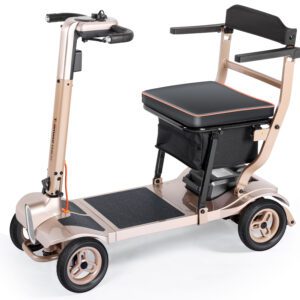
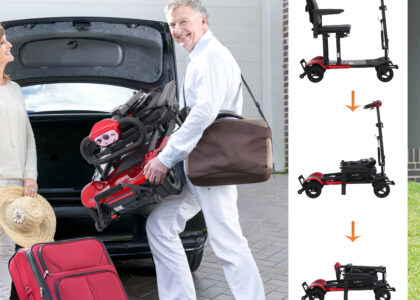
A compact folding scooter can be practical when your commute combines riding with car travel, indoor storage, or public transport. Its smaller folded dimensions may make it easier to store between journeys.
However, folding designs can involve compromises in seat support, wheel size, load capacity, and suitability for demanding outdoor routes. A larger scooter may offer features better suited to longer rides or more challenging conditions, but it can be harder to transport and store.
Compare the scooter’s total weight with and without its battery. A removable battery may reduce the weight of the component you need to lift, but the remaining frame can still be heavy. Confirm whether you or your caregiver can safely manage the loading process.
TopMate models worth comparing
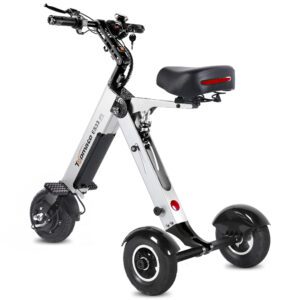
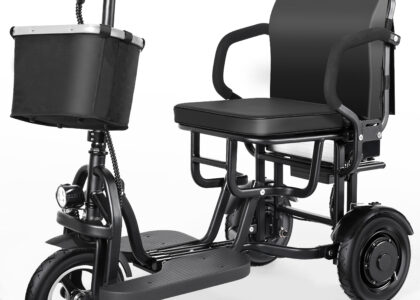
- TopMate ES15: The official product listing specifies a removable 36V 7.8Ah lithium battery, a folding design, pneumatic tires, and a maximum load of 300 lb. It may be worth evaluating if your commute includes outdoor paved sections and regular vehicle transport. Check its full dimensions and terrain suitability against your route.
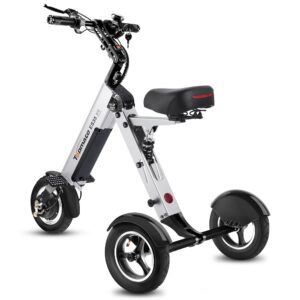
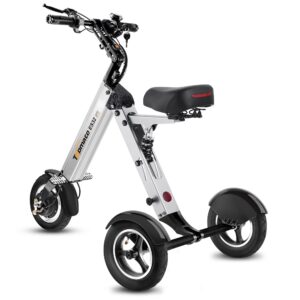
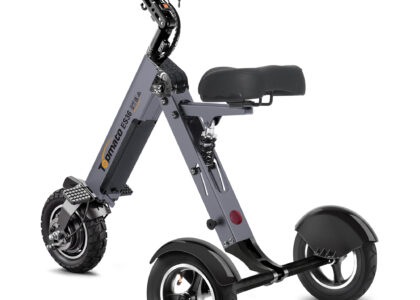
- TopMate ES35: The published specifications include 10-inch pneumatic tires, a removable 36V 7.8Ah battery, and a maximum load of approximately 220 lb. It may be relevant for mixed paved routes when its load limit and dimensions suit the rider.
Neither model should be treated as suitable for every commute. Compare current official specifications and test the scooter on representative surfaces before deciding.
7. Four Realistic Commuting Scenarios
Scenario 1: Visiting a local shop
Your journey involves a paved sidewalk, a crossing, and narrow aisles inside a shop. Prioritise manageable width, low-speed control, a comfortable seat, and sufficient space to turn. Check the entrance and the shop’s accessibility before relying on the route.
Scenario 2: Attending regular appointments
You travel to a clinic or community centre several times a week. Calculate the return journey and any extra distance inside the building or around its grounds. Check battery reserve, waiting-area access, and whether charging is available if your schedule changes.
Scenario 3: Travelling between a car park and a building
You drive to a destination and use the scooter for the remaining distance. Folding dimensions, lifting weight, battery removal, and storage in the vehicle become important. Also assess the route from the parking space to the entrance; ramps, uneven paving, and traffic crossings may be more challenging than the distance suggests.
Scenario 4: Making several short stops
You visit a pharmacy, collect groceries, and then attend an appointment. Add the distance between every stop, not just the distance from home. Consider basket or bag capacity, safe parking, battery reserve, and the time needed to manoeuvre through busy areas.
8. Compare Commuting Needs With the Right Specifications
| Commuting need | What to check |
|---|---|
| Long round trip | Advertised range, battery capacity, and practical reserve |
| Frequent stops | Battery performance, low-speed control, and braking |
| Cracked or uneven paving | Tire type and size, ground clearance, and terrain rating |
| Narrow entrances | Overall width, length, and turning radius |
| Car transport | Folded dimensions, lifting weight, and removable battery |
| Longer rides | Seat support, posture, and riding comfort |
| Rider plus shopping bags | Maximum load capacity |
| Sloped routes | Rated gradient, traction, braking, and manufacturer guidance |
| Indoor storage | Folded footprint and safe charging arrangements |
9. Use This Checklist Before Buying
Map your routine and confirm each point before selecting a model.
-
Measure the full round-trip distance, including all stops.
-
Identify the roughest surfaces, steepest slopes, and most difficult crossings.
-
Measure narrow doorways, corridors, and storage areas.
-
Confirm that the scooter’s terrain rating suits the route.
-
Check battery range and plan a practical reserve.
-
Verify the maximum load, including bags and other cargo.
-
Test seating, controls, turning, and low-speed manoeuvring.
-
Confirm the folded dimensions and the weight you must lift.
-
Check charging access, battery compatibility, and local service options.
-
Review local rules for scooter use on sidewalks, roads, and shared paths.
10. When a Mobility Scooter May Not Suit the Route
A mobility scooter may not be appropriate if your regular journey requires negotiating deep potholes, loose surfaces, steep slopes beyond the manufacturer’s rating, inaccessible steps, or narrow passages that prevent safe turning.
Busy roads, unsafe crossings, and routes without suitable accessible paths may also require a different plan. Consider an accessible taxi, community transport, a vehicle drop-off, or a different route where practical.
Local rules vary across the USA, UK, Canada, and Australia. Check the requirements that apply to your location, including where you may ride, speed restrictions, lighting, and any registration or equipment requirements.
Never assume that a scooter is safe for a route simply because it can physically reach the destination. The complete journey must be accessible and manageable for both the rider and the equipment.
Final Thoughts
The best mobility scooter for daily commuting is the one that fits your complete route, not simply the one with the longest advertised range or smallest folded size. Compare the terrain, distance, turning space, comfort, load limit, and transport requirements together. A route checklist and a practical test can help you identify the most suitable design before making a purchase.
FAQ
What range should I look for in a mobility scooter for daily commuting?
Choose a range that comfortably covers your full round trip, including errands and likely detours. Allow a battery reserve because rider weight, hills, frequent stops, temperature, and battery condition can reduce the distance available in everyday use.
Are folding mobility scooters suitable for mixed routes?
Some folding scooters can suit commutes involving paved paths, shops, and vehicle transport. However, suitability depends on wheel design, ground clearance, stability, load capacity, and the manufacturer’s terrain guidance. Check the most difficult section of your route before buying.
Can I charge a mobility scooter at work or while visiting appointments?
That depends on the available facilities, the scooter’s charging instructions, and permission to charge at the destination. A removable battery can simplify indoor charging on compatible models. Always use the approved charger and follow the manufacturer’s battery safety guidance.
Should I choose a three-wheel or four-wheel mobility scooter for commuting?
Neither design is universally best. Compare turning space, stability, dimensions, wheel configuration, and the surfaces you regularly encounter. Test the scooter if possible, particularly if your route includes tight indoor spaces, slopes, or uneven paving.