-1000x550.jpg)
If you’re deciding between a portable and full-size mobility scooter, the easiest way to choose is not to start with the scooter. Start with your daily routine.
Do you need to put the scooter in a car several times a week? Do you live in a small apartment? Are most of your trips short and on paved surfaces? Or do you spend hours outdoors and need more seating space, ground clearance, and battery capacity?
Those questions can lead to very different answers.
In general, a portable mobility scooter makes more sense when transportation and storage are priorities, while a full-size scooter can be more suitable for frequent outdoor riding, longer trips, and users who need more space or capability. However, there is no universal winner. Individual scooter specifications matter more than the category name.
The Question I Would Ask First: How Will You Actually Use It?
When helping someone choose a mobility scooter, I would start with five questions:
- Where will you ride most often?
- How far do you normally travel?
- Will you need to put the scooter in a vehicle?
- Where will you store it?
- What weight capacity and seating space do you need?
These questions quickly reveal whether portability or riding capability should take priority.
For example, someone who drives to a shopping center, removes the scooter from the vehicle, rides around the store, and then loads it again has very different requirements from someone who rides several miles outdoors every day.
That is why simply asking, “Which scooter is better?” isn’t particularly useful.
Scenario 1: You Regularly Put Your Scooter in a Car
Suppose you visit medical appointments, shopping centers, family members, or community facilities several times a week.
In that situation, transportation can become one of the most important factors.
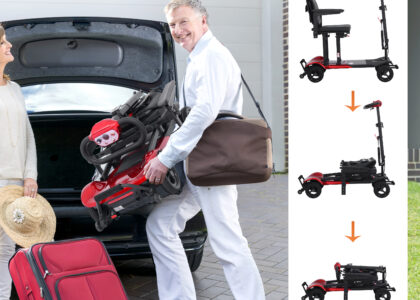
A portable scooter is generally easier to transport because it may have:
- A folding frame
- Compact dimensions
- Removable components
- Lower overall weight
However, don’t assume that every portable scooter is easy for one person to lift.
A scooter weighing around 60 lb may still be difficult to load repeatedly, particularly if you have limited lifting strength.
Before buying, measure both the scooter and the vehicle.
Check:
- The vehicle’s cargo opening
- Trunk or cargo-area dimensions
- The scooter’s folded dimensions
- The actual lifting weight
- How often you expect to load and unload it
My view: If the scooter will regularly travel by car, transportation should be one of your first buying criteria—not an afterthought.
Scenario 2: You Live in an Apartment or Have Limited Storage
Storage is another situation where portable scooters can have a practical advantage.
A full-size scooter can require considerably more space because of its larger frame. Portable models, particularly folding designs, can reduce the amount of space needed for storage.
This can matter if your scooter needs to be stored:
- Inside an apartment
- In a small home
- In a retirement community
- In a limited indoor storage area
- Alongside other household items
Measure your available storage space before choosing a scooter.
Don’t rely only on descriptions such as “compact.” Compare the actual folded and unfolded dimensions with the space available in your home.
Scenario 3: Most of Your Trips Are Short
If your typical trips are relatively short, you may not need the larger battery systems commonly found on full-size scooters.
A portable scooter can be practical for trips such as:
- Nearby shopping
- Appointments
- Visiting friends
- Community facilities
- Short neighborhood journeys
That doesn’t mean range is unimportant.
Instead, estimate your normal round-trip distance and leave some battery reserve rather than planning around the maximum advertised range.
Real-world range can vary with factors such as:
- Rider weight
- Terrain
- Temperature
- Tire pressure
- Speed
- Battery condition
- Riding habits
So a published maximum range should be treated as a test result, not a guarantee of how far you will travel in every situation.
Scenario 4: You Spend Most of Your Time Riding Outdoors
This is where the decision can change.
If your scooter will spend most of its time outdoors, a full-size model may offer characteristics that make extended riding more practical.
Depending on the model, full-size scooters may provide:
- Larger tires
- Greater ground clearance
- Larger batteries
- Suspension
- More supportive seating
- Higher weight capacity
These features can become especially useful when riding on uneven pavement, slopes, grass, or other challenging surfaces.
However, portable does not automatically mean indoor-only.
Some portable scooters also offer features suitable for outdoor use. The important thing is to compare the actual specifications, including tire type, motor output, ground clearance, weight capacity, and climbing capability.
Scenario 5: Comfort Matters More Than Portability
There is another situation buyers sometimes overlook: how long they will actually sit on the scooter.
If your trips are short, a compact scooter may provide everything you need.
But if you expect to ride for longer periods, pay closer attention to:
- Seat width
- Back support
- Armrests
- Riding position
- Suspension
- Available seating space
Full-size scooters often have larger and more supportive seating because their frames are designed around sustained riding. portable vs full-size
In this situation, saving space may not be worth sacrificing the comfort you need during longer journeys.
Portable vs Full-Size: What Are You Really Trading Off?
The choice is essentially a trade-off between transportability and riding capability.
A portable scooter generally prioritizes:
- Easier transportation
- Compact storage
- Easier handling
- Smaller turning dimensions
- Shorter or moderate journeys
A full-size scooter generally prioritizes:
- Outdoor riding
- Longer journeys
- Larger seating areas
- Greater battery capacity
- Higher ground clearance
- Greater weight capacity on many models
Neither category automatically wins.
A portable scooter can still have useful range, meaningful weight capacity, pneumatic tires, and outdoor functionality. Likewise, a full-size scooter may be unnecessary for someone whose biggest concern is getting a scooter into a car.
What About Range?
Full-size scooters usually have greater potential range because they commonly accommodate larger battery systems.
However, scooter size alone doesn’t determine range.
When comparing two scooters, look at:
- Battery voltage
- Amp-hour capacity
- Battery chemistry
- Manufacturer-stated range
- Conditions used for the range test
- Whether the battery is removable
For a buyer who frequently travels longer distances, battery capacity deserves more attention.
For someone whose journeys are short, portability may be more important than maximizing range.
What About Weight Capacity?
Weight capacity should be treated as a practical requirement rather than simply another specification.
Consider your:
- Body weight
- Clothing
- Shopping
- Bags
- Other items carried on the scooter
Full-size scooters often offer higher weight capacities, but portable models can also provide substantial capacity.
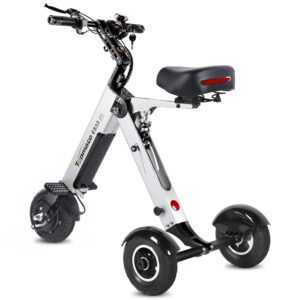
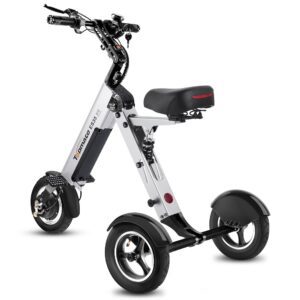
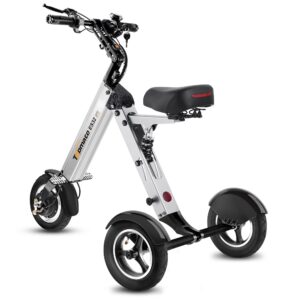
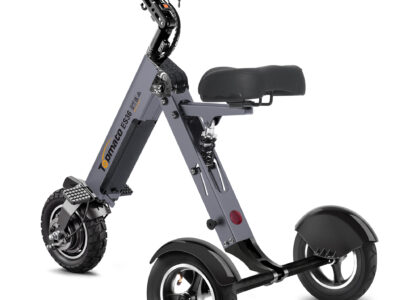
For example, TopMate lists the ES15 with a 300 lb maximum weight capacity, a 36V 7.8Ah removable lithium-ion battery, and a stated driving range of approximately 16–19 miles. It weighs 56.88 lb without the battery and uses 10-inch pneumatic tires with a dual 250W motor system.
The important point is not simply that the ES15 is portable. Its individual specifications show why buyers should evaluate the complete scooter rather than assuming that portable means limited capability.
So, Which One Should You Choose?
Here’s how I would approach the decision.
Choose a portable scooter if:
- You frequently travel by car.
- You have limited storage space.
- Most of your trips are relatively short.
- You need to transport the scooter regularly.
- Vehicle loading is a major concern.
- You primarily ride on smooth, maintained surfaces.
Consider a full-size scooter if:
- You spend considerable time riding outdoors.
- You regularly travel longer distances.
- You encounter uneven surfaces.
- You need greater ground clearance.
- You want a larger seating area.
- You require a higher weight capacity.
The key word here is consider.
A full-size scooter isn’t automatically the better choice simply because it is larger. Likewise, a portable scooter isn’t automatically the better choice because it is easier to store.
A Simple Decision Test
If you’re still unsure, imagine a normal week.
Monday: You drive to an appointment.
Wednesday: You visit a nearby store.
Friday: You visit family.
Weekend: You take a longer outdoor trip.
Now ask yourself:
Final Takeaway
If you regularly transport your scooter, live in a smaller space, and mostly make short trips, a portable mobility scooter is likely to make everyday life easier.
If you spend more time riding outdoors, travel longer distances, need more seating space, or encounter uneven terrain, a full-size mobility scooter may be worth considering.
But don’t stop at the category.
Measure your vehicle. Measure your storage space. Estimate your real travel distance. Check the weight capacity. Think about the terrain you encounter. Most importantly, consider how much lifting and transportation you can realistically manage.
The best choice is the scooter that solves your everyday mobility problem without creating a new one.
FAQ
What is the difference between a portable and full-size mobility scooter?
A portable mobility scooter is designed for easier transportation and storage, while a full-size mobility scooter generally provides more seating space, battery capacity, ground clearance, and outdoor capability.
Is a portable mobility scooter suitable for everyday use?
Yes. A portable mobility scooter can be suitable for everyday use if its weight capacity, range, comfort, dimensions, and terrain capability match the user’s daily routine.
Which type of mobility scooter usually has more range?
Full-size mobility scooters usually have more range because they can accommodate larger battery systems. However, range varies by model, battery capacity, rider weight, terrain, and riding conditions.
How do I know which mobility scooter size I need?
Consider where you ride, how far you travel, how you transport the scooter, available storage space, required weight capacity, terrain, and seating comfort. Compare these needs with the specifications of individual models.

-scaled-2-420x300.jpg)