Quick Answer: A mobility scooter can become hard to steer because of low or uneven tire pressure, worn or damaged tires, wheel misalignment, debris around the wheels, steering-column problems, worn bearings or linkage, excessive load, or difficult terrain. Start with the tires and visible obstructions. If steering suddenly changes, feels excessively loose or stiff, or directional control is reduced, stop riding and have the scooter inspected.
Why Is My Mobility Scooter Hard to Steer?
Hard steering is not always caused by a serious mechanical fault. In many cases, the first things to investigate are tire condition, tire pressure, wheel alignment, terrain, and anything physically interfering with the wheels.
Mobility scooter service documentation commonly associates difficult steering or pulling with low tire pressure, incorrect alignment, damaged or worn tires, steering-linkage problems, wheel bearings, and other mechanical components.
Common Causes of Hard Steering
1. Low or Uneven Tire Pressure
Can low tire pressure make a mobility scooter hard to steer? Yes. Pneumatic tires that are underinflated can increase rolling resistance and change how the scooter tracks.
Check the pressure on each pneumatic tire and compare it with the pressure specified by the scooter or tire manufacturer. Do not use a generic pressure number simply because it appears suitable for another scooter. Manufacturer guidance specifically warns that incorrect pressure can affect control and tire performance.
Unequal pressure can also make the scooter pull toward one side.
What you can do: Check pressure with a suitable gauge and inflate only to the specified rating.
Do not: Overinflate a tire to compensate for steering difficulty.
2. Worn, Damaged, or Unevenly Worn Tires
A tire may look inflated but still be part of the problem.
Inspect for:
- Cuts or cracks
- Punctures
- Bulges
- Excessive tread wear
- Flat spots
- Objects embedded in the tread
- One tire wearing substantially differently from the other
Uneven tire wear can be a symptom of another issue, such as incorrect alignment or steering-component wear, rather than simply a tire that needs replacing.
If a tire has visible structural damage, do not continue riding until it has been assessed.
3. Wheel Alignment Problems
Why does my mobility scooter pull to one side? Incorrect front-wheel alignment is one of the common causes.
You may notice that the scooter:
- Drifts left or right on relatively level pavement
- Requires constant correction from the tiller
- Has uneven front-tire wear
- Feels reluctant to travel straight
- Makes tire-scrubbing or squealing sounds during turns
Alignment can be affected by impacts with curbs, potholes, or other obstacles. Some scooters have adjustable steering components, but the correct alignment method varies by design.
What you can do: Visually inspect whether the front wheels appear obviously misaligned.
When to get help: If adjustment requires loosening steering hardware, changing tie-rod length, lifting the scooter, or working on steering components, follow the manufacturer’s service procedure or use a qualified technician.
4. Debris Around the Wheels
Grass, string, plastic, fabric, stones, or other debris can become trapped around a wheel or axle.
Turn the scooter off and inspect the accessible areas around the wheels. Look particularly closely after riding through grass, gravel, leaves, or areas containing loose debris.
Remove only debris that can be safely reached without dismantling the scooter.
If something is wrapped tightly around an axle or appears to have damaged a component, have it inspected rather than forcing it loose.
5. Steering Column or Tiller Problems
The tiller should move predictably and without unusual binding.
Possible warning signs include:
- Excessive side-to-side play
- A tiller that feels unusually stiff
- Grinding or clicking
- A steering column that does not stay properly positioned
- A steering wheel or tiller that appears out of alignment
- Steering that suddenly becomes different from normal
Some mobility scooter service documentation identifies steering bearings, steering-shaft components, and excessive resistance in steering components as possible causes of hard steering.
These are generally not components to adjust by trial and error. If the steering assembly itself feels mechanically abnormal, professional inspection is safer.
6. Excessive Load or Poor Weight Distribution
A mobility scooter’s steering can feel different when carrying a heavy load or when weight is positioned differently from normal.
The issue is not simply the rider’s body weight. Cargo in baskets, bags, rear carriers, or other accessories can change the scooter’s overall load and balance.
Always stay within the scooter’s specified weight capacity and distribute permitted cargo according to the manufacturer’s guidance.
If steering becomes difficult only after adding substantial cargo, remove the additional load and test the scooter again in a safe area.
7. Uneven Pavement and Difficult Terrain
Can uneven ground make a mobility scooter harder to steer? Absolutely.
A scooter that feels normal on smooth pavement may require considerably more steering correction on:
- Rough pavement
- Gravel
- Grass
- Slopes
- Uneven paths
- Broken sidewalks
- Surfaces with ruts or edges
The wheels are responding to changes in the surface rather than simply following a smooth, predictable path.
A temporary increase in steering effort on rough terrain is therefore not automatically evidence of a mechanical fault.
The key question is whether the steering becomes difficult even after returning to a smooth, level surface.
8. Low Battery or Power-Related Problems
Battery condition is usually not the first thing to investigate when a scooter is physically hard to steer.
However, a weak battery or electrical problem can sometimes be associated with hesitation, reduced motor performance, or abnormal acceleration, which a rider may perceive as poor control rather than purely heavy steering. Some scooter manuals recommend checking battery condition when the motor surges or hesitates.
If the tiller itself is physically difficult to turn while the scooter is stationary, focus first on tires, steering, wheels, and mechanical components rather than assuming the battery is responsible.
How to Tell What Type of Problem You Have
| Situation | More Likely Cause | What to Check | When to Stop Riding |
|---|---|---|---|
| Steering suddenly becomes heavy | Mechanical obstruction, steering component, tire problem | Wheels, tires, visible debris, tiller movement | If the change is severe or sudden |
| Scooter pulls left or right | Tire pressure, tire wear, alignment, steering linkage | Both tires and straight-line tracking | If you cannot maintain directional control |
| Hard steering only on gravel or grass | Terrain | Try smooth, level pavement | If steering remains abnormal on smooth ground |
| One tire looks different | Tire damage or pressure issue | Pressure, tread, cuts, bulges | If tire is damaged or visibly unsafe |
| Tiller has excessive play | Steering linkage, bearings, column | Check for abnormal looseness without dismantling | Yes, until inspected |
| Grinding or unusual mechanical noise | Bearing, linkage, wheel, or steering component | Identify where sound originates | Yes if accompanied by abnormal steering |
| Steering problem after hitting a curb/pothole | Alignment or component damage | Wheels and steering assembly | Yes if tracking or control changed significantly |
| Steering is normal unloaded but difficult with cargo | Load or weight distribution | Remove extra cargo and check rated capacity | If load causes instability or loss of control |
Which Checks Can You Safely Do Yourself?
For most owners, the safest first-stage inspection is visual and does not require taking the scooter apart.
Basic owner checks
- Check pneumatic tire pressure against the manufacturer’s specified pressure.
- Inspect tires for cuts, cracks, punctures, bulges, or severe wear.
- Look for stones, string, plastic, or other debris around accessible wheels.
- Confirm that nothing is rubbing against a tire.
- Check whether the scooter pulls to one side on a safe, level surface.
- Check that the tiller does not have obvious excessive movement.
- Confirm that cargo has not exceeded the scooter’s specified capacity.
- Compare steering behavior on smooth pavement with behavior on rough terrain.
Avoid loosening steering bolts, removing wheels, adjusting tie rods, opening electrical compartments, or dismantling bearings unless the manufacturer’s service instructions specifically identify the procedure as suitable for the owner.
When Is Hard Steering a Safety Issue?
When should I stop using a mobility scooter because of steering problems? Stop riding if the steering problem is sudden, severe, worsening, or accompanied by loss of directional control.
Particularly important warning signs include:
- Sudden change in steering behavior
- Excessive steering play
- Severe resistance when turning
- Pulling strongly to one side
- Grinding, knocking, or unusual mechanical noises
- A visibly damaged or deflated tire
- A bent or displaced wheel
- Steering that does not respond normally
- Repeated loss of directional control
Do not attempt to “ride through” a mechanical steering problem. A scooter that cannot be reliably directed can become hazardous around pedestrians, vehicles, curbs, ramps, and slopes.
How Steering Difficulty Changes on Different Surfaces
Smooth pavement
This is the most useful surface for troubleshooting. If steering is difficult on a flat, smooth area, investigate the scooter rather than blaming the terrain.
Rough pavement
Small bumps can cause the front wheels to change direction slightly. Slow, controlled steering is appropriate.
Gravel
Loose material can reduce predictable traction and make the scooter wander. Steering effort and correction can increase.
Grass
Grass can create additional rolling resistance, particularly when wet, long, or uneven.
Slopes
A slope can naturally encourage the scooter to track toward the lower side. This can feel like pulling even when the steering system itself is functioning normally.
Tight indoor spaces
Furniture, doorways, walls, and corners require more frequent steering corrections. Scooter dimensions and turning geometry become especially relevant.
How Scooter Design Affects Steering Effort
Steering behavior is influenced by several measurable design characteristics:
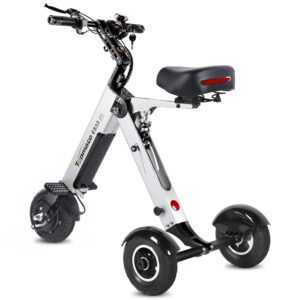
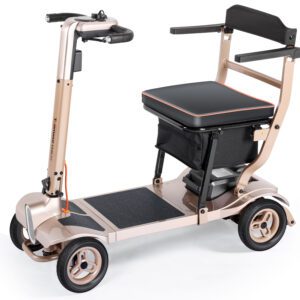
Wheel configuration: Three-wheel and four-wheel layouts involve different compromises between maneuverability and stability. Neither configuration is universally easier to steer.
Wheel size: Larger wheels can behave differently over surface irregularities, while smaller wheels may make some compact scooters easier to maneuver in confined spaces.
Wheelbase: A longer wheelbase can influence turning behavior and the space required to complete a turn.
Steering geometry: The relationship between the steering column, front wheels, and steering linkage affects steering response and effort.
Scooter weight: A heavier scooter may feel different during manual maneuvering and transportation, while the motor and steering system determine how it behaves under power.
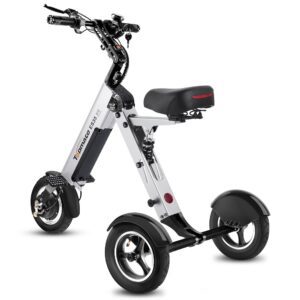
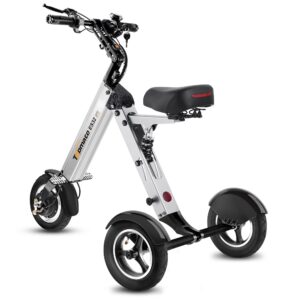
For a TopMate scooter or another model you are considering, evaluate these characteristics using the manufacturer’s actual specifications rather than assuming that a particular wheel configuration automatically means easier steering.
A Simple Troubleshooting Sequence
If your scooter suddenly feels harder to steer, use this order:
1. Stop somewhere safe.
Do not continue riding if directional control is compromised.
2. Inspect the tires.
Look for damage, abnormal wear, and incorrect pressure.
3. Check for debris.
Inspect accessible wheel and tire areas.
4. Test on smooth, level ground.
Determine whether the problem is terrain-related.
5. Check straight-line behavior.
If the scooter consistently pulls to one side, alignment or steering components may need attention.
6. Check the tiller.
Unusual stiffness, looseness, grinding, or play suggests a mechanical issue.
7. Escalate when necessary.
If the cause is not obvious or involves steering hardware, bearings, alignment adjustment, wiring, or structural components, contact a qualified mobility scooter technician or authorized service center.
Conclusion
Hard steering does not automatically mean your mobility scooter needs major repairs. Start with the simplest possibilities: tire pressure, tire condition, debris, terrain, load, and obvious alignment changes. If the scooter still steers poorly on smooth, level ground—or if you notice excessive play, grinding, sudden resistance, damaged tires, or loss of directional control—stop using it until the steering system has been professionally checked.
FAQ
Why is my mobility scooter hard to steer?
Common causes include low or uneven tire pressure, worn tires, wheel alignment problems, debris around the wheels, steering-component wear, excessive load, or uneven terrain.
Why does my mobility scooter pull to one side?
A scooter may pull to one side because of uneven tire pressure, tire wear, wheel misalignment, or a problem with the steering linkage. If it pulls consistently on smooth, level ground, have it inspected.
Can low tire pressure make a mobility scooter hard to steer?
Yes. Low or uneven tire pressure can increase rolling resistance and affect steering and tracking. Check the tires against the pressure recommended by the scooter manufacturer.
When should I stop riding a mobility scooter because of steering problems?
Stop riding if steering suddenly becomes difficult, the scooter pulls strongly, the tiller has excessive play, you hear grinding, a tire is damaged, or you lose reliable directional control. Have the scooter checked before riding again.

-scaled-2-420x300.jpg)