A mobility scooter does not need a specific amount of floor space in every home. The practical requirement depends on the scooter’s width, length, turning radius, doorway clearance, and storage dimensions, as well as the layout of the route you actually use.
A scooter that fits through a 32-inch doorway may still be difficult to use if there is no room to approach the door, turn into a hallway, or position the scooter beside a bed. For that reason, measuring only the doorway is not enough. mobility scooter space requirements
The better approach is to measure your entire everyday route—from the entrance to the rooms you use most—and compare those measurements with the scooter’s published specifications.
What Space Does a Mobility Scooter Actually Need?
There is no universal minimum floor area for a mobility scooter.
Instead, think about four different types of space:
- Passage space: enough width for the scooter to move through a doorway or hallway.
- Turning space: enough room to change direction without repeatedly reversing.
- Positioning space: enough room to approach a bed, counter, elevator, or other destination.
- Storage space: enough room to park, fold, charge, or access the scooter when it is not being used.
A compact scooter might need less space than a larger model, but a smaller overall footprint does not automatically mean easier maneuvering. Steering design, scooter length, turning radius, and the furniture around the route all matter.
The most useful question is not simply, “Will the scooter fit?” It is:
Can I drive, turn, position, and store it without constantly fighting the space?
Start With the Scooter’s Five Key Measurements
Before comparing a scooter with your home, find these specifications from the manufacturer:
| Scooter measurement | Why it matters |
|---|---|
| Width | Determines whether it can pass through narrow openings |
| Length | Affects turning, reversing, and positioning |
| Height | Matters for storage beneath shelves or counters |
| Turning radius | Indicates how tightly the scooter can turn |
| Folded dimensions | Important for storage and transportation |
Do not substitute one measurement for another.
For example, a scooter’s width tells you whether it can pass through a doorway. It does not tell you whether the scooter can make a 90-degree turn immediately after that doorway.
Likewise, folded dimensions are useful for storage but do not tell you how much room the scooter needs while being driven.
How Wide Should a Doorway Be for a Mobility Scooter?
Measure the actual clear opening, rather than measuring from one wall or door trim to the other.
A hinged door can reduce the usable opening when opened. Handles, frames, nearby furniture, and the direction from which you approach the doorway can also affect how easy it is to enter.
For example, suppose you have:
- Doorway clear opening: 32 inches
- Scooter width: 22 inches
- Difference: 10 inches
On paper, there is plenty of width for the scooter body. In practice, the approach still matters. Entering straight through is generally easier than trying to make a turn immediately before the doorway.
How Much Hallway Space Does a Mobility Scooter Need?
Hallways create a different problem because the scooter needs room to travel and correct its direction.
Measure the narrowest point, not the widest part of the hallway.
Look for anything that reduces usable space:
- Shoe racks
- Side tables
- Radiators
- Furniture
- Door frames
- Wall decorations that protrude
- Open doors
- Storage boxes
A scooter may technically fit through a narrow corridor but still be frustrating to drive if there is little room to make small steering corrections.
If your hallway leads directly into a bedroom, bathroom, or kitchen, also check what happens at the end of the corridor. The tightest part of the route may actually be the turn rather than the hallway itself.
Turning Space Can Matter More Than Doorway Width
Turning radius is one of the easiest specifications to overlook.
A narrow scooter is not necessarily a scooter that can turn in a very small space. A longer scooter can require more room to reverse or change direction even when its width is modest.
Imagine this route:
Hallway → bedroom doorway → turn → position beside the bed
The doorway may be wide enough, but if the hallway ends close to the bedroom door, there may not be enough room to line up the scooter.
Bedroom Space: Getting Through the Door Is Only Half the Problem
A bedroom can have a wide entrance and still be difficult to navigate.
Measure:
- Doorway clear width
- Distance from the doorway to the bed
- Space beside the bed
- Space at the foot of the bed
- Clearance around wardrobes and dressers
- Space needed to reverse or reposition
This becomes particularly important if the scooter is used close to the bed for transfers.
A person may be able to enter the bedroom but discover that there is no practical place to position the scooter next to the bed. In that situation, the room’s total square footage is less useful than the clearance around the furniture.
Apartment Buildings: Measure the Route Beyond Your Front Door
If you live in an apartment, the scooter needs to fit through more than your apartment entrance.
Measure:
- Building entrance
- Security doors
- Lobby corridors
- Elevator doorway
- Elevator interior
- Thresholds and floor transitions
- Apartment doorway
- Storage location
For an elevator, record both the door opening and the interior floor dimensions.
A scooter may fit through the elevator entrance but leave little room for the rider to enter, reposition, or exit. If the elevator requires a turn inside the car, turning ability becomes just as important as width.
How Much Storage Space Does a Mobility Scooter Need?
Storage is a separate calculation from driving space.
Measure the available area in three dimensions:
Width × length × height
Do not measure only the floor footprint.
You may also need clearance for:
- Sitting or standing beside the scooter
- Removing the battery
- Connecting the charger
- Folding and unfolding
- Moving the scooter away from a wall
- Caregiver access
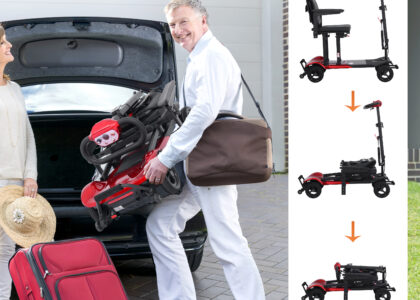
For a small apartment, a folding scooter can reduce the amount of floor space needed for storage. However, the folded dimensions still need to fit the actual storage location, and you need enough clearance to fold and move the scooter safely.
Folded vs. Unfolded Dimensions: Don’t Mix Them Up
This distinction is especially important with folding mobility scooters.
Unfolded dimensions tell you whether the scooter can operate in your home.
Folded dimensions tell you whether it can be stored or transported.
The two measurements can be substantially different.
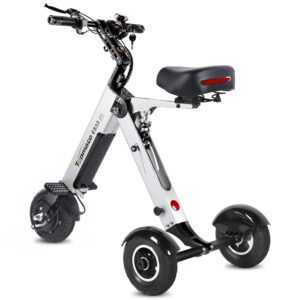
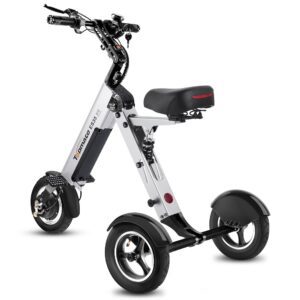
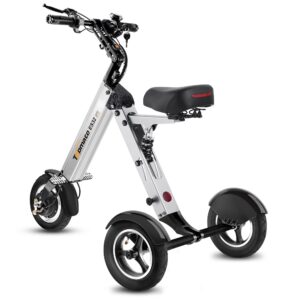
For example, the supplied TopMate ES33 specifications list an unfolded size of 37.2 × 20.8 × 35.8 inches and a folded size of 15.7 × 20.8 × 33.6 inches. Notice that folding reduces the length considerably, while the published width remains 20.8 inches.
That is why a buyer should not assume that a folding scooter becomes smaller in every direction.
How to Measure Your Home Before Buying
A tape measure and a simple floor-plan sketch can prevent an expensive mistake.
Record the smallest clear measurement at each point:
- Front door
- Interior doorways
- Hallway
- Narrowest corridor
- Bedroom entrance
- Bathroom entrance
- Kitchen route
- Elevator door
- Elevator interior
- Tight corners
- Storage area
- Relevant thresholds
Then compare those measurements with the scooter specifications.
| Your home | Compare it with |
|---|---|
| Doorway clear width | Scooter width |
| Hallway width | Scooter width |
| Tight corner | Turning radius and scooter length |
| Bedroom route | Width + length + maneuvering space |
| Elevator entrance | Scooter width |
| Elevator interior | Scooter width + length |
| Storage area | Folded width + length + height |
| Low-clearance storage | Scooter height |
The comparison needs to be like-for-like. Do not compare a doorway measurement with the scooter’s folded length, for example.
If the manufacturer does not publish a turning radius, do not try to calculate it from the scooter’s width or estimate it from a product photograph. The original article correctly emphasizes using a verified manufacturer specification where available.
Real-Life Space Checks Before You Buy
Small apartment
Someone living in a small apartment may care less about the scooter’s maximum range and more about whether it can get through the apartment entrance, move around the hallway, fit in an elevator, and occupy a manageable storage area.
A folding design can help with storage, but the unfolded dimensions still determine whether the scooter works during everyday use.
Grocery shopping
For grocery trips, home storage is only one part of the calculation. Consider how easily the scooter can leave the apartment or house, pass through the entrance, and maneuver once you reach the store.
A scooter that is convenient at home but difficult to position in tight spaces may not be practical for frequent errands.
Airport or travel
Travel introduces another space problem: transportation.
If the scooter needs to be placed in a vehicle, check the folded dimensions and actual weight rather than relying on terms such as “compact” or “portable.” A scooter that fits in the vehicle still needs to be manageable for the person loading it.
Cruise or vacation
For travel-oriented use, folded size can become particularly important because the scooter may need to be transported between a vehicle, accommodation, elevator, and other confined areas.
A model such as the TopMate ES40 is positioned around compact folding and transportation rather than being presented as a solution for every home layout.
Which TopMate Scooter Type Fits Different Space Needs?
The right model depends on the route and use case rather than simply choosing the smallest scooter.
- TopMate ES15: Its positioning emphasizes lightweight portability, compact storage, frequent transportation, and travel-oriented use.
- TopMate ES35: Aimed more toward everyday use while maintaining portability and outdoor capability.
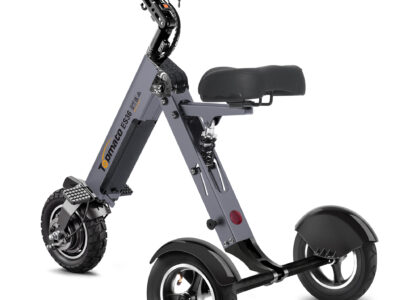
- TopMate ES36: Better aligned with users who place greater emphasis on everyday comfort and stability.
- TopMate ES40: Focused on compact folding and transportation for travel situations such as vacations and cruises.
These examples illustrate why “smallest scooter” is not always the same as “best fit.” A person who mainly needs a scooter for apartment storage may prioritize folded dimensions, while someone using it every day may give greater weight to the usable driving footprint and ride characteristics. mobility scooter space requirements
The Simple Way to Decide
Before buying, trace the route you expect to use most often:
Entrance → hallway → bedroom/bathroom → storage → exit
Measure every restriction along that route.
Then compare those measurements with the scooter’s:
width + length + turning radius + height + folded dimensions
If one point is very close to the scooter’s physical limit, treat that location as the main problem to solve. You may need a different scooter design, a furniture adjustment, or a different storage location.
The goal is not to find a scooter that merely fits through one doorway. It is to find a setup that allows you to drive, turn, position, park, and store the scooter without unnecessary difficulty.
For U.S. accessibility requirements, consult the current ADA Standards. For homes, apartment buildings, transportation systems, or public facilities outside the U.S., check the applicable local requirements rather than assuming U.S. measurements apply.
FAQ
How much turning space does a mobility scooter need?
There is no single turning-space requirement for every mobility scooter. The needed space depends on the scooter’s turning radius, length, steering design, and the maneuver being attempted. Check the manufacturer’s turning-radius specification and measure the tightest turn in your home before buying.
Can a folding mobility scooter fit in a small apartment?
Yes, a folding mobility scooter can reduce storage requirements, but folded dimensions are only part of the calculation. Check the folded width, length, and height against the actual storage area, while also confirming that the unfolded scooter can navigate your doorways and hallways.
What measurements should I take before buying a mobility scooter?
Measure the clear width of every important doorway, the narrowest hallway point, tight corners, bedroom and bathroom entrances, elevator doors and interiors, and the planned storage area. Then compare those measurements with the scooter’s width, length, height, folded dimensions, and turning radius.
Will a mobility scooter fit through a standard doorway?
It may, but do not rely on the phrase “standard doorway.” Measure the actual clear opening and compare it with the scooter’s width. Also consider the door swing, approach angle, nearby walls or furniture, and the space available to turn after entering.

-scaled-2-420x300.jpg)